Common home cooking mistakes and how to avoid them: 8 technique fails that ruin your dishes
 By
Diego Cortés
By
Diego Cortés
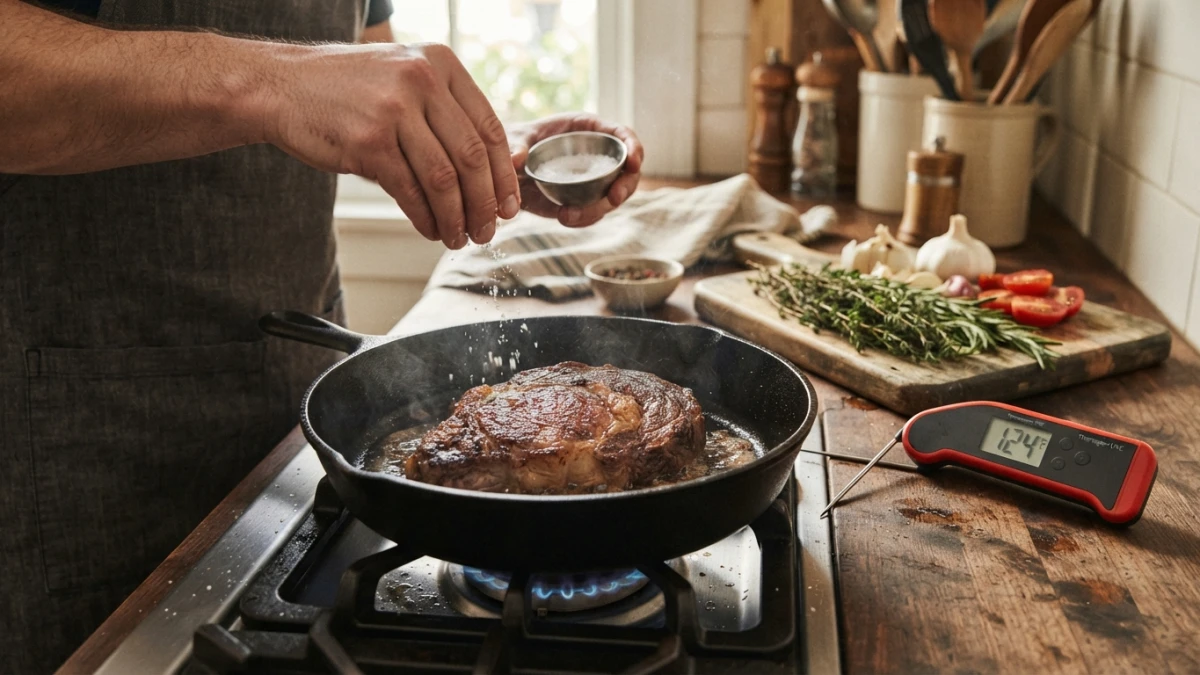
Is your meat always dry, the crust never forms, and everything tastes bland? If these scenes sound familiar, it is not bad luck: they are common home cooking mistakes, technique fails repeated in every kitchen that ruin dishes that are actually simple. The good news is that all of them have a fix, and almost none requires buying new gear. Here are the eight most common ones and how to avoid them from the next time you turn on the stove.
Seasoning without tasting: salt goes in stages
Adding all the salt at the start or at the end leaves the dish bland or, worse, salty beyond repair. Professional cooks season in layers, throughout the cooking process, so every ingredient gets the right touch and the flavors come together.
The rule changes with the dish. Pasta water is salted generously, "like the sea," because most of the salt stays in the water. Meat is salted right before searing, not long before, to avoid drawing out its juices. And a stew is seasoned halfway through cooking, once the liquid has reduced and you can judge the concentration better.
The final trick is what separates a decent dish from a delicious one: always taste at the end and adjust. A bland dish can be rescued with a pinch of salt in the last minute; a salty one, with a touch of acid, sugar, or more neutral liquid. Tasting while you cook is not optional; it is part of the technique.
Cooking by eye: why you need a thermometer
"It looks done" fails more often than people admit. Chicken dries out one minute past the point or stays raw near the bone; fish falls apart or remains translucent in the center. With an instant-read thermometer, the guesswork disappears.
The reference points are clear: chicken at 74 °C (165 °F) in the center, pork at 63 °C (145 °F) with a resting period, fish between 55 and 60 °C (130-140 °F) depending on the texture you want. Red meat can come off a few degrees early because it keeps cooking while it rests.
A thermometer also helps check oil temperature, verify dough that needs to proof at a specific temperature, and reheat leftovers safely. It is a small investment that removes the biggest of all common home cooking mistakes: guessing.
The crust that never comes: wet meat and a cold pan
That deep golden crust that fills the kitchen with aroma does not happen by chance: it needs a dry surface and intense heat. If the meat is wet or the pan is lukewarm, the food releases water, steams, and the crust never forms.
The protocol is simple. First, pat the meat dry with paper towels right before searing. Second, heat the pan and the oil well before the meat touches them, without letting the oil smoke. Third, do not move the meat during the first minutes: the crust forms when the food browns and releases from the pan on its own; if you move it or pry it, you break the process.
With these three steps, a steak or a chicken breast comes out with a golden crust and juicy inside, with no advanced techniques required.
The dull knife: the mistake that ruins everything
A dull knife does not cut; it crushes. It breaks down vegetable textures, makes onions release more gas and make you cry more, and it is more dangerous than a sharp one because it needs more force and slips easily.
Cutting technique matters too. Rest the tip of the knife on the board and rock the blade back and forth without lifting it: the cut stays even and fast. You do not need to be fast; you need to be consistent.
To keep the edge, run a honing rod over it every few uses, at a gentle angle and without pressure. Deep sharpening on a whetstone happens once or twice a year, or when the rod no longer brings the edge back.
The oil: neither lukewarm nor smoking
Frying or sautéing with barely warm oil soaks the food: the oil gets absorbed before the surface seals, and the result is greasy. With smoking oil, on the other hand, it burns, breaks down, and turns everything bitter.
There is a foolproof home test: dip a wooden skewer in the oil; if it bubbles immediately and vigorously, the oil is ready. You can also drop a small piece of bread: it should turn golden in seconds without burning.
Choose the oil for the cooking method. For high heat, use oils with a high smoke point such as avocado or high-oleic sunflower; save extra virgin olive oil for dressings and gentle cooking, where its flavor shines and does not degrade.
Not adjusting the heat: boiling is not cooking
A stock or a rice dish at a constant rolling boil loses flavor, texture, and clarity: too much water evaporates, grains break apart, and flavors blur together. After the first boil, almost everything cooks better over gentle heat.
The lid is a tool, not an accessory. Cover when you want to keep heat and moisture in, like stews and legumes; uncover when you want to reduce liquids and concentrate flavors, like sauces.
And a reminder: high heat does not speed up cooking; it only burns the outside and leaves the inside raw. Cooking is managing heat, not applying maximum power.
Not resting: dough, meat, and sauces
Cutting meat right out of the pan lets the juices escape: they end up on the board and the plate turns dry. Five to ten minutes of rest on a warm plate, loosely covered, redistributes the juices and makes the meat more tender.
Dough also needs rest: the gluten relaxes, the dough stretches more easily, and the result is more airy. Emulsified sauces need a minute off the heat to come together properly.
Resting is not dead time; it is part of the recipe. You plan for it before you start cooking, just like prepping ingredients, and it changes the final result as much as the cooking temperature does.
Cooking without a plan: the chaos that causes more mistakes
Most failures do not happen during cooking but before it: reading the recipe halfway, discovering mid-way that an ingredient is missing, or improvising with whatever is at hand. Reading the full recipe and having every ingredient prepped and measured before you turn on the stove avoids most mistakes.
Cleaning and tidying as you cook keeps you in control: fewer occupied surfaces, less risk of mixing ingredients or skipping a step, and a safe kitchen where everything is in sight. Order also reduces accidents with knives and fire.
And when something goes wrong, do not panic. Rice sticks from too much heat or from stirring it too early; a broken sauce can be rescued with a few spoonfuls of warm liquid and vigorous whisking; and if a dish is beyond saving, starting over calmly is better than serving something nobody would eat. Failing is part of learning to cook; repeating the same mistake is not.
FAQ: common home cooking mistakes, answered
Why does my rice stick?
Because of heat that is too high, stirring while it absorbs the liquid, or not respecting the water ratio. Cook it over low heat with the lid on and do not stir it during cooking.
How do I rescue a broken sauce?
Add a few spoonfuls of warm liquid (water, stock, or wine) and whisk vigorously off the heat. If it stays broken, emulsify it with a little cold butter.
When is it better to start over?
When the dish is burnt, beyond repair salty, or has an unrecoverable texture. Recognizing it early saves time, ingredients, and patience.