How to Boil Eggs: Exact Timings for Soft-Boiled, Jammy and Hard-Boiled Eggs
 By
Diego Cortés
By
Diego Cortés
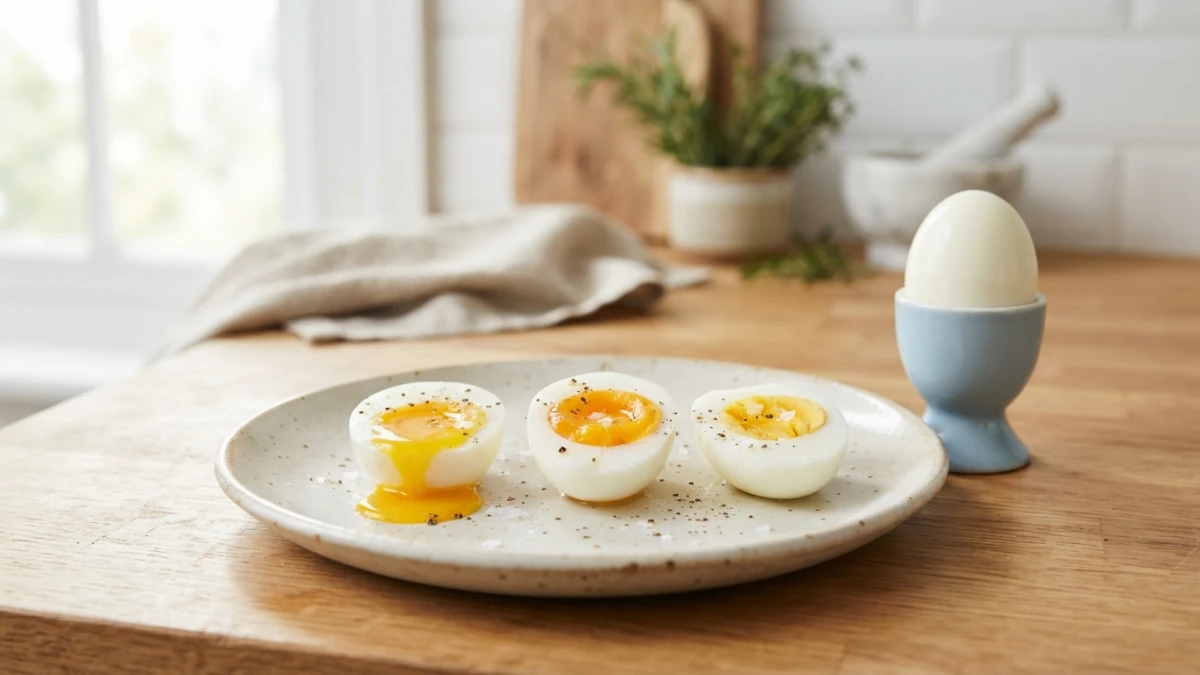
Learning how to boil eggs seems easy, but one extra minute ruins the yolk: it turns dry, gray-green and the white turns rubbery. The perfect point is just a matter of minutes, and this guide with a timing chart lets you hit it every time.
The difference between a soft-boiled egg with a runny yolk, a jammy egg and a perfectly hard-boiled egg is not luck: it comes down to the timer and an ice bath. Count from the moment the water returns to a boil, follow the chart and stop the cooking in seconds, without cracked shells or peeling disasters.
The basic method: how to boil eggs without cracking them
Before talking about minutes, you need to make sure the egg reaches the plate in one piece. Three simple habits prevent cracks and runaway whites:
- Take the eggs out of the fridge 10 minutes before cooking. The thermal shock of a cold egg dropped into boiling water cracks the shell; at room temperature they handle the change much better.
- Lower them in with a spoon or slotted spoon into already boiling water, never drop them: if they hit the bottom or knock into each other, they crack.
- Turn the heat down to a gentle simmer. A violent rolling boil makes the eggs bounce and bump into one another; with a steady but calm movement they cook evenly.
Prefer not to watch a pot of boiling water? Steaming gives a very similar result with fewer surprises, because the eggs do not move or collide: see how in how to steam eggs easily and quickly.
Egg cooking time chart: when to start counting
The timer starts when the water returns to a boil after you add the eggs, not before. That is why the water should already be boiling when you lower them in: if you start them in cold water and count from the moment you turn on the heat, the timings are no longer reliable.
| Stage | Time | Yolk | Best for |
|---|---|---|---|
| Soft-boiled | 3-4 minutes | Runny | Dipping toast or bread |
| Jammy | 6-7 minutes | Creamy | Salads, ramen, toast |
| Hard-boiled | 10-12 minutes | Fully set but moist | Salads, sandwiches, snacks |
| Overcooked | More than 14 minutes | Dry and greenish | Avoid |
The timings are for large eggs, the most common size. Medium eggs need 1 minute less and extra-large eggs 1 minute more. Altitude matters too: the higher you are, the lower the temperature at which water boils and the harder it is to set the white, so add a little cooking time and check the stage before serving.
If you do not eat the egg the moment it leaves the pot, remember the yolk keeps moving through its stages: the ice bath trick in the next section is what freezes the result at the exact minute.
The ice bath: the step that stops the cooking in seconds
When you take the egg out of the hot water, the yolk keeps cooking with the accumulated heat. That residual heat is what turns a perfect jammy egg into a nearly hard one while you finish the salad.
- Prepare a bowl with cold water and ice before the cooking time ends.
- Move the eggs to the ice bath the moment the timer rings and leave them for 5 to 10 minutes.
- The cold shock also separates the white from the inner membrane of the shell, which makes the eggs much easier to peel afterward.
How to peel hard-boiled eggs without destroying them
- Use eggs that are 5-7 days old. Very fresh eggs cling to the shell; after a few days in the fridge the air pocket grows and the white releases much more easily.
- Tap them gently on the counter and roll them to crack the whole surface. Start peeling from the blunt end, where the air pocket is: water gets in there and the shell gives way first.
- Peel under running cold water: the water slips between the white and the membrane and lifts the shell off almost effortlessly, without dragging chunks of white with it.
The green ring around the yolk: what causes it and how to avoid it
That gray-green layer does not mean the egg is bad. It is a chemical reaction between the iron in the yolk and the sulfur in the white that happens when the egg is overcooked or cooled too slowly.
- It is avoided with two moves: respect the time (10-12 minutes maximum for a hard-boiled egg) and move the egg to the ice bath right away.
- An egg with a green ring is perfectly safe to eat, but it tastes more sulfurous, the texture is drier and it does not look good on the plate.
Common mistakes when boiling eggs (and how to avoid them)
- Cooking by eye, without a timer. The gap between a jammy egg and a hard-boiled one is only 3-4 minutes: use a timer and count from the moment the water returns to a boil.
- Boiling at full blast the whole time. The eggs knock together, crack and the white leaks out through the break; keep it at a gentle simmer.
- Leaving cooked eggs in the hot water or out of the fridge "just in case". They keep cooking and, after more than 2 hours at room temperature, they lose food safety.
How to tell if an egg is fresh before boiling it
- The water glass test: a fresh egg sinks and lies on its side; if it tilts or stands upright it is older; if it floats, open it separately and smell it before using it.
- The shell should be clean and free of cracks: a crack lets bacteria in and turns boiling into a risk instead of a solution.
- In the fridge, keep eggs in their carton and not in the door: the temperature changes with every opening and that speeds up their deterioration.
How long do boiled eggs last and how to store them
- Hard-boiled eggs in the shell keep for up to 1 week in the fridge; peeled ones are best eaten within 2-3 days stored in an airtight container.
- Write the cooking date on them if you plan to keep them for a few days: an unmarked boiled egg is easily confused with a raw one and ends up in the trash or in the wrong dish.
- Soft-boiled and jammy eggs are meant to be eaten right away: their runny or creamy yolk does not keep like a fully set one.
Once you have the point under control, boiled eggs become the most practical ally of the week: ready for salads, snacks and breakfasts in minutes. And they are not just convenient: if you want to know why you should include them often, read these 6 reasons why eggs are healthy superfoods.