How to Chop Onions Without Crying: Tricks, Cuts and Storage
 By
Diego Cortés
By
Diego Cortés
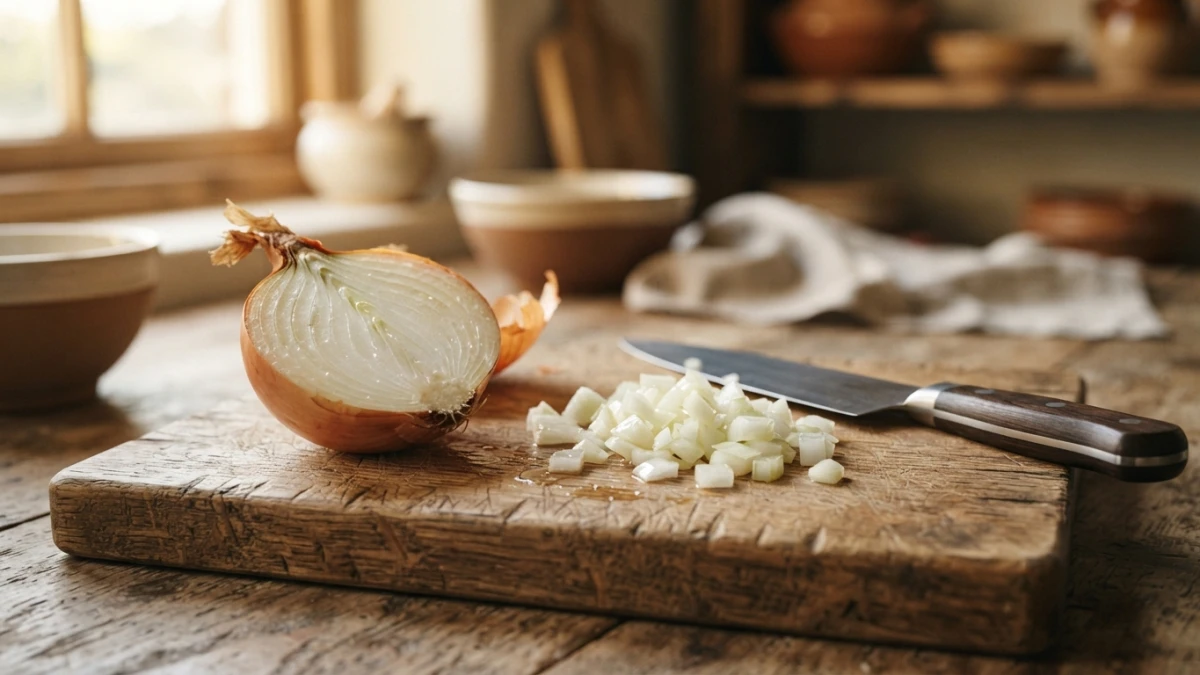
Do you always end up with watery eyes when you cut an onion? It is not you being dramatic: it is a chemical reaction that starts within seconds. Learning how to chop onions without crying comes down to where the stinging gas comes from and how to deal with it.
Why onions make you cry
An onion keeps its sulfur compounds locked inside its cells, separated from the enzymes that activate them. While the onion is whole, nothing happens. When the knife breaks those cells, the enzymes meet the compounds and turn them into an irritating gas that rises towards your face.
That gas dissolves in the thin film of water covering your eyes and forms a very diluted acid. Your eyes cannot tolerate it, so they respond with the only tool they have: tears, to dilute the irritant and wash it away. The longer you stand over an open onion, the more gas builds up and the more you cry.
So the whole problem comes down to one thing: how much gas reaches your eyes. The tricks that really work are the ones that cut that amount down (cold, a sharp edge, fewer broken cells, moving air). Everything else just distracts you.
How to chop onions without crying: 7 tricks that work
These are the ones you notice right away, from easiest to most drastic:
- Chill the onion first. 20-30 minutes in the fridge, or 10-15 in the freezer, slow down the enzyme that produces the gas. A cold onion makes a visible difference.
- Use your sharpest knife. A good edge slices cleanly; a dull one crushes cells and releases more irritant compounds, besides ruining the texture.
- Keep the root end intact. The base holds the highest concentration of sulfur compounds: cut the rest and discard the root end at the end, not at the start.
- Cut where air moves. Turn on the extractor hood, open a window or stand next to a draft. The gas leaves before it reaches your face.
- Keep your face back and work fast. Firm, confident cuts while looking slightly sideways cut down the time you spend breathing right above the onion.
- Soak it in cold water only if you are in a hurry. Water holds back some of the gas, but it also washes away aroma and sweetness. Treat it as a patch, not a method.
- If nothing else works, swim goggles. It is the only real physical barrier and it sounds silly until you try it: with goggles on you can chop kilos of onions without a single tear.
The home remedies that do not do much
Chewing gum, biting a matchstick, holding a spoon or a piece of bread in your mouth, running the onion under the tap or lighting a candle: none of these change how much gas forms, and none stop it from reaching your eyes. At best, they distract you for a moment.
Cutting with your arms stretched out, as far away as possible, does not help either. The gas rises anyway and you cut worse, with more risk for your fingers. The four factors that really matter are still cold, a sharp edge, an intact root and ventilation.
Onion cuts and what each one is for
The same onion changes completely depending on how you cut it, and every cut has its dish:
- Rings. Cuts perpendicular to the onion axis, at an even thickness. Ideal for breading, frying, burgers and salads that need crunch.
- Slices (feather cut). Thin slices taken along the layers, which end up as curved strips. Perfect for stir-fries, empanadas and quick stews.
- Small dice. The sofrito cut. You get it with parallel vertical cuts, one or two horizontal cuts and then cuts across the onion.
- Wedges and half-moons. Thick cuts running the length of the onion, for grilling, caramelizing and long-simmered stews.
- Rough chop. For stocks and broths, or any cooking where the onion is strained out or removed later.
The rule is simple: the smaller the cut, the faster it cooks, the sweeter it turns and the more it blends in. The thicker the cut, the more texture and presence it keeps.
How to chop an onion step by step
The method professional kitchens use relies on the root so the onion does not fall apart while you work:
- Cut off the stem, peel the dry skin and halve the onion, keeping the root end as an anchor.
- Place the half flat side down on the board. Never curve it: always look for stability.
- Make parallel vertical cuts, following the curve of the layers and stopping short of the root.
- Make one or two horizontal cuts parallel to the board so you get dice instead of long strips.
- Finish with cuts across the onion axis: the dice fall apart on their own and the root end stays whole.
- Discard the root end and repeat with the other half.
For safety, the holding hand curls into a claw, fingertips tucked in and knuckles guiding the blade. The tip of the knife stays on the board and only the handle moves up and down: it is faster and far safer. A good cutting board with proper grip also stops the onion from sliding around.
How to store chopped onion (and whole onions)
Raw chopped onion is cut food, so it falls into the danger zone and cannot sit on the counter for hours:
- Chopped and raw: airtight container in the fridge, 3-4 days at the most. If it smells harsh, looks slimy or changes colour, throw it out without hesitating.
- Frozen: in flat portions inside small bags, up to 3 months. It softens when thawed, so use it cooked: sofritos, stews, sauces.
- Whole: a dry, dark, well-ventilated spot, never inside a closed bag. Never next to potatoes: moisture and the gases they release ruin both.
If you are cooking soon, put the chopped onion to work as a base sofrito: onion with a little oil and salt over medium-low heat, 8-10 minutes, stirring now and then until it turns translucent and sweet without browning. It is the starting point for stews, sauces, legumes and a proper onion soup.
Common mistakes when cutting and cooking onion
- A dull knife. It crushes the onion, makes you cry more and leaves bitter juices on the board.
- Leaving it chopped at room temperature. More than two hours out of the fridge is not a good idea.
- Frying over high heat. It burns outside, stays raw inside and turns the whole dish bitter.
- Ignoring the green sprout in the middle. Once an onion starts to sprout, that green core tastes bitter. Take it out before chopping.
- Salting too early. It releases water, dries out and cooks unevenly.
How to pick a good onion at the market
A well-chosen onion lasts for weeks and stings less:
- Dry, shiny, papery skin with no soft spots and no green shoots showing.
- A dry, tightly closed neck: the best sign that it will keep well.
- It should feel heavy for its size and sound hollow when you squeeze it: plenty of water, few inner layers.
- By variety: red and thin white onions sting more and are crunchier; sweet and storage onions sting less and last longer.
The bottom line
Chill the onion, sharpen the knife, leave the root end alone and cut where the air moves. With those four moves most people stop crying and, as a bonus, chop faster. And on a bad day, swim goggles never fail.