How to choose a cutting board: materials, hygiene and care
 By
Diego Cortés
By
Diego Cortés
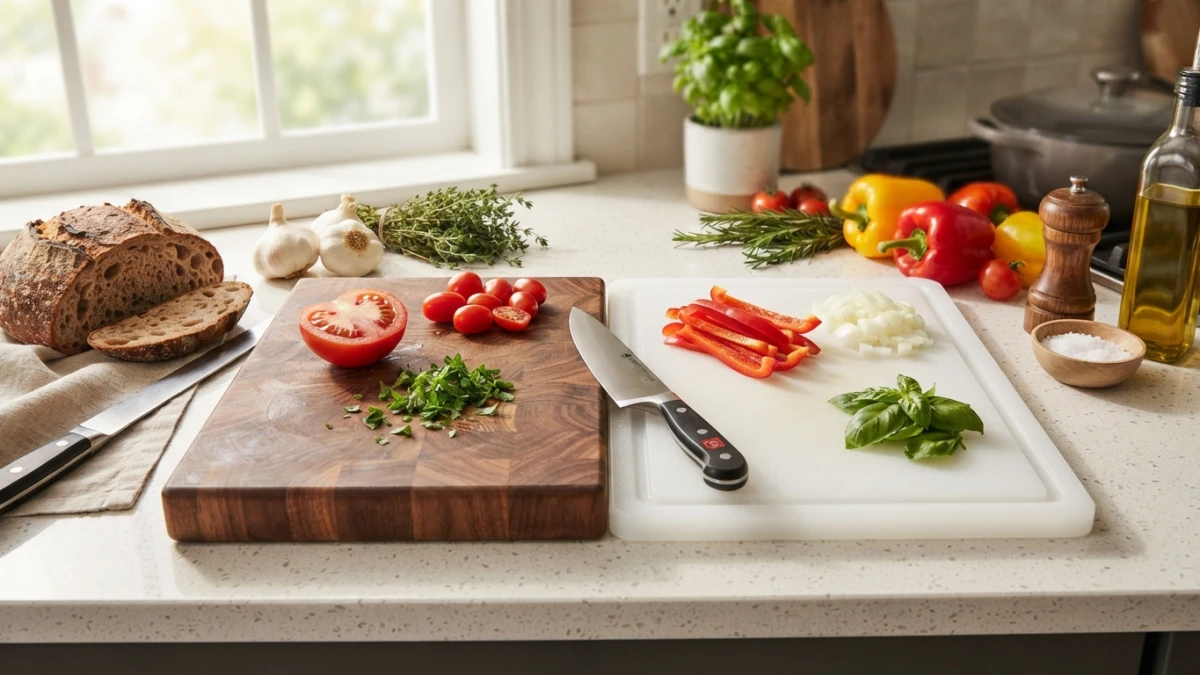
Learning how to choose a cutting board that suits your kitchen is not a chef-only concern: it affects your knives and the hygiene of your food. In this guide we compare wood, plastic, bamboo and other materials, and explain how many boards you need and how to care for them so they last for years.
Why a good cutting board matters
The board is the surface your knife touches the most. Every chop hits the edge against the material: if the board is too hard, like glass or marble, the edge dulls or chips within a few uses, even with quality knives. That is why knife makers recommend surfaces with a little give that let the blade "bite" without punishing it.
The board also plays a role in food safety. Porous materials, cracks and deep grooves trap food scraps and moisture, an ideal environment for bacteria. A well-chosen, well-cared-for board cleans thoroughly and keeps no surprises. Finally, there is comfort: a large, stable board with good support on the counter makes cutting safer and more pleasant. In the end, the best board is the one you enjoy using and find easy to clean.
How to choose a cutting board by material
Before buying, answer four questions. First, what you will cut: raw meat, vegetables, bread or a bit of everything. Second, which knives you own: very thin edges, typical of Japanese knives, are more sensitive to hard surfaces than European edges. Third, how much maintenance you are willing to do: wood needs oiling and hand washing, plastic needs almost nothing. Fourth, your budget and your storage space.
In short: wood is the great choice for daily work and for serving at the table; plastic is the practical choice for raw meat and heavy washing; bamboo is an affordable alternative; natural rubber is a favorite among professionals; and glass or stone should not be used for cutting. Let us look at each material in detail.
Wood boards: the classic chef option
Wood remains the queen of professional kitchens for a reason: its surface is relatively soft and protects the blade, and its fibers close up after cutting, which makes it harder for bacteria to penetrate deep. On top of that, a wood board can be sanded and brought back to life when it shows wear.
The most common woods are maple, dense and light in color, walnut, slightly softer and darker, beech, affordable and common in Europe, and olive, which is very hard, heavy and decorative. All of them are good choices; pick according to the weight you want to handle and the look you prefer in your kitchen.
Their downsides are well known: they do not go in the dishwasher, because water and heat make them crack and warp; they need periodic oiling to avoid drying out; they weigh more than plastic and usually cost more. Use them for bread, vegetables, fruit, cheese and already cooked food, and many homes use them as the main working board.
Plastic boards: hygiene at a low price
Plastic boards, almost always made of high-density polyethylene, are the most practical option on the market. They are cheap, lightweight, do not absorb liquids and, most importantly, they survive the dishwasher, which combines hot water and detergent for a deep clean. Since they come in several colors, they also allow a simple color-coding system to separate foods.
Their weak points show up with use: the knife leaves marks and grooves where bacteria can hide if you do not scrub them well; heat warps them, so never place a hot pot on top; and when the surface becomes too scratched, it is time to replace it. They are ideal as a board for raw meat, poultry and fish, or as an extra board for messy tasks such as peeling beets or mincing garlic.
Bamboo, rubber and materials to avoid
Bamboo is not exactly wood: it is a fast-growing woody grass, which makes it an eco-friendly and affordable option. It is harder than most woods, so it is durable but a bit more aggressive with the blade, and it can crack if it gets too wet or is left soaking. It is a fine choice if you want something natural without spending too much.
Natural rubber, on the other hand, is the favorite board of many Japanese professional kitchens: very gentle on the blade, non-slip and resistant to marks. Its main downside is the price, considerably higher than wood, and it is not easy to find in regular supermarkets.
And the materials to avoid for cutting are glass, ceramic, marble, granite and steel: they are so hard that they ruin the edge, they are noisy and they are slippery. They work as serving trays, not as cutting surfaces. Very thin bamboo or wood boards also work better for serving than for working with a knife.
Cross-contamination: how many boards you need
The main reason to own more than one board is to avoid cross-contamination: the juices of raw meat, chicken or fish can carry bacteria that pass to foods that will not be cooked, such as salad, bread or fruit, if you use the same surface without washing it. With two separate boards, the risk almost disappears.
The simplest practical rule is to have two: a plastic one for raw meat, poultry and fish, which you can put in the dishwasher or sanitize with mild bleach, and a wood one for fresh vegetables, fruit, bread, cheese and cooked food. If you cook a lot or several people share the kitchen, you can expand with a color code: red for meat, white for bread and dairy, green for vegetables and blue for fish, as many professional kitchens do. Wash the board between uses, especially after cutting meat, even if you are switching foods.
How to clean and sanitize each board
Wood boards are washed by hand with hot water and mild soap, without soaking them or putting them in the dishwasher. Dry them immediately with a cloth and store them standing up or resting on one edge so air can circulate. From time to time you can sanitize them by rubbing half a lemon with coarse salt or a cloth dipped in white vinegar, and letting them air dry.
Plastic boards can go in the dishwasher or be washed with hot soapy water. Once a week you can apply a solution of one tablespoon of bleach per liter of water, let it sit for a few minutes and rinse very well. To remove strong odors, such as garlic, onion or fish, rub the surface with coarse salt, let it rest for a few minutes and rinse; baking soda mixed with a little water also works well on both materials.
Care tips to make it last (and when to replace it)
Wood and bamboo boards need oiling to avoid drying out and cracking. Use food-grade mineral oil or walnut oil, never common cooking oils, because they turn rancid. Apply a thin layer with a cloth, let the wood absorb it and wipe off the excess. At first, repeat every two to four weeks; after that, once a month is enough. If the surface becomes scratched, sand it with fine sandpaper following the grain and oil it again.
It is time to replace a board when it has deep cracks, which hide bacteria and are hard to clean; when it is warped and no longer sits flat; when plastic has very deep grooves; or when an odor lingers after a thorough cleaning. In those cases, buying a new board is cheaper than a health problem or a ruined knife.
Frequently asked questions about cutting boards
Wood or plastic for raw meat? Both are safe with proper cleaning. Plastic handles the dishwasher and bleach better, while wood requires immediate drying and should not get too wet. In practice, many homes use plastic for raw foods and wood for everything else.
Can I put a wood board in the dishwasher? No: hot water and harsh detergent dry out the wood, causing cracks and warping. Always wash it by hand and dry it right away. Is bamboo wood? No, it is a woody grass; it behaves in a similar way, but it is harder and a bit more aggressive with the blade. How often should I oil the board? Once a month is usually enough, more often during the first month of use. And is bread better cut on wood? Yes, wood is ideal for bread because it does not punish the serrated blade and is easy to clean of crumbs.