How to Cook Pasta Perfectly: Water, Salt, Cooking Times and Pro Tips
 By
Diego Cortés
By
Diego Cortés
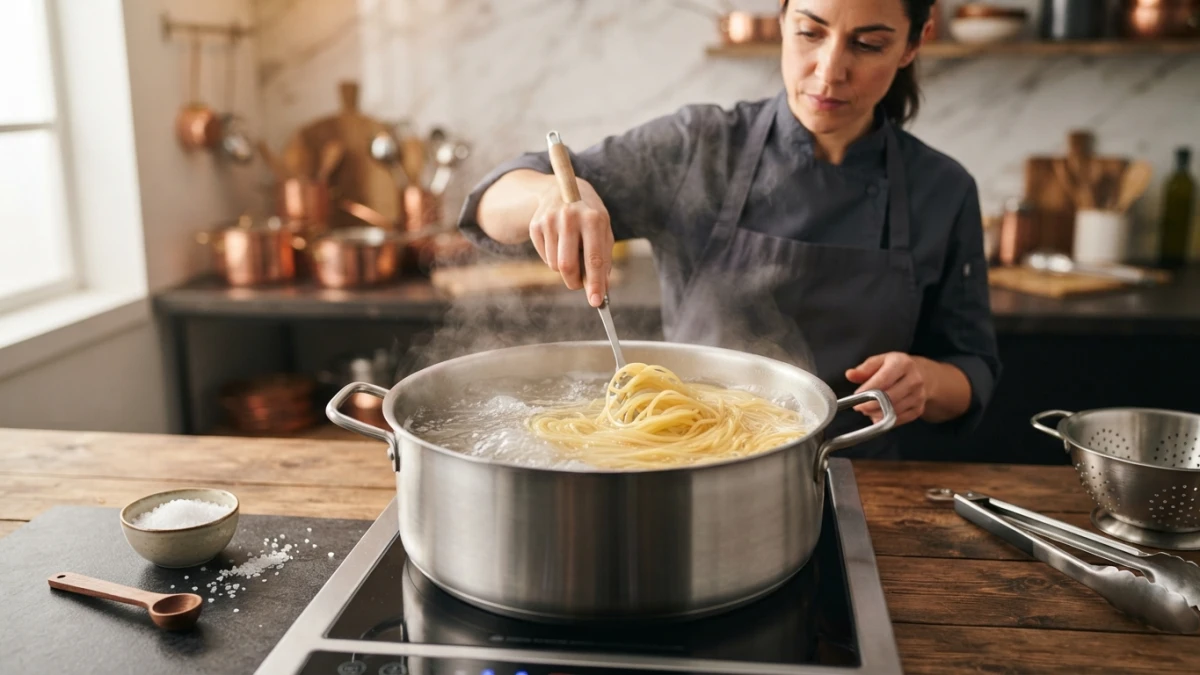
Does your pasta come out sticky, bland or overcooked? Learning how to cook pasta perfectly does not require chef-level technique: just the right water ratio, the right salt and respect for the cooking times.
In this guide I explain how much water to use per person, how much salt the water needs (and why you cannot add it later), how to recognize the al dente point, and the tricks that make sauce cling to every noodle.
The water ratio: how much you need to cook pasta without it sticking
The golden rule is simple: use 1 liter of water for every 100 grams of dry pasta. That ratio is not random: the extra water gives the noodles room to move freely as they release starch, and that movement is what keeps them from clumping together. If you are cooking for two with 200 grams of pasta, you need about 2 liters of water.
The size of the pot matters almost as much as the amount of water. Choose a tall, wide pot, because spaghetti and fettuccine need room to submerge without breaking. If you fill the pot to the rim, it takes longer to reach a boil and you risk overflow; if you use too little water, the temperature drops sharply when you add the pasta and the result is a gummy, sticky texture.
A practical detail: always cook without the lid. The lid speeds up the initial boil, but during cooking it is better to leave the pot uncovered so you can control the bubbling and prevent the starchy water from spilling over the edges. It is one of those common mistakes that fix themselves with a little attention.
How much salt the pasta water needs (and why you cannot salt it later)
The Italian rule says the water should taste like the sea: about 10 grams of coarse salt per liter, roughly one heaped tablespoon. Add the salt when the water is already boiling and before you add the pasta, not at the start: this way it dissolves completely and does not slow down the boil.
Salt is not only about surface flavor. As the pasta hydrates, it absorbs water and with it the salt: that is why it seasons the noodle from the inside, something you cannot achieve by adding salt to the sauce at the end. Pasta cooked in unsalted water will always taste bland no matter how flavorful the sauce on top is.
If you are cooking for someone on a low-sodium diet, you can cut the salt in half and compensate with a more aromatic sauce. But do not skip it entirely if you want the pasta to taste good on its own. The salt in the cooking water also enhances the other ingredients of the dish, so it is a step worth keeping.
When to add the pasta and how to keep it from sticking
Wait until the water is at a rolling boil before adding the pasta. If you drop it in when the water is barely bubbling, the temperature drops too much and the noodles cook unevenly. As soon as you add it, stir immediately with a wooden spoon or a spatula so it does not stick to the bottom or to itself during the first few seconds.
Stir again after about 2 minutes. That is when the pasta releases the most starch and the noodles tend to stick together. Two or three stirs during cooking are enough: you do not need to stir constantly, but you should not abandon it either.
One myth worth busting is the oil in the water. Adding oil does not keep pasta from sticking, because the oil floats on the surface and barely touches the noodles. All it does is coat the pasta with a greasy film that later prevents the sauce from clinging. If you want juicy, well-coated pasta, skip the drizzle of oil and trust the wooden spoon.
Cooking times: how to find the al dente point
The time printed on the package is a reference, not an order. Start testing the pasta 1 or 2 minutes before the stated time: the al dente point is recognizable when you bite into it, firm but cooked, with a tiny white dot in the center. If there is no white dot left, it is already overcooked.
Times change depending on the type of pasta. Fresh pasta cooks in 1 to 3 minutes, about the time it takes to float to the surface and bring the water back to a boil. Dry pasta takes longer depending on the shape: small shapes like macaroni or penne are usually ready in 8 to 10 minutes, and long ones like spaghetti in 9 to 12. Filled pasta, such as ravioli or tortellini, is ready when it floats, between 3 and 5 minutes.
Keep in mind that pasta keeps cooking with its own residual heat after you drain it. If you are going to finish it in the pan with the sauce, take it out a little before it is fully al dente: those final 1 or 2 minutes in the pan will complete the cooking without overcooking it.
The sauce secret: cooking water and no rinsing
Before draining the pasta, reserve a cup of the cooking water. That cloudy liquid is loaded with starch and is the secret ingredient that emulsifies any sauce: carbonara, pomodoro or a simple vegetable sauté all turn creamy and well combined when you add a few tablespoons of that water while tossing. It is the technique Italian restaurants use, and it costs nothing.
Do not rinse the pasta with cold water after draining it. The starch left on the surface is exactly what makes the sauce cling to the noodle. Rinsing only makes sense if you are using the pasta in a cold salad or in a stir-fry that will be chilled afterwards, but for a hot saucy dish, rinsing is the number one enemy of texture.
To finish, sauté the pasta in the pan with the sauce for 1 or 2 minutes, adding cooking water little by little until you reach the creaminess you are after. If you want to know which oil to use for that sauce or that final sauté, our guide to types of cooking oil by smoke point has the answer.
Common mistakes when cooking pasta (and how to avoid them)
Breaking spaghetti so it fits in the pot is the most repeated mistake and also the most unnecessary one. You do not need to: add the noodles and press gently on the end that sticks out; within 30 to 60 seconds the submerged part softens and the rest folds into the water on its own.
Overcooking just in case is another classic. If the taste test comes out al dente, drain it right away; leaving the pasta in hot water or in the colander without sauce makes it keep cooking and turn soft. And if the sauce is not ready, the best approach is to make the sauce first and cook the pasta last, not the other way around.
Do not guess the portion size either. The standard serving is 80 to 100 grams of dry pasta per person as a main course, and 60 to 80 grams as a side dish. Remember that 100 grams dry turns into about 225 to 250 grams cooked, so the amount on the plate is deceiving. If you do not have a scale, our guide to measuring ingredients with cups and grams will get you out of trouble.
Finally, if you have leftover cooked noodles, do not throw them away: store them in the fridge and reheat them with the right method so they do not dry out. We explain how in our article on how to reheat food in the microwave.
Gluten-free pasta and other special formats
Gluten-free pasta, made from corn, rice or legumes, overcooks much faster than wheat pasta. Watch it closely, stir it less so it does not fall apart, and serve it right away: it turns soft quickly once it rests. Start testing even 2 minutes before the time on the package.
Whole wheat pasta needs a little more water and usually requires 1 or 2 extra minutes of cooking. The al dente point feels the same as with white pasta: firm on the outside and cooked through, without a floury center. Do not confuse it with raw pasta: whole wheat keeps a darker color even when it is ready.
And one last tip to avoid waste: the cooking water left after you drain the pasta is great for thickening sauces, giving body to stews or even for kneading bread. It is liquid gold loaded with starch, so think twice before pouring it down the sink.