How to measure ingredients correctly: cups and grams
 By
Diego Cortés
By
Diego Cortés
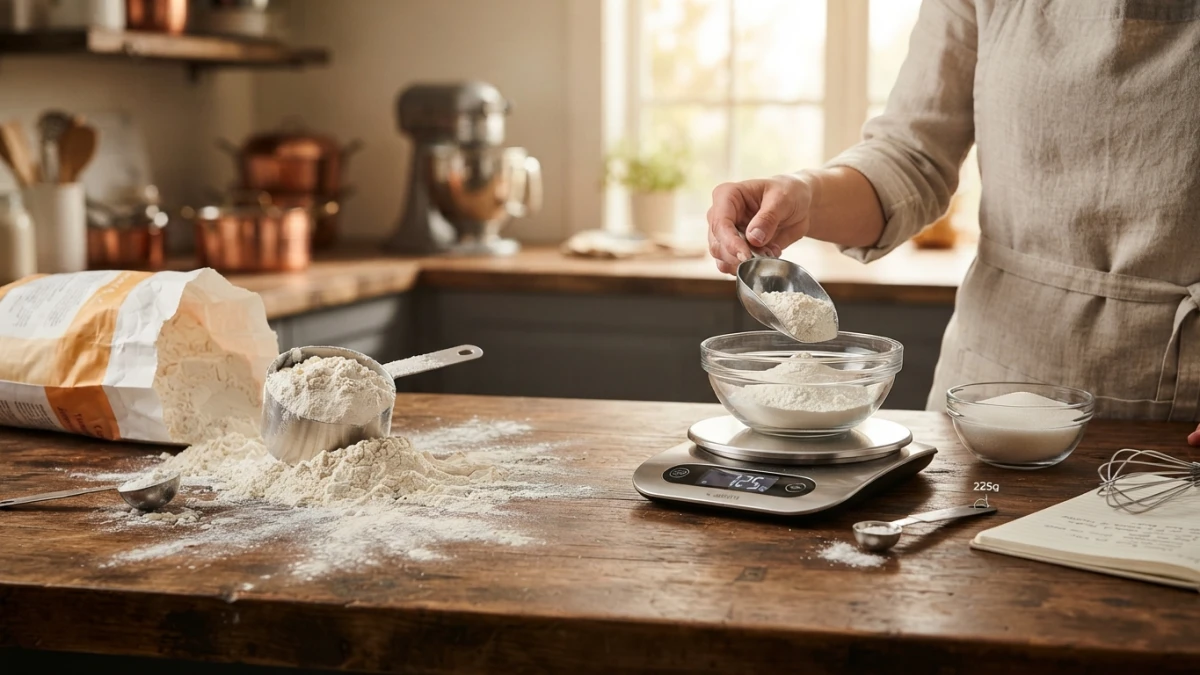
Is your cake dry, are your cookies flat, or does the dough fail to rise? Before blaming the oven or the recipe, check how you measure: eyeballing amounts or filling cups carelessly ruins more bakes than any other kitchen mistake. Learning how to measure ingredients correctly is the most cost-effective skill in baking: it costs nothing, takes seconds to apply, and completely changes the final result.
Why measuring correctly changes the outcome of your recipes
Measuring by volume (cups and spoons) has a huge margin of error: a heaped cup of flour does not weigh the same as a leveled one, and that difference can exceed 20 %. If the recipe was written for 120 g of flour and you add 150 g, the dough turns out dry, the cake does not rise, and the cookies spread too much. It is not your oven: it is the ratio.
Weight, on the other hand, is constant and does not depend on technique. 250 g of flour is always 250 g, while volume changes with air humidity, the type of ingredient, and how compacted it is. In baking and bread-making, precision matters more than in everyday stir-frying: small amounts of yeast, baking soda, or salt unbalance the whole result, and that is where a kitchen scale becomes your best ally.
Kitchen scale vs. measuring cups: when to use each one
A digital scale is the most reliable option for dry ingredients and for any delicate preparation: it shows the real weight without depending on packaging or on how you fill the container. Besides, most models let you tare (place the bowl and press zero), so you can add several ingredients to the same bowl without dirtying anything else.
Measuring cups and jugs are enough for liquids (water, milk, oil), which keep a stable volume because they do not compress, and for quick everyday cooking where a couple of grams do not matter. The practical rule is simple: always weigh flours, sugars, nuts, and any ingredient used in small critical amounts (yeast, baking soda, fine salt); save the measuring cup for liquids.
How to measure dry ingredients step by step
Flour is the ingredient that causes the most mistakes. Never dip the cup into the bag: that compacts it and adds 20 to 30 % extra product. Instead, spoon the flour into the cup and level the excess with the straight edge of a knife or a spatula, without pressing.
Brown sugar is measured the opposite way: it is pressed into the cup until it holds its shape when turned out (this removes lumps and air). White sugar, on the other hand, is leveled without pressing, just like flour. For small amounts, use measuring spoons, not table spoons (every cutlery set varies), and level with the back of a knife. Yeast and salt are measured leveled unless the recipe explicitly says otherwise.
How to measure liquid ingredients without getting it wrong
For liquids, use a transparent glass jug or cup with markings, place it on a flat surface, and read the measurement at eye level: the lower curve of the liquid (the meniscus) must touch the mark. Reading from above at an angle is one of the most common mistakes and adds or removes several milliliters.
Sticky ingredients (honey, syrup, molasses) slide off better if you lightly grease the spoon or cup before measuring, or you can simply weigh them on the scale so nothing is lost. Tablespoons and teaspoons also work for liquids: 1 tablespoon = 15 ml and 1 teaspoon = 5 ml, perfect for extracts, vinegar, or oil in small amounts.
Conversion chart: cups, grams, tablespoons, and milliliters
Standard measuring cups use the US measure: 1 cup = 240 ml, 1 tablespoon = 15 ml, and 1 teaspoon = 5 ml. A regular drinking glass holds about 200-250 ml depending on its size, so do not confuse it with the measuring cup.
- 1 cup of wheat flour ≈ 120-135 g (depending on how it is filled)
- 1 cup of white sugar ≈ 200 g
- 1 cup of brown sugar ≈ 220 g (packed)
- 1 cup of rice ≈ 180-200 g
- 1 cup of butter = 2 sticks = 226 g
- 1 stick of butter = 113 g = ½ cup
- 1 ounce = 28 g
For the oven, the most used conversions are 180 °C = 350 °F, 200 °C = 400 °F, and 220 °C = 425 °F. If you want to go deeper into which flour to choose for each preparation, we recommend our guide to flour types and their uses.
The 6 most common measuring mistakes (and how to avoid them)
These are the mistakes almost every home cook repeats, and the solution is always the same: technique and a scale.
- Dipping the cup into the flour or sugar: it compacts the ingredient and adds extra grams. Always spoon and level.
- Using table spoons and glasses: they have no reliable measurements and every cutlery set varies. Use proper measuring tools.
- Not taring the scale: placing the bowl on without pressing zero adds the weight of the container and throws off the amount.
- Measuring liquids in cups meant for solids (or the other way around) and reading the measurement from above at an angle: use the right jug and read at eye level.
- Measuring sticky ingredients by volume without greasing: part is lost on the spoon and the final amount comes up short.
- Adding yeast, baking soda, or spices "by eye": these are potent ingredients where one gram more or less is immediately noticeable.
Frequently asked questions about measuring ingredients
How many grams are in a cup? It depends on the ingredient: 120-135 g of wheat flour, about 200 g of white sugar, and 226 g of butter. The conversion chart in this article summarizes it by ingredient.
Can you measure without a scale? Yes, with measuring cups and spoons and the conversion chart, assuming up to 20 % variation. For fine baking, the scale is still recommended.
Is a cup the same in Spain and the United States? Not exactly: the standard measuring cup is 240 ml, but many breakfast cups hold around 250 ml. It is better to rely on your kitchen measuring cups.
How do you measure butter that comes in a block? By weight (113 g per stick or 226 g per cup) or using the marks on the wrapper, which usually indicate tablespoons and cups.