How to choose your first kitchen knife: forged vs stamped and what to look for
 By
Diego Cortés
By
Diego Cortés
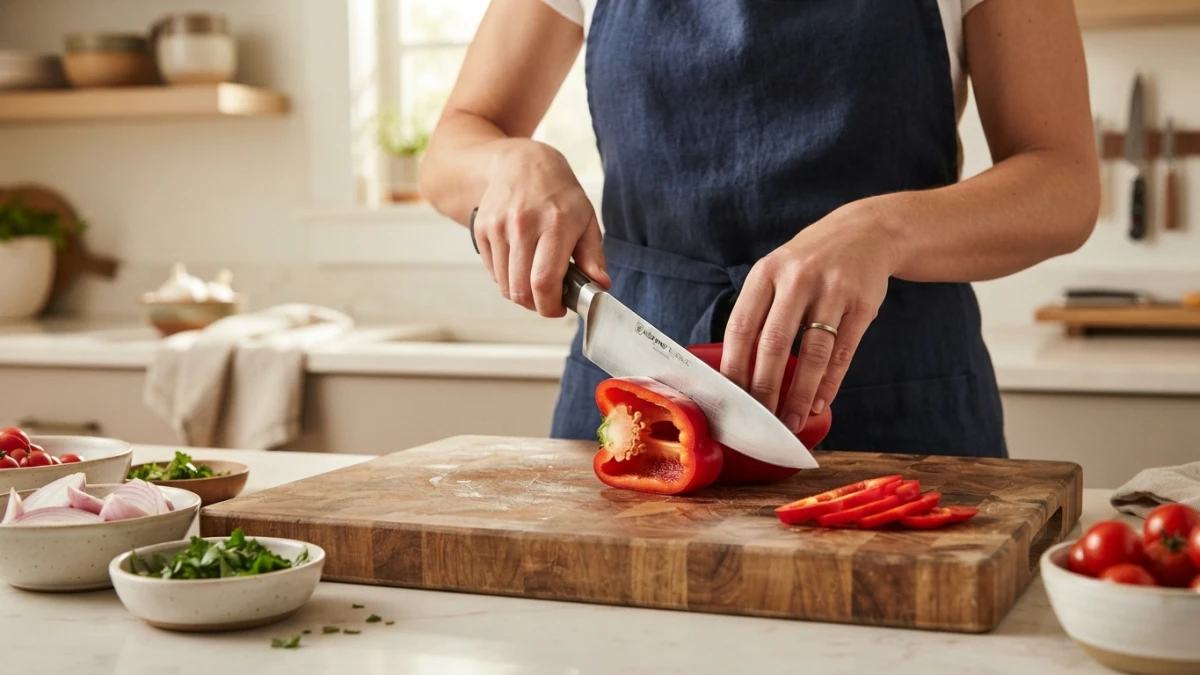
Your first kitchen knife is the difference between chopping with pleasure and dreading every onion. Learn to read the labels, tell forged from stamped and test the knife before paying: choose well and get it right the first time.
Choosing a kitchen knife is not about brand or price, but about understanding what hides behind the blade: how it was made, what steel it uses and how it feels in your hand. This guide gives you the keys to spend your money wisely on the tool you will use most in the kitchen.
Why your first knife deserves a thoughtful decision
It is the most-used tool in the kitchen. A good knife makes preparing any recipe faster and more enjoyable, while a bad one turns every cut into a struggle. A sharp knife is also safer than a dull one: it cuts with less force and slips less, so the risk of accidents drops noticeably.
Chosen well, it lasts for years and can even be passed down. Chosen carelessly, it ends up forgotten in a drawer and you buy another one. That is why, before paying, it is worth understanding the three factors that define a good knife: how it is made, what steel it is made of, and how it feels in your hand.
Forged vs. stamped: what it really means
The first big distinction you will see in any store is between forged and stamped knives. A forged knife is shaped from a hot steel bar through hammering and pressure. The result usually weighs more, has better balance and, generally, costs more. It is the classic professional chef's knife.
A stamped knife, on the other hand, is cut from a sheet of steel with a press, then sharpened and fitted with a handle. It is lighter, cheaper and, these days, there are stamped knives of excellent quality that perform at the level of many mid-range forged ones. The line between the two has blurred so much that the label matters less than it seems.
More than the label, what matters is how the knife feels in your hand when you use it. A well-balanced stamped knife with a good edge can be the best purchase to start with, and a heavy forged knife you cannot control can end up being a nuisance. Try both before deciding.
Steel matters, but not as much as you think
Steel hardness, measured on the HRC (Rockwell) scale, determines edge retention. Harder steels keep their edge longer, but they are harder to sharpen at home and can chip if used on hard surfaces such as glass or marble. Softer steels sharpen easily but lose their edge quickly and demand constant maintenance.
Common steels in quality kitchen knives, such as X50CrMoV15 or VG-10, offer a good balance between edge retention and ease of maintenance. To start, a balanced mid-range steel performs better than an ultra-hard steel you do not know how to maintain. The perfect hardness for a first knife is around 56-58 HRC: enough to cut for a long time and easy to bring back with a honing rod or whetstone.
What to look for when holding it: handle, weight and balance
The handle must fit your hand and not slip, even when your hands are wet or greasy. If holding it tires you or you feel you have to force it to stay in control, that knife is not for you, no matter how beautiful it is. Modern synthetic handles offer better grip than traditional wood and require almost no maintenance.
Balance is noticeable almost immediately: hold the knife with one hand, as if you were about to chop, and see where the weight falls. It should feel stable, neither tip-heavy nor handle-heavy. A well-balanced knife guides itself, and your arm gets far less tired after a long cooking session.
The real test before buying is using it: chop parsley, cut an onion, a carrot and a hard squash. If the store will not let you try it, find another store. A knife you have not held is a blind purchase.
How much to spend: price ranges and where to invest
With a quality stamped knife you can start without spending much: there are very decent options at a modest price that will serve you well for years. The jump to a mid-range forged knife is noticeable mainly in weight, balance and a feeling of solidity, and it is a reasonable investment if you cook daily.
The smart investment is a single good chef's knife, not a whole cheap set. A good mid-range chef's knife costs the same as many twenty-piece sets and performs far better, because it is the one you will actually use. Recognized mid-range brands offer the best value for a first home knife: reliability, spare parts and warranty without paying the luxury markup.
What to avoid: 20-piece blocks and fads
Huge sets include knives that are never used and usually take budget away from the knife that really matters. Of those twenty knives, most households use two or three; the rest take up space and collect dust. Better to buy individual pieces, one at a time, as you need them.
Ceramic knives cut very well at first, but they are fragile: they chip if dropped or if they hit a bone, and they are almost impossible to sharpen at home. They are not a good first purchase. Do not be carried away by fads either: the Japanese blue-steel knife is wonderful in expert hands, but it demands maintenance a beginner does not need.
And remember: brand matters less than care. A well-maintained ordinary knife outperforms a neglected expensive one. With a honing rod passed over it every few uses and occasional sharpening, any decent knife performs for years.
The 3 knives that complete your first purchase
With three well-chosen knives you have the kitchen covered for 95 percent of tasks:
- Chef's knife: the all-rounder that solves most cuts. Look for a blade around 20 cm with some curve so you can rock the knife when chopping. It is the centerpiece of your kitchen and where you should invest most of your budget.
- Paring knife: small, with a short blade and fine tip, ideal for peeling, cleaning fruit, deveining shrimp and all precision work. It costs little and gets used far more than you would expect.
- Serrated or bread knife: essential for cutting crusty bread and tomatoes without crushing them. Its serrated edge cuts the crust without crumbling the crumb and lasts for years without sharpening.
Frequently asked questions before buying
How much should I spend on my first knife?
A good mid-range chef's knife is enough to start. You do not need the most expensive knife in the store: you need one that fits your hand, holds its edge and that you want to use every day. Expensive additions can come later, piece by piece.
Japanese or Western knife?
Japanese knives tend to be lighter, with harder steels and finer edges; Western knives are more robust and forgiving. It is a matter of personal preference and technique: if you are starting out, a mid-range Western knife or a well-balanced gyuto (the Japanese chef's knife) are equally valid options.
Where should I buy it?
Preferably in a physical store, where you can hold it and try it before paying. The feel in your hand is the most important criterion and cannot be evaluated by looking at a photo. If you buy online, choose stores with a good return policy.