Meat cooking temperatures: the complete internal temperature chart for perfect doneness
 By
Diego Cortés
By
Diego Cortés
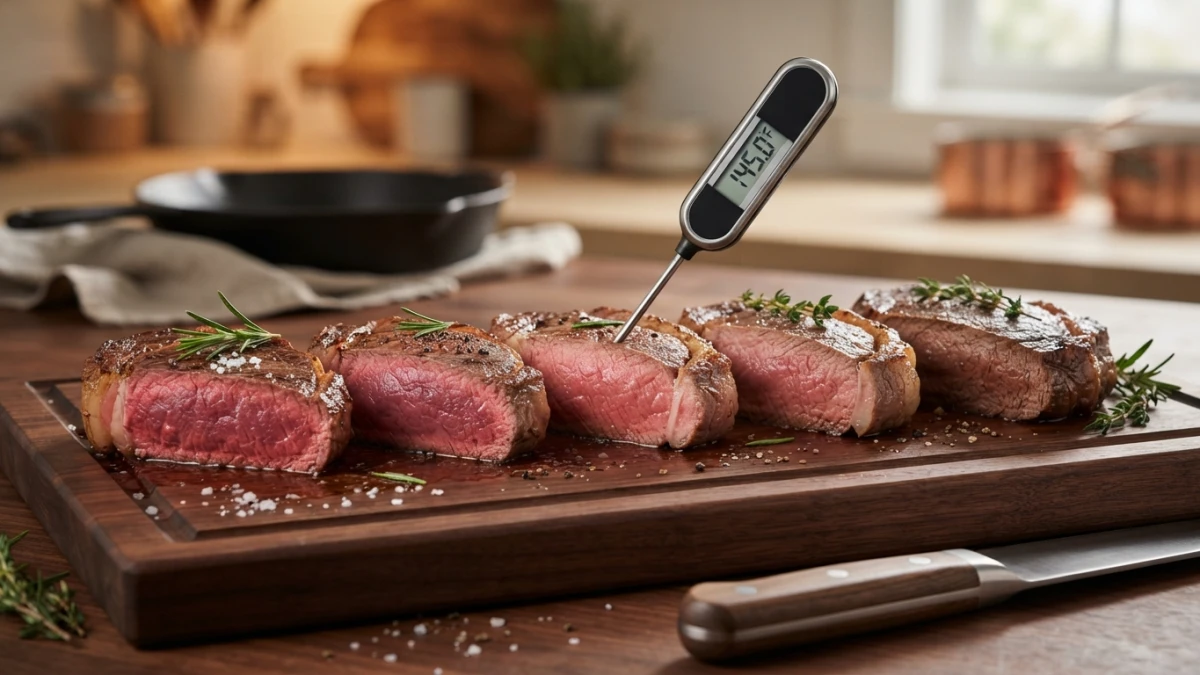
Meat cooking temperatures are the difference between a perfect dish and a dry or, worse, unsafe meal. Outside color deceives: a steak can look golden brown on the outside and still be raw inside.
Two pieces of the same size do not cook the same way depending on thickness, starting temperature, or how your oven behaves. The only reliable way to know when meat is cooked to the right doneness and safe to eat is to measure the internal temperature at the center of the piece with a kitchen thermometer. In this guide you will find the complete meat temperature chart by type of meat, beef doneness levels, resting times, and how to use the thermometer without making mistakes.
Why internal temperature is the only reliable way to tell when meat is done
Professional chefs do not guess: they measure. The time in a recipe is only a reference, because the thickness of the cut, the temperature at which the meat comes out of the fridge, and the behavior of each oven change the result completely. Chicken can look golden and juicy on the outside and still be raw near the bone; a burger can have a pink center that looks "medium" when it never reached a safe temperature.
Food safety depends on the temperature at the center of the food. Between 4 °C and 60 °C (40-140 °F) lies the so-called "danger zone", where bacteria multiply quickly. Reaching the safe temperature for each type of meat destroys the most common pathogens, such as salmonella in poultry or E. coli in ground meat. An instant-read thermometer turns cooking into a measurable, repeatable process: the same results every time, without cutting into the meat to check it and losing its juices.
Safe meat cooking temperatures chart (USDA reference)
This chart follows USDA food safety recommendations and works as a quick reference for any recipe. Always measure at the thickest part of the piece, away from bones, fat, and cartilage. Temperatures are shown in Fahrenheit, with the Celsius equivalent in parentheses.
| Food | Safe temperature | Recommended doneness | Rest time |
|---|---|---|---|
| Poultry (chicken and turkey, whole, pieces, or ground) | 165 °F (74 °C) | Well done, no intermediate levels | 10-20 min (whole birds) |
| Ground meat (burgers, meatballs, ragù) | 160 °F (71 °C) | Well done | 3-5 min |
| Whole cuts of beef, pork, lamb, and veal | 145 °F (63 °C) | Medium, with resting | At least 3 min |
| Fish | 145 °F (63 °C) | Opaque and flakes easily | 3-5 min |
| Leftovers and reheated stews | 165 °F (74 °C) | Hot all the way through | - |
Poultry is the only meat that does not allow intermediate doneness levels: the risk of salmonella means it must always reach 165 °F (74 °C). Ground meat, because it is minced, mixes surface bacteria into the interior, which is why it needs a higher temperature than a whole cut.
Beef doneness levels: from rare to well done
When cooking quality whole cuts, beef doneness is a matter of personal taste, as long as the surface has been properly seared. This is the reference scale:
- Rare: 120-125 °F (50-52 °C), cold red center.
- Medium rare: 135-140 °F (57-60 °C), warm red center; the favorite for premium cuts because of its juiciness.
- Medium: 140-145 °F (60-63 °C), pink and juicy center.
- Medium well: 150-155 °F (65-68 °C), just a thin line of pink.
- Well done: 160 °F (71 °C) or more, no trace of pink.
Remember that doneness levels below 145 °F (63 °C) are only safe in whole cuts whose surface has been seared over high heat. For ground meat, the rule does not change: always cook to 160 °F (71 °C).
Carryover cooking and resting: meat keeps cooking off the heat
When you take the meat off the heat, the heat accumulated on the surface keeps traveling toward the center, and the internal temperature continues to rise by about 5-9 °F (3-5 °C). That is why you should pull the piece from the heat slightly before it reaches the target temperature. If you want a medium steak (145 °F / 63 °C), take it off the heat at about 136-140 °F (58-60 °C) and let it rest covered before slicing.
Resting also redistributes the juices throughout the piece, leaving the meat more tender and flavorful. As a reference: 3-5 minutes for steaks and burgers, and 10-20 minutes for large roasts. During that time the internal temperature finishes rising safely, with no risk of the meat cooling down inside.
How to use a kitchen thermometer correctly
There are two types of thermometers, and each has its ideal use. An instant-read thermometer is perfect for steaks, burgers, and thin cuts: insert it into the center of the thickest part, avoiding bone, fat, and the pan, and wait 5-10 seconds for the reading to stabilize. An oven probe, on the other hand, stays inside the roast for the whole cooking time and alerts you when the programmed temperature is reached; many models let you set the target temperature and beep when you get there.
To keep accuracy and hygiene, wash the probe with hot soapy water between uses, especially when moving from raw to cooked meat. Check calibration from time to time by dipping the tip into a glass of ice water: it should read 32 °F (0 °C).
Common mistakes and myths about meat temperature
One of the most widespread myths is about pink color: pork or chicken can keep pink tones and be perfectly cooked at their safe temperature. Color is not a reliable indicator; temperature is. In the same way, cutting into the meat to check if it is done makes it lose juices and dry out: it is much better to measure with a thermometer.
Do not rely only on the time given in a recipe either: every oven and every cut behaves differently. And if you work with frozen meat, always thaw it in the fridge, never at room temperature; otherwise the inside will stay cold while the outside burns or overcooks.
Frequently asked questions about meat cooking temperatures
What temperature is chicken done at? At 165 °F (74 °C) in the thickest part, without touching the bone. It is the mandatory temperature for poultry, whole or in pieces.
Can you eat pink pork? Yes, if it reached 145 °F (63 °C) in the center and rested for at least 3 minutes. Trichinella is destroyed at that temperature, and a pink tone is no longer a sign of danger.
How long should each meat rest? 3-5 minutes for steaks and burgers, and 10-20 minutes for large roasts. During resting, the internal temperature rises another 5-9 °F (3-5 °C).
What do I do if I do not have a thermometer? Cook poultry and ground meat all the way through, with no trace of pink or pink juices, for longer than you think necessary. For whole cuts, use the touch test (compare the firmness of the meat with the muscle of your hand), accepting a larger margin of error.
Cook's note: meat temperature is a skill you train. Buy a good-quality instant-read thermometer and always measure at the same spot: the thickest part, away from the bone. In a few weeks you will cook at the exact temperature without thinking about it, and you can apply it to dishes like oven-roasted chicken with potatoes, meatballs in tomato sauce, or oven-baked lemon salmon.