How to thaw food safely: methods, times and mistakes to avoid
 By
Diego Cortés
By
Diego Cortés
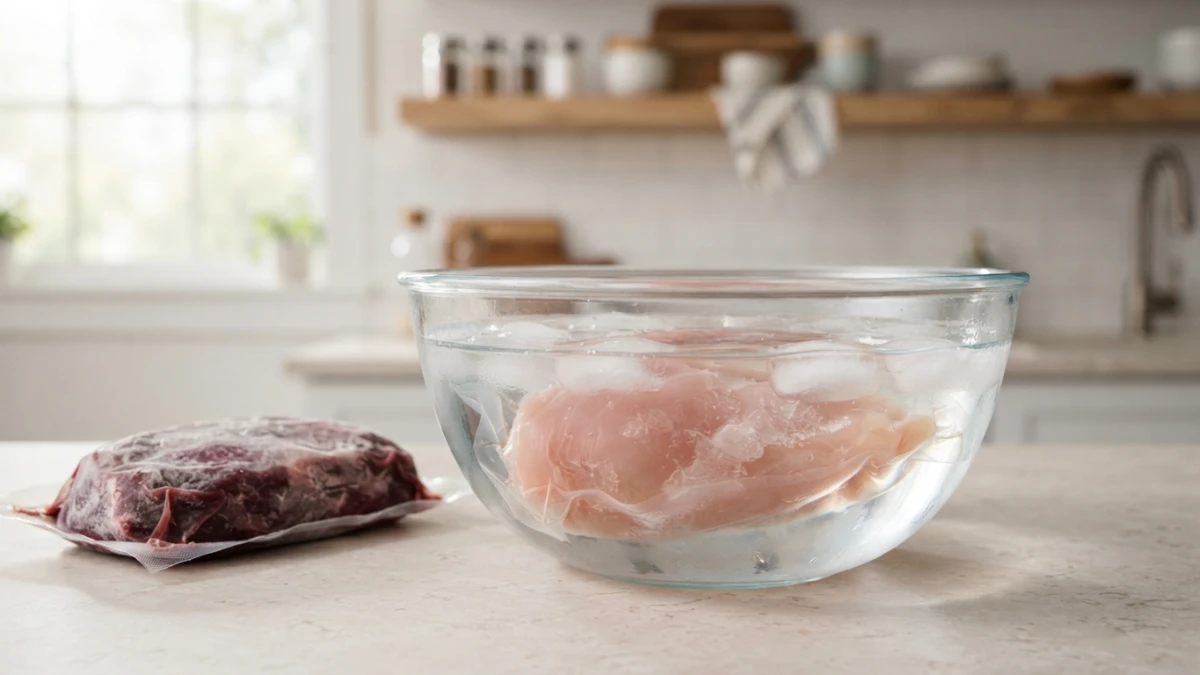
Leaving a whole chicken on the counter in the morning to cook it in the evening is one of the most dangerous mistakes in home kitchens. Knowing how to thaw food safely prevents food poisoning and waste.
In this guide you will find the 3 safe methods recognized by food safety agencies (fridge, cold water and microwave), the per-food timing chart and the exact rules for refreezing without risk. The good news: thawing properly is easy once you understand the why. It all comes down to one number, 4 °C: as long as the food stays below that temperature, bacteria cannot multiply at a dangerous rate. Any method that respects that rule is safe; any other is not.
Why thawing the wrong way is dangerous: the danger zone and the 2-hour rule
Between 4 and 60 °C lies what experts call the danger zone: the range in which bacteria multiply rapidly. When you thaw at room temperature, the outside of the food spends hours inside that zone while the center stays frozen; a single bacterium can become millions and produce toxins that cooking does not always destroy.
That is why the 2-hour rule exists: a perishable food must not stay at room temperature for more than 2 hours (1 hour when it is hotter than 32 °C). After that, the risk grows even if you cook the food thoroughly. Thawing in the fridge, in cold water or in the microwave are the only safe methods recognized by food safety agencies, with the USDA FSIS Big Thaw guide as the international reference (USDA Food Safety and Inspection Service). Any other home trick (countertop, radiator, hot water) multiplies the risk with no real advantage.
Method 1: thawing in the fridge, the safest and the one that preserves best
It is the recommended method whenever you can plan ahead: the constant temperature of the refrigerator (ideally 4 °C or below) keeps the food out of the danger zone during the whole process, and it is the only method that lets you refreeze the raw food without cooking it first, as we will see later.
The approximate time is about 5 hours per 500 g: a 2 kg piece needs around 20 hours and a whole 1.5 kg chicken around 30. That is why the classic trick works: move the meat from the freezer to the fridge the night before, or two nights before for large pieces.
Practical details: place the food on a plate or tray on the bottom shelf so its juices do not drip onto other foods (this prevents cross-contamination). Once thawed, it keeps for 1-2 days (poultry and fish) or 3-5 days (red meat and ground meat) before cooking.
Method 2: thawing in cold water, the fast and safe plan B
If you ran out of planning time, cold water is the fastest plan B and it is still 100 % safe. The food must go inside a leak-proof bag with no holes (if the water touches the meat, it absorbs liquid and picks up bacteria) and be fully submerged in cold tap water. Never use hot or warm water: it would push the surface into the danger zone.
The timing rule: about 30 minutes per 500 g, changing the water every 30 minutes to keep it cold. A 1 kg package takes about 1 hour. Cook immediately when done: this method has already taken the food out of freezing temperature, so it cannot go back into the fridge or freezer raw.
Method 3: thawing in the microwave, only if you cook it right away
It is the emergency method: fast, but with two serious limitations. Use the defrost function or low power and keep an eye on the food, because microwaves heat unevenly and can start cooking the edges while the center stays frozen.
The golden rule: cook the food immediately afterwards, because part of its surface may have entered the danger zone. It works for small last-minute portions (breasts, fillets, ground meat); it is not suitable for large pieces, which end up cooked outside and frozen inside.
Thawing times by food and method
Times are approximate: they depend on the thickness of the piece, the packaging and the real temperature of your fridge. The general rule is 5 hours per 500 g in the fridge and 30 minutes per 500 g in cold water, changing the water every half hour.
| Food | Fridge (approx.) | Cold water (approx.) | Microwave |
|---|---|---|---|
| Whole chicken (1.5 kg) | 30 hours | 1.5 hours | Not recommended |
| Chicken breasts (500 g) | 5 hours | 30 minutes | 6-8 minutes |
| Red meat cuts (500 g) | 5 hours | 30 minutes | 5-7 minutes |
| Ground meat (500 g) | 5 hours | 30 minutes | 5-6 minutes |
| Fish fillets (500 g) | 5 hours | 30 minutes | 4-6 minutes |
| Seafood (500 g) | 5 hours | 30 minutes | 4-6 minutes |
For the microwave, the times correspond to the defrost function at low power and the food must be cooked immediately; whole chicken is not recommended (uneven result, possibly raw inside).
What if you forgot to thaw: how to thaw food safely by type
If cooking time arrives and the food is still frozen, you have three safe options: cold water for small pieces, microwave for single portions, or cooking directly from frozen, which is safe in most cases and only adds 50 % more cooking time, as long as the internal temperature reaches the recommended minimum (70-74 °C depending on the food).
That said, not all foods behave the same: bread, pastries and fruit can indeed thaw at room temperature or straight in the toaster, oven or pan (in fact, that is the correct way, as the National Center for Home Food Preservation explains, NCHFP, University of Georgia). Products with egg, milk, meat or fish: never. To portion meat, thaw it partially in cold water and cut it before it thaws completely; frozen soups and stews go straight into the pot over gentle heat. For the specific case of chicken breasts, we have a dedicated guide: how to quickly and safely defrost chicken breast.
Can you refreeze thawed meat?
Yes, but with conditions. If the food was thawed in the fridge and stayed below 4 °C the whole time, it can go back to the freezer raw: it never entered the danger zone, so the second freeze is as safe as the first (quality may notice it; safety will not).
If it was thawed in cold water or in the microwave, you must cook it first (internal temperature of at least 70-74 °C) and only then can the cooked food be refrozen. The same applies to any food that has been at room temperature for more than 2 hours. We covered it in detail in is it safe to refreeze thawed meat?. The most practical way to avoid the dilemma is not to have it: freeze in individual portions from the start, as in our guides to how to freeze vegetables and how to organize your fridge.
Common mistakes and frequently asked questions
The mistakes that repeat the most: thawing on the countertop or in hot water (the classic, and the most dangerous); leaving the package in the sink all day; refreezing without criteria (only safe if thawed in the fridge or already cooked); and marinating at room temperature (marinating must also happen in the fridge).
How long does chicken take to thaw in the fridge?
A whole 1.5 kg chicken, about 30 hours; 500 g of breasts, about 5. The general rule is 5 hours per 500 g.
Can you cook frozen chicken?
Yes, straight from the freezer, adding 50 % cooking time and checking that the internal temperature reaches 74 °C in the thickest part.
How long does thawed food last in the fridge?
Poultry and fish, 1-2 days; red meat and ground meat, 3-5 days. If you notice any unusual smell, color or texture, throw it away.
Can bread thaw on the countertop?
Yes: bread, pastries and fruit are the exceptions to the rule and can thaw at room temperature or straight in the toaster, oven or pan.
Is freezer burn dangerous?
No: it affects quality (flavor and texture), not safety, and you can trim the affected areas before cooking.
Thawing well requires no special equipment and no extra time: it requires choosing the method based on the time available and respecting the 4 °C rule. With the timing chart and the refreezing rules you can stop guessing and thaw chicken, beef, fish and seafood with confidence. To complete the cycle, check out how long vegetables last in the fridge so nothing ends up in the trash.