How to choose pots and pans: materials, sizes and uses
 By
Diego Cortés
By
Diego Cortés
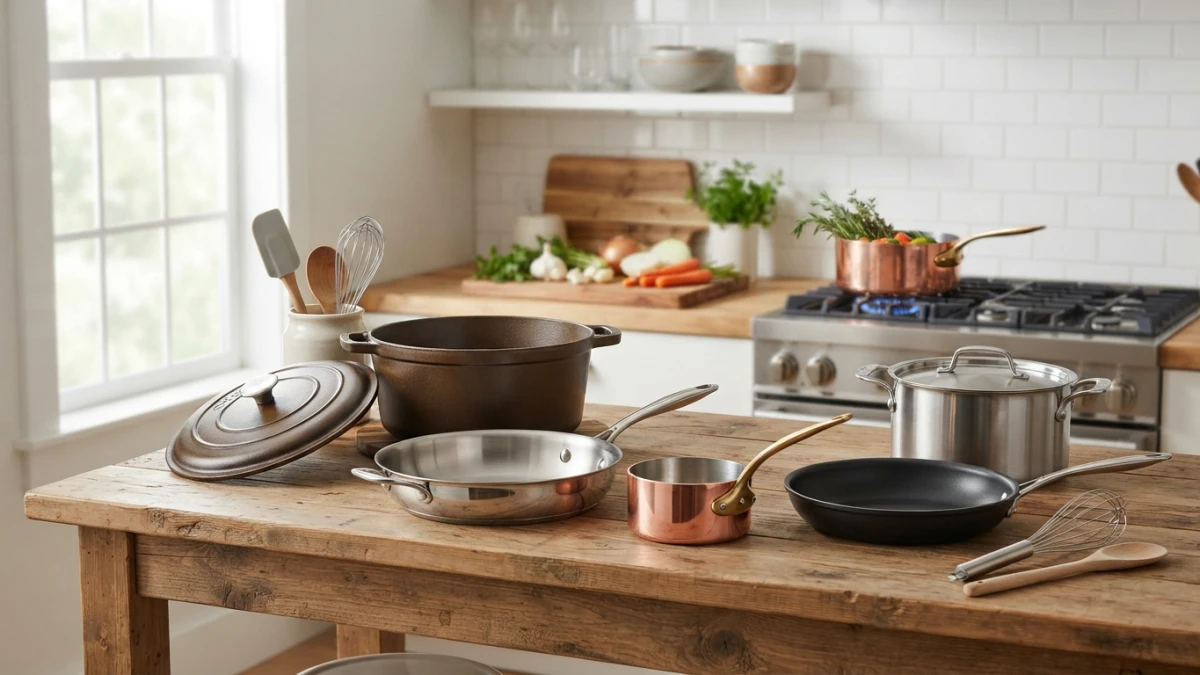
If you are looking for how to choose pots and pans, this guide saves you from expensive mistakes: what sets each piece apart, which material suits what you cook and how many liters you really need, so you do not end up with cookware that fails within months.
Pot, casserole or small saucepan: what each piece is for
The first step to choosing well is understanding that these are not the same thing, even if they look similar in the store. The pot is tall with little surface area for its volume: it holds liquid and heat, which makes it the ideal piece for broths, legumes, pasta and long cooking in plenty of water.
The casserole, on the other hand, is lower and wider. Its larger surface lets liquid evaporate more easily, so you can sear first and then simmer without switching vessels: it shines in sauces, rice dishes and stews, and in general in any recipe that starts with browning and finishes over gentle heat.
The small saucepan, 1 to 2 liters, covers daily tasks without wasting energy: warming milk, making a quick sauce, boiling an egg or reheating a single portion of soup. If you already own a large pot, the saucepan is the second most cost-effective purchase in the whole set.
Materials: stainless steel, cast iron, nonstick and aluminum
More than the brand, the material defines how long the piece lasts and what it is for. Stainless steel with a multi-layer base is the most balanced option: it lasts a lifetime, does not release flavors, handles high temperatures and goes from stovetop to oven without issue. Its only requirement is technique: it needs some fat or liquid and proper preheating so food does not stick.
Enameled cast iron, the classic cocotte style, retains heat like no other material. It is perfect for slow stews and crusty breads, but it is heavy and needs careful washing so the enamel does not chip. If you make braises often, it is an investment you notice every time.
Nonstick, usually anodized aluminum with a coating, is the king of convenience: ideal for eggs, fish and delicate sauces that stick to other materials. Its Achilles heel is durability: the coating degrades with high heat, metal utensils and the dishwasher. And note that many nonstick pieces have no magnetic base, so they do not work on induction.
Pure aluminum conducts heat very well and weighs little, but it reacts with acidic foods and dents easily: today it is mostly used as the core of coated pieces or multi-layer bases rather than as the visible material of a quality pot.
Size: how many liters you need for your household
The practical rule for capacity is simple: count about 1 liter per person and round up. Also, never fill the pot to the top: liquid rises when it boils and you need room to stir without spills.
If you live alone or as a couple, pieces of 1.5 to 2.5 liters are enough for daily cooking: a medium casserole covers most recipes, from a sauce to a quick soup for two. For a family of 3 to 4, look for pieces of 4 to 6 liters; if you cook for 5 or more, a 6 to 10 liter pot gives you real comfort for big stews, broths and gatherings.
Before buying, also check the height of your shelves and the size of your burners: a 10-liter pot that does not fit in the cabinet or overhangs the burner ends up stored away and unused.
Compatibility with your cooktop: induction, gas and ceramic glass
The cooktop you own decides which pieces you can buy, so check this before you fall in love with a set. Induction requires a ferromagnetic base: test with a magnet on the bottom and, if it sticks, the pot works. Also look for the induction symbol (the spiral) and a flat, thick base, because on an induction plate full contact distributes heat and prevents warping.
On gas, magnetism does not matter, but a thick and stable base does: a thin base concentrates the flame in the center and burns food right in the middle while the edges stay undercooked. On ceramic glass, the main requirement is a perfectly flat and smooth base, free of rust or burrs that could scratch the plate as you slide the pot.
Lids, handles and details you notice every day
The details make the difference between a pot you use daily and one that drives you crazy. A tempered glass lid lets you watch the cooking without lifting it and losing steam; a metal lid handles more heat and allows the piece to go into the oven, although you cannot see what is happening inside.
Check the handles: riveted ones (not screwed) with an insulating material such as bakelite, silicone or coated steel prevent burns and do not loosen with use. Shake the piece in the store and make sure the joint does not wobble.
Finally, pouring rims for serving broth without dripping and internal measurement marks simplify tasks you repeat every day. These are not luxuries: they are the touches that turn a correct casserole into your favorite one.
Full set or individual pieces? Where to start
With an efficient core set you do not need twelve pieces. A basic kit of a medium 3 to 4 liter casserole, a large 6 to 8 liter pot and a 1.5 to 2 liter saucepan covers almost 90 percent of home recipes. Full sets look economical on paper, but they usually include pieces you never take out of the cabinet; if you cook stews often, prioritize the large pot over the set.
My advice is to buy the piece you use the most individually and in good quality, for example multi-layer stainless steel, and save the nonstick for eggs, fish and daily cooking. If you also sear meats frequently, choosing your frying pan follows the same material and compatibility rules you just saw.
Care: how to make them last for years
A good pot lasts decades if you treat it according to its material. Wash by hand whenever the piece requires it: cast iron and nonstick degrade quickly in the dishwasher, which speeds up coating wear and attacks the enamel.
Avoid thermal shock: do not run a hot pot under cold water, because the base warps and, on enameled pieces, the enamel can chip. Let it cool on its own and wash it with warm water.
On nonstick, always use wooden or silicone utensils and medium heat; on uncoated cast iron, dry it well and apply a thin layer of oil after washing to prevent rust. With these three habits, the piece you buy today will be the same one you use ten years from now.
Frequently asked questions about how to choose pots and pans
What is the difference between a pot and a casserole?
Height and base. The pot cooks in volume with liquid: it is tall and works for broths, legumes and pasta. The casserole is lower and wider: it sears, reduces and simmers using the surface, which makes it the all-rounder of the kitchen.
How many pots do I really need?
With a medium casserole, a large pot and a small saucepan you cover the vast majority of home recipes. Add pieces only when a specific dish asks for it often, such as a pressure cooker if you cook legumes daily.
Stainless steel or nonstick?
Stainless for stews, broths and high-heat searing, because it handles high temperatures and lasts a lifetime. Nonstick for eggs, fish and quick daily cooking, accepting that the coating needs replacing every few years.