Recipe of Puto Maya and Sikwate
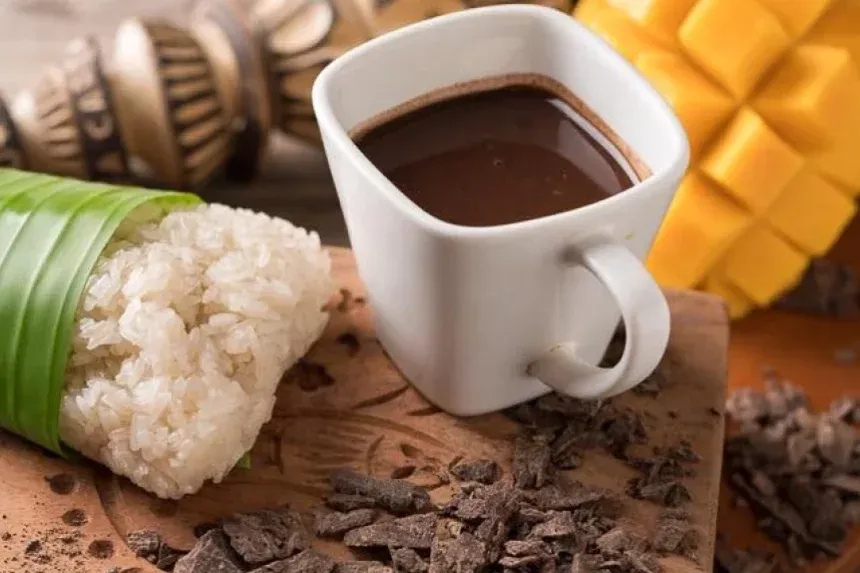
Puto maya with sikwate is the Cebu breakfast: glutinous rice (malagkit) steamed with coconut milk, muscovado sugar, ginger and salt, served warm on a banana leaf with a cup of thick cocoa tablea chocolate. This page has the quantities for 6 servings: 20 minutes of preparation, 50 minutes of cooking and a one-hour soak.
The rice cooks in two stages: steamed until the grains are half open, then stirred into the hot coconut milk, which is what makes it buttery without falling apart. The sikwate is made separately, in five minutes, and served unstrained.
What to know before you start
- Soaking: at least one hour; without it the centre of the grain stays hard.
- The right rice: malagkit or sticky rice; regular white rice will not give the chewy texture.
- Purple tint: a handful of black glutinous rice (pirurutong) mixed into the white rice.
- Calories: about 450 per serving, cup of sikwate included.
For the background —what the dish is, where it comes from and how it differs from suman or champorado— read the article on puto maya and sikwate. Champorado is the same cocoa as a rice dish, and mango sticky rice shares the steamed glutinous rice technique.

Prep
20 min
Cook
50 min
Servings
6
Calories
450 kcal
Ingredients
Directions
-
1
Rinse the glutinous rice, changing the water four or five times until it runs clear, and soak it for at least one hour; drain it well before use.
-
2
If using pirurutong, soak it in the same bowl: mixed with the white rice it gives the greyish-purple tint sold in the markets.
-
3
Line the base and sides of the steamer with banana leaves and spread the drained rice in an even layer.
-
4
Cover and steam for 20 minutes: the grains should be firm outside and still opaque in the centre.
-
5
While the rice steams, warm the coconut milk in a pot with the muscovado sugar, ginger and salt over medium heat, without letting it boil, until the sugar dissolves.
-
6
Tip the half-cooked rice into that pot and cook over low heat for 6 to 8 minutes, stirring with a wooden spoon, until it has absorbed almost all the liquid.
-
7
Transfer the mixture to a mould or basket lined with banana leaf, smooth it with the spoon and cover with another leaf.
-
8
Return it to the steamer for 20 to 25 minutes, covered and undisturbed, until the grains are translucent and tender when bitten.
-
9
Take it off the heat and rest for 10 minutes with the lid on: the rice finishes setting and slices more cleanly.
-
10
For the sikwate, grate or chop the tablea and dissolve it in half a cup of the hot water, stirring into a smooth paste.
-
11
Boil the remaining water with the two tablespoons of sugar, add the cocoa paste and whisk for 4 to 5 minutes, on or off the heat, until it thickens and turns frothy.
-
12
Stir in the evaporated milk if using, whisk for one more minute, and serve unstrained alongside the warm puto maya on a banana leaf, with the mango on the side.
Frequently Asked Questions
How difficult is it to prepare Puto Maya and Sikwate?
This recipe has a easy difficulty level, which means it's accessible for cooks of all levels.
How long does it take to prepare Puto Maya and Sikwate?
The preparation time is 20 minutes and the cooking time is 50 minutes.
How many people does this recipe serve?
This recipe is designed for 6 servings.
Can I substitute some ingredients?
Yes, many ingredients can be substituted with similar alternatives. We recommend checking the recipe variations.
How should I store this preparation?
Store the preparation in the refrigerator for up to 3 days in an airtight container. Some preparations can be frozen for up to 3 months.