Beshbarmak: What It Is, How It Is Eaten and Why It Means Five Fingers
 By
Diego Cortés
By
Diego Cortés
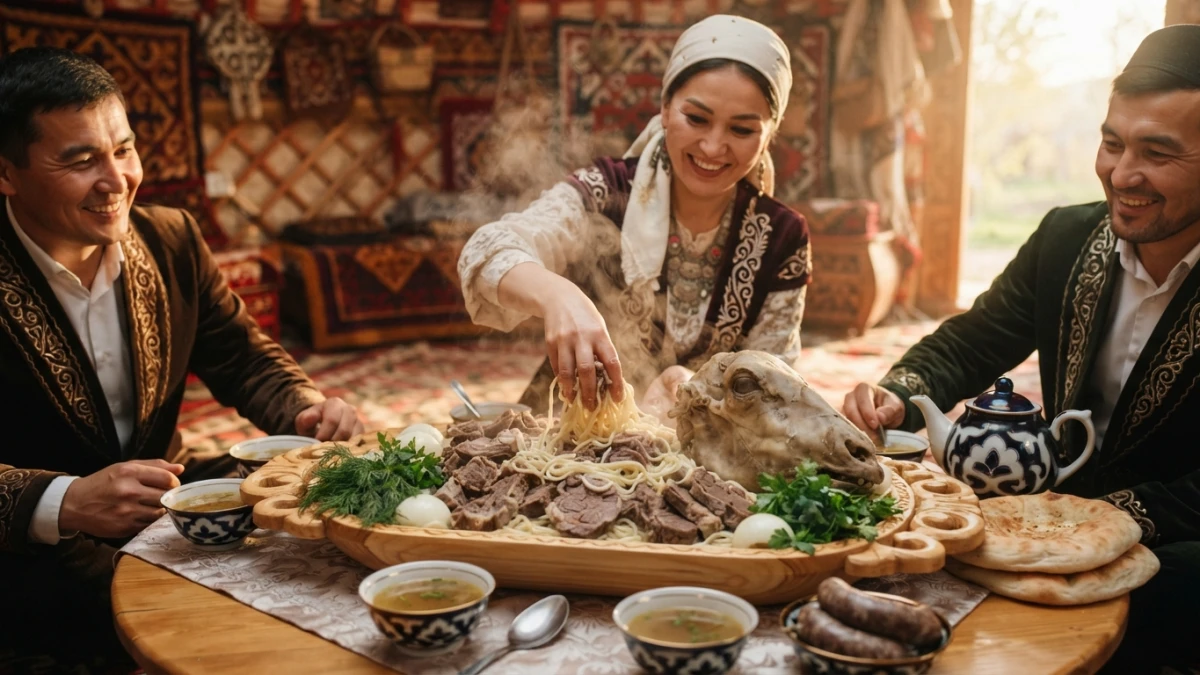
The beshbarmak is the national dish of Kazakhstan and Kyrgyzstan: boiled, shredded meat over squares of thin noodles, topped with onion sauce and served on one shared platter. Its name, which means "five fingers", hints at how it used to be eaten.
What Beshbarmak Is: Boiled Meat, Thin Noodles and Onion in One Platter
The first time someone describes the beshbarmak they usually call it "meat with noodles", and that is not entirely wrong. What sets it apart is how the dish is built and what it stands for: the meat (lamb, beef or horse, depending on the household and the occasion) is boiled until tender, shredded into bite-sized pieces and served over squares of thin dough that were cooked in the same broth. Over the top goes the chyk, an onion sauce made with the meat broth.
It helps to say what it is not, because that is where most people get lost: it is not a stew with gravy, it is not a noodle soup, and it is not dumplings (those would be manti). It is three parts cooked separately and brought together only at serving time: the meat, the noodles and the onion. The broth does not go inside the platter. It is served on its own, before, as a first course.
In this article I go through the whole dish: what it is, what the name means, where it comes from, how it is served and which cut each guest receives, how it is made, the regional variants, how many calories it has and the questions that come up most often. At the end there is the link to the step-by-step version, with quantities.
The Name: Why It Means "Five Fingers"
Beshbarmak comes from the Turkic languages: besh is "five" and barmak is "finger". The name points to the old habit of eating the dish with your hands, taking the meat and the noodles straight from the shared platter. It does not describe the dish, it describes the gesture that went with it.
There is a nuance worth knowing: the name seems to have settled late, mainly through the Russian ethnographic descriptions of the nomadic peoples of Central Asia. In Kyrgyzstan the same dish is also called tuuralgan et, something close to "shredded meat" or "chopped meat".
And today the "five fingers" is almost archaeology: the normal thing is to eat it with cutlery. It is a historical reference to the gesture, not an etiquette rule still in force at the table.
Where It Comes From: Central Asia's Nomads and the Shared Dish
The origin sits in the nomadic cooking of Central Asia, that of the Kazakhs, Kyrgyz and other Turkic peoples. It was a cuisine built around the animals they raised and around wasting nothing: meat, milk, broth and fat. Out of that logic comes a dish of boiled meat plus dough cooked in the same broth. Nothing is thrown away and everything comes out of one pot.
Today it is considered the national dish of Kazakhstan and Kyrgyzstan, and it is made for big occasions: weddings, family celebrations and funerals too. It is not everyday food, and a good part of its symbolic weight lives right there. Central Asian cooking was codified as "national cuisine" during the Soviet era, when reference cookbooks wrote these preparations down.
The regional footprint is the best proof of how widely the recipe is shared: the same dish shows up under other names in neighbouring countries, and those names are listed further down.
How It Is Served: The Ustukan Ritual and Which Cut Each Guest Gets
The beshbarmak reaches the table on a large platter in the middle (the dastarkhan), and people eat from there. The distribution of the ustukan, the cuts on the bone, is the most charged moment of the meal: the host hands them out according to each guest's age, sex and rank, as a gesture of respect. The guest of honour or the eldest receives the head (bash) and shares from there; the oldest man receives the femur (jambash); the older women get the tail bone (kuiruk).
The order of the meal explains why so many people mix the dish up: first comes the shorpo, a lamb broth served in bowls called kese; then the beshbarmak; and at the end a broth with a fermented milk drink to "settle" the stomach. The ritual distribution is table tradition, not a rule anyone has to reproduce at home.
What actually matters to a curious reader is simpler: it is meat, noodles and onion on a shared platter, with one portion per person behind it. The ceremony is the context, not the how-to.
How It Is Made, Told in Prose (the Recipe Is in the Recipe Card)
The method makes sense in three steps. First the meat goes into salted water and boils until it is tender and the broth has taken on flavour. With part of that broth and plenty of onion you make the chyk, the sauce that goes on top. And with the dough (flour, egg, water and salt) you roll out a very thin sheet, cut it into squares and cook them in the same meat broth.
What pulls you in is the reasoning behind each move. The dough rests so the gluten relaxes and rolling it thin is easy. The squares cook in the meat broth so they pick up fat and flavour. And the meat is shredded into small bites instead of being served as one big piece, which is exactly where the alternative name "chopped meat" comes from.
Real details change the result: in warm weather lamb is used, while in winter or on a festive table horse meat and its sausage show up. There are also versions with boiled potato, with carrot or with herbs. If you want the quantities and the steps in order, they are in the beshbarmak recipe with measurements.
Festive Beshbarmak: Horse, Sausage and the Order of the Table
The version a visitor sees in Kazakhstan is the festive one: the beshbarmak is joined by horse sausages (kazy and chuchuk), served on large trays, and the ritual sharing of the cuts takes centre stage. This is the face of the dish at weddings and banquets.
The names change from country to country, with no exact equivalents: naryn in Uzbekistan and Xinjiang, turama in Karakalpakstan and Dagestan, dograma in Turkmenistan, and related names in Bashkortostan and Tatarstan. They all play with the same idea: boiled meat, noodles cooked in the broth and onion.
It is also worth not mixing it up with its banquet neighbours. The manti (steamed dumplings), the plov (rice with meat) and the shelpek (thin fried bread) are relatives from the same table, not the same preparation. They share the logic of Central Asian cooking, but each one is its own dish.
How Many Calories Beshbarmak Has
Better to give the figure as a breakdown than as a fixed number. A standard serving, about 150 g of boiled meat plus a portion of noodles, the onion and some broth, lands around 420-450 kcal. And it climbs easily toward 550-600 when the cut is fatty, the serving is large or horse sausage is added. Nutrition databases usually reference around 420 kcal per serving for lamb beshbarmak with noodles.
The profile, without selling anything: it is a hearty meal, high in protein, with carbs from the noodles and fat from the meat. It barely has fibre, because the onion is the only vegetable. It fills you up, but it is not a light dish or an everyday one: it is winter food, celebration food and shared-table food. You can trim the portion by serving less pasta or choosing leaner cuts, but there is no point dressing it up as a diet dish.
Frequently Asked Questions About Beshbarmak
Do you have to eat it with your hands? No. The name recalls the old custom, but today it is served with cutlery. Does it contain horse meat? It can, in the festive or Kyrgyz version, while the everyday version uses lamb or beef.
The family mix-ups: is it the same as naryn? It is the same dish under another name in Uzbekistan and Xinjiang. Is it a noodle soup? No: the noodles and the meat are served together and the broth (shorpo) is a separate first course.
To close: the beshbarmak is the national dish of Kazakhstan and Kyrgyzstan, a shared platter of boiled meat and thin noodles with onion sauce, and its recipe with measurements is in the recipe card linked above.