Lamb al palo: What Patagonia's Cross-Roasted Lamb Is and How It Is Cooked
 By
Diego Cortés
By
Diego Cortés
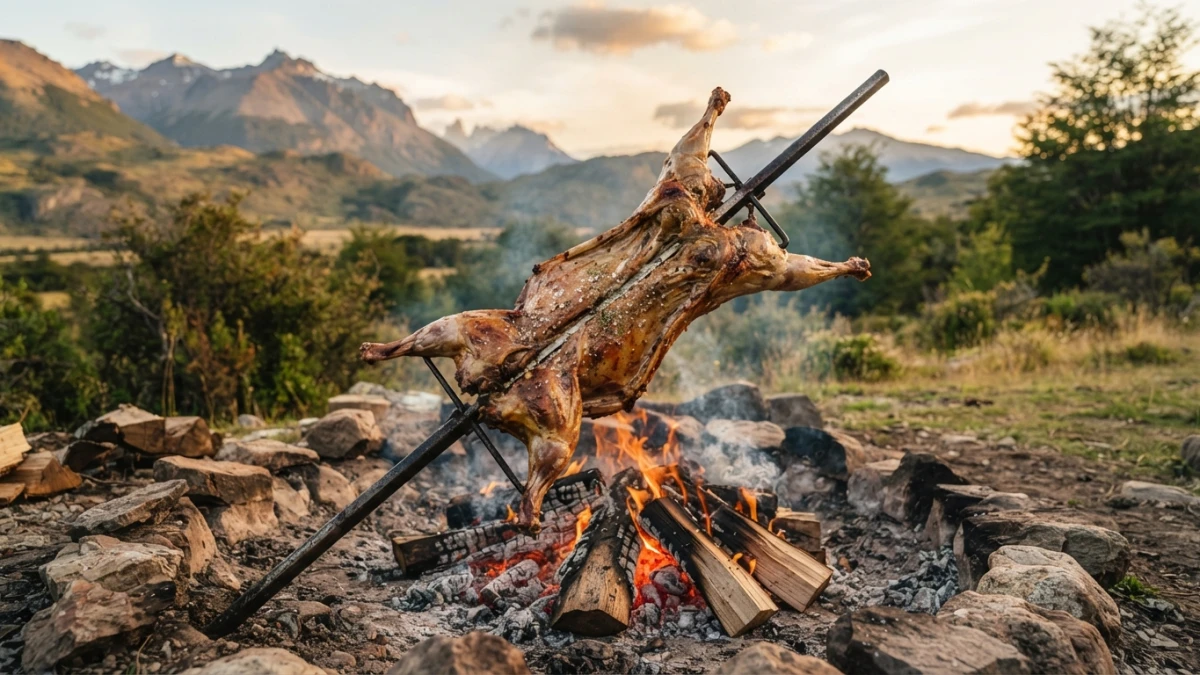
Cordero al palo is a whole lamb skewered on a pole or an iron cross and roasted slowly in front of the embers until the skin is golden and the meat pulls away from the bone. It is Patagonia's most recognizable roast, the dish that gathers people around the fire.
What cordero al palo is: a whole lamb roasting slowly in front of the fire
In Chile people mostly say cordero al palo; in Argentina you hear "al asador" or "a la cruz", and in some areas "a la estaca". They are variations of the same method: the animal impaled on a pole or an iron cross and set facing the embers. They are not four different dishes, but four names for the same slow cooking.
The difference from an ordinary grill is size and time: here a whole or half lamb goes on, split open and tied to a frame, and it cooks by radiation. The heat comes from a fire set to the side, and the tilt of the pole controls its intensity.
Here I cover what it is, where it comes from, how it is prepared told in prose, what seasoning it takes, how it is served, how it differs from oven and grill, and how many calories it has.
Where it comes from: the Patagonian estancias and the roast that is shared
The dish was born from the sheep ranching of Patagonia, the stretch shared by Magallanes and Tierra del Fuego in Chile and Santa Cruz on the Argentine side. Lamb was the animal of that land, and cross-roasted lamb appeared as the practical way to cook a whole animal for many people, with local firewood and no tool beyond a pole. The custom is tied to the large estancias and to field work.
It survives for the same reason it appeared: it is a celebration dish. Traditional festivals, local anniversaries and family gatherings revolve around the fire, and the cook carves in front of the guests. In southern Chile it is also made in rural versions, at lakeside cookouts and in communities where the wait by the embers is part of the experience.
Beyond Chile and Argentina, Patagonian cooking became known around this dish, and some international food guides have placed it among the best lamb dishes in the world. I mention it as recognition, not as advertising: what sustains the tradition is the custom.
How it is prepared, told in prose (the recipe with amounts is in the card)
The setup comes down to three gestures. First the pole, or the cross, is driven into the ground and tilted toward the hearth. Then the lamb is tied to the frame, split open with its legs locked so it holds firm. Finally the fire is lit to one side, with hardwood, and you wait until it turns to embers: no flame should touch the meat.
What hooks people is the mechanism. Heat arrives by radiation, and the tilt of the pole controls the intensity: closer to the fire means more heat and faster browning. The lamb has to be turned every so often so it cooks evenly, and as it turns the fat drips down and bastes the meat. Total time runs about four to six hours depending on the size of the animal, and the sign that it is ready is the usual one: crisp skin and meat that falls off the bone.
If you want the measured amounts and the ordered steps, they are in the lamb al palo recipe with amounts and times. This article deliberately does not repeat them.
The seasoning: little, salt and fire (and why it works)
The Patagonian logic is simple: local lamb already has flavor of its own, so the seasoning is minimal. Traditionally it is coarse salt and, in many homes, a brine of warm water with salt and garlic used to wet the skin while it roasts.
In Chile you do see heavier variations: garlic, merkén, oregano and a little oil, sometimes with a splash of vinegar, to build a crust. In Argentina the strong seasoning usually arrives at the end, at the table, with chimichurri and salsa criolla.
The mistake that ruins the roast is loading with spices a meat that does not need them and brushing on oil or marinade from the start, because it burns before the meat is cooked. Less is more, and the wood smoke does the rest.
How it is served: pebre, pan amasado and a table that fills up
The lamb comes off the pole and is carved right away on a board, by cuts: rib, shoulder, leg and loin. It is passed around hot while people sit down, so this is long-table food rather than a plated and finished dish.
The Chilean sides are part of the ritual:
- Fresh Chilean pebre, to cut the fat with a little heat and onion.
- Just-baked pan amasado, made for dipping in the juices.
- Boiled or roasted potatoes and a fresh tomato and onion salad.
- To drink, red wine or chicha depending on the occasion.
Across the Andes the table changes: chimichurri, salsa criolla and a mixed salad too. The dish is the same, only the company changes. If you are drawn to another slow lamb cooking, the lamb tagine is a good contrast: same animal, another technique.
Cordero al palo, grill or oven: what changes
Each method comes down to one idea. On the pole the whole animal cooks by radiation for hours, and the result has smoke and crisp skin. On the grill cuts or a rack cook in one to two hours over direct heat. In the oven the temperature is controlled and the smoke is lost, but you gain convenience for small groups.
How to choose: the pole asks for space, firewood and patience, and it is for eight to twenty people and a full afternoon. A rack on the grill is the realistic option for four to six. The oven is the home route when there is no yard and no embers. What does not change is the foundation: little seasoning and gentle heat; the difference is in the smoke and in how the fat renders.
How many calories cordero al palo has
It is worth giving the figure as a breakdown and a range, not a single number. One hundred grams of roast lamb provides around 250 to 315 kcal depending on the cut: the rib and the chop sit at the high end, with about 25 grams of protein per 100 grams and much of the calories coming from fat. A normal 200-gram serving of meat lands around 500 to 630 kcal, without the sides.
The profile is protein and fat, with practically no carbohydrates of its own. It is very filling and it is a celebration dish, not a diet one. The golden skin and the fat that bastes the meat during the roast are exactly what raises the count.
To lighten it, remove the visible fat and the skin, serve more salad and pebre and adjust the portion. To compare with other classics, I have a chart of Chilean food calories per serving.
Frequently asked questions about cordero al palo
Is it the same as lamb on a spit or on a cross? Yes: the name changes by country and household, not the method. Is it the same as a curanto? No: curanto is earth-oven cooking with hot stones, native to Chiloé, while cordero al palo is roasted in the open air, facing the fire.
Can you make it without a pole? Yes, with adaptations such as a rack on the grill or in the oven for small groups, though you do not quite replicate the smoke or the skin. How long does it take? Between four and six hours, and it is not worth rushing it by raising the fire. Suckling lamb or a larger animal? Suckling lamb is more tender and mild, and older lamb has a more intense flavor; in Patagonia the local lamb is used.
In short: cordero al palo is Patagonia's whole-lamb roast, cooked slowly in front of the embers with very little seasoning. And if you came for the recipe with amounts, you found it above in the house card.