How to Tell If Eggs Are Fresh: 5 Tests, Storage Times and Tips
 By
Diego Cortés
By
Diego Cortés
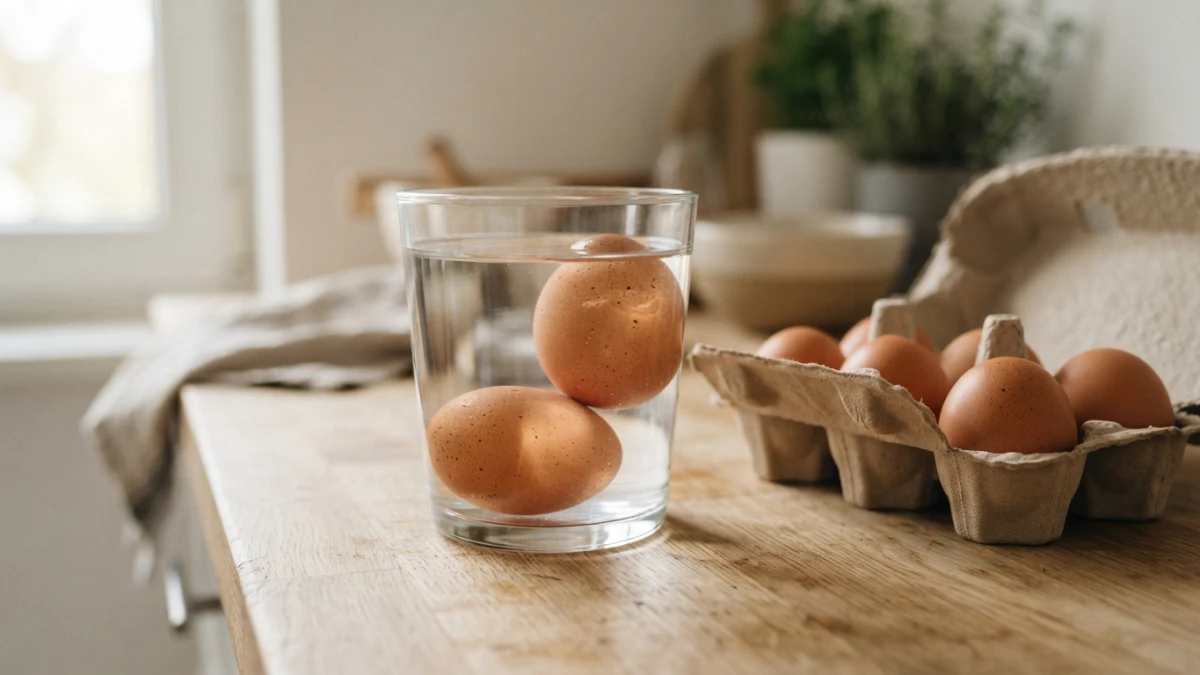
How to tell if eggs are fresh is a question you answer in the kitchen, not on the carton: an egg can be old and perfectly safe, or look flawless and carry Salmonella. Here are the five tests that actually work, the real storage times and what to do so nothing catches you out.
The date printed on the carton is a quality reference, not a safety guarantee, and steady refrigeration plus thorough cooking are the two things that really protect you. Everything else only helps you estimate age, which is a different story.
Why an egg changes over time (and what the air cell is)
The shell is not an airtight seal: it is porous and covered by a natural protective layer, the cuticle (or bloom), which slows bacteria coming in and moisture going out. Over the days the egg loses water and carbon dioxide through those pores: the white gets runnier, it pulls away from the shell and the empty space at the blunt end, the air cell, grows. That is the egg's real clock and the reason an old one floats in a glass of water.
It helps to separate age from safety. Age is about quality on the plate: the white thins, the yolk flattens and the inner membrane weakens. Safety depends on cold and heat, meaning the cold chain never breaks and the egg is cooked until white and yolk are firm. A well-refrigerated three-week-old egg can be safer than a freshly laid one that spent the afternoon in the sun.
How to tell if eggs are fresh: the 5 tests that work
No home test replaces refrigeration or thorough cooking, so the sensible approach is to combine them, from the most reliable to the most indicative.
1. Smell, the most reliable signal
A fresh egg barely smells of anything. If cracking it releases a strong, sulfurous or rotten smell, throw it out without arguing: it is the clearest sign that something is wrong.
2. The plate test
Crack the egg into a separate bowl, never straight into the batter or the pan. A thick white surrounding a high, firm yolk means fresh; a runny white spreading out with a flat yolk means an old egg, perfect for omelettes or baking, but not for frying.
3. The glass of water test
A very fresh egg sinks and lies flat on the bottom; one that is one or two weeks old also sinks but stands up or tilts; the one that stands on its tip or floats outright has an enlarged air cell. Beware the myth: according to the USDA-FSIS, floating indicates poor quality, not an unsafe egg.
4. Candle it with a flashlight
In a dim room with a flashlight right against the shell (the technique the industry calls candling), a fresh egg looks almost uniform, with the yolk barely visible and a small air cell; an old one shows scattered shadows and a large air cell.
5. The shake test
If shaking it sounds like liquid sloshing around, the air cell is large and the egg has some days on it. It is indicative, but with the egg held to your ear you will notice.
A bonus so you never mix up raw and cooked eggs: set the egg on the table and spin it. A hard-boiled egg spins fast and evenly; a raw one wobbles, because the liquid inside slows the motion. It pairs well with this guide to exact boiling times for eggs.
How long eggs last: fridge, room temperature and hard-boiled
In the refrigerator, at 4 °C (40 °F) or below, raw shell eggs keep well for 3 to 5 weeks from the day they reach your home, according to the USDA-FSIS. The carton date is about quality and commercial control, so a properly refrigerated egg can still be safe after that date.
| Egg format | Where it is stored | Indicative shelf life |
|---|---|---|
| Raw, in the shell | Refrigerated at 4 °C or below | 3 to 5 weeks |
| Raw, in the shell | Cool, dry spot, unwashed | Days to a few weeks if the cuticle is intact; never more than 2 hours in heat |
| Hard-boiled, in the shell | Refrigerated | Up to 1 week |
| Separated whites and yolks | Refrigerated and covered | 2 to 4 days |
| Cooked egg (leftovers) | Refrigerated | 3 to 4 days |
| Beaten, out of the shell | Freezer | Up to 12 months at best quality |
Outside the fridge the answer depends on the country. In Chile and Spain eggs are sold unwashed, so the cuticle stays intact and they hold up at room temperature in a cool, steady place, which is the norm in small shops and markets. In summer heat that window gets shorter. The fridge extends shelf life and is the safer option: store eggs within 2 hours of buying them, and within 1 hour if it is above 32 °C.
How to store them so they last longer: 3 simple rules
Do not wash them before storing
Water strips the cuticle and leaves the shell bare and more permeable to bacteria. If an egg is dirty, wipe it with a dry cloth and use it first; if you still want to wash it, do it right before cooking.
In the carton, on a shelf inside the fridge
Leave them in the original carton, on a shelf or in a drawer, never in the door, which is the zone that swings the most every time it opens. Store them in a single layer, pointed end down and away from strongly scented foods, because the porous shell absorbs odors. To fine-tune the spot, there is this fridge zone and temperature map.
Check, rotate and use the oldest first
A useful kitchen trick: eggs that are 7 to 10 days old peel much better when hard-boiled, because the inner membrane has already loosened a little; very fresh eggs stick to the shell. In summer or with no fridge available, use them fast and be wary of any that spent hours in the sun. And if you like steaming them, the step by step is in how to steam eggs easily.
Freezing eggs: what you can and cannot do
Never freeze an egg inside its shell: the liquid expands as it freezes and cracks it, and the USDA-FSIS advises against it explicitly. Out of the shell it is perfectly fine: beat yolks and whites together, or separate them, and keep the mix in a sealed container labeled with a name and date. It holds up to 12 months at best quality, and yolks benefit from a pinch of salt or sugar so they do not turn gummy. Always thaw in the fridge and use frozen egg in preparations that get cooked: omelettes, cakes, scrambled eggs. The texture changes, so it will not work for soft-boiled eggs or frying.
Safety: what really matters with Salmonella
Eggs can carry Salmonella and cold is the most important barrier: do not leave eggs or egg dishes at room temperature for more than 2 hours, and discard any that are cracked, broken or visibly dirty.
Cook until both white and yolk are firm: dishes with egg need to reach 71 °C (160 °F) in the center to kill germs. Wash your hands, cutting board and fork after they touch raw egg, and keep raw egg from dripping onto ready-to-eat food. Higher-risk groups (pregnant women, young children, older adults and immunocompromised people) should avoid raw or undercooked egg: homemade mayonnaise, mousse, uncooked meringue and raw-egg batters. If that hits close to home, the egg in older adults has specific recommendations.
Fresh or old egg: which one suits each dish
- For frying, poaching, soft-boiled eggs and omelettes: use the freshest ones, because the thick white holds around the yolk and the result looks neat. A Spanish potato tortilla made with same-day eggs holds together far better.
- For hard-boiled and deviled eggs: the 7 to 10 day old ones peel without a fight; a freshly laid egg peels badly even though the flavor is identical.
- For baking and sauces: anything that passes the plate test works, but always crack it into a separate bowl so one bad egg does not ruin the whole batter.
- At the supermarket: clean, uncracked shells, cartons with the furthest date and straight into the fridge at home, unwashed.
And if the nutritional side of the ingredient interests you, these reasons why eggs are a healthy superfood round out everything above.
The tip that sums it all up
If you take away a single rule, make it this one: a fresh egg barely smells, gets cracked into a separate bowl and is stored unwashed, in its carton, on a shelf inside the fridge. And when in doubt, the answer is not in the glass of water but in the calendar and the thermometer: what matters for safety is steady refrigeration and cooking until white and yolk are firm.