How to Store Cheese: Methods, Times and Mistakes by Type
 By
Diego Cortés
By
Diego Cortés
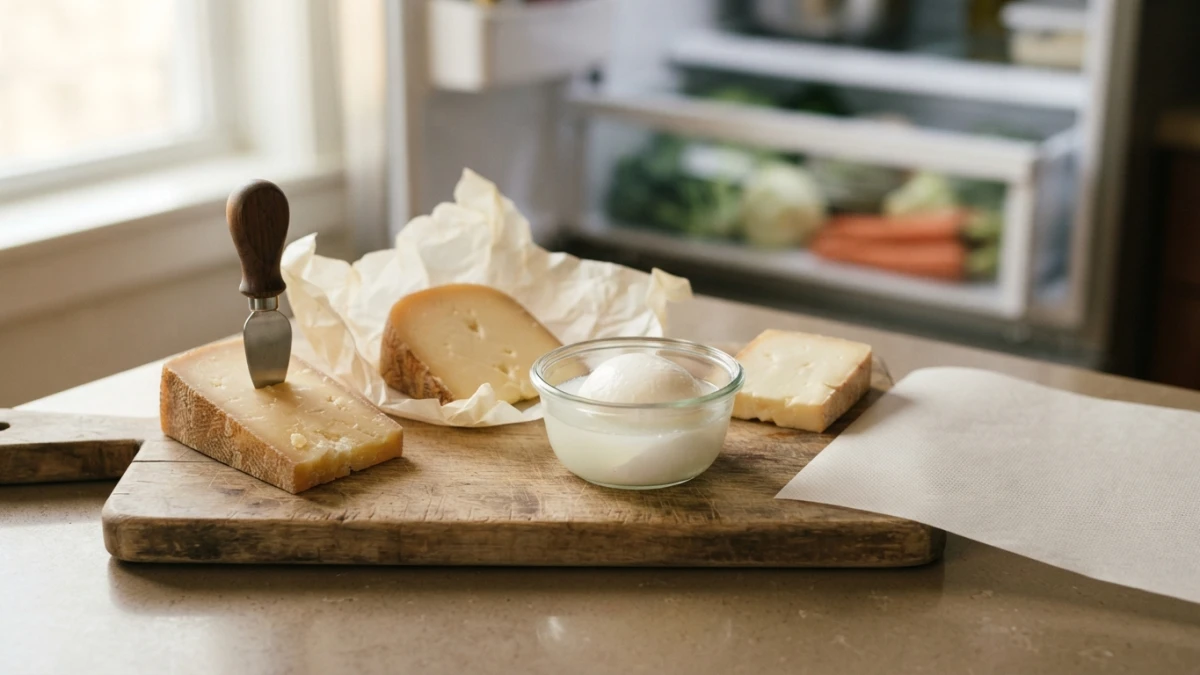
How to store cheese depends on the wrapper more than on the fridge: plastic wrap seals in the moisture the piece sweats out and mold shows up within days. Here is the right method for each type, the real fridge times and when a piece can still be saved.
Why cheese spoils so fast (and why plastic wrap speeds it up)
Cheese is a living food: fat, protein and water, the perfect broth for molds and bacteria. And molds are stubborn. They tolerate salt and sugar better than almost any other food invader and they also grow at refrigerator temperature, so the fridge does not stop them, it only slows them down.
The number one mistake at home is wrapping cheese in plastic film. Plastic seals in the moisture the cheese itself gives off, the surface stays damp and sticky, and mold shows up far sooner than on a piece that can breathe.
The other extreme is no better: leaving it uncovered dries it out and forms a crust, and since fat absorbs odors it ends up tasting like whatever sat next to it in the fridge. Not suffocated, not naked: ventilated.
The rule that explains everything: the less water, the longer it keeps
There is no single storage time because there is no single cheese. Water content is what rules: a cured, dry, compact cheese makes life hard for bacteria and molds, while a fresh, moist, barely ripened one is easy prey.
That is why a cured cheese lasts weeks or months and a fresh one is measured in days. It is the same logic as butter or bread: moisture and exposed surface are what decide.
And there is a label difference worth gold. Cured and semi-cured cheeses usually carry a best-before date, which is about quality, while fresh cheese and ricotta carry a use-by date, which is about safety and must be respected.
How to store cheese by type: the right wrapper
Hard and cured cheeses (parmesan, aged manchego, gruyère, aged gouda, farmhouse cheese) and semi-hard ones (gouda, emmental, mantecoso, chanco): wax paper or cheese paper, never plastic stuck to the surface, inside a container that does not close all the way, in a cold, steady spot. Change the paper every time you cut a portion and, if the rind has dried out, rub it with a few drops of olive oil.
Soft-ripened cheeses (brie, camembert): wax paper, because the rind needs to breathe and plastic kills it. Watch one detail that is easy to forget: they keep ripening inside the fridge, so it is best to eat them within the first week.
One mental rule that works for everything: wrap it in something that lets it breathe out and store it in a container that is not airtight. That way cheese neither suffocates nor dries out.
Fresh and blue cheeses: the two cases that store differently
Fresh cheeses (queso fresco, mozzarella, burrata, ricotta, feta): in their own whey or brine, in a closed container, pouring off the liquid that collects. Eat them soon and keep in mind that burrata is the most fragile of all: it is gone in one or two days.
This family is the most delicate because of its moisture and lack of ripening. Soft cheeses get contaminated more easily than hard ones, which is why queso fresco and brie appear in listeriosis outbreaks. Pregnant women, adults 65 and older and immunocompromised people are the highest-risk groups: they should choose pasteurized versions or avoid these cheeses.
Blue cheeses (roquefort, gorgonzola, cabrales): wrapped in foil and always kept apart from the rest, so they do not spread their spores around the fridge. Their blue-green mold is the good kind; if pink, black or yellow mold that was not there before shows up, the piece is discarded.
Where to put it in the fridge (and why the door is the worst spot)
The door is the worst possible zone: every time you open it the temperature changes and the cheese suffers. The front of the shelves has the same problem. If you want the full zone and temperature map, it is in how to organize your fridge.
The steady place is the drawer: the cheese drawer if your fridge has one, and if not, the vegetable drawer, which is designed precisely to buffer changes in humidity and temperature.
Temperature: 4 °C (40 °F) or below for everything perishable, the FDA recommendation. Fresh cheeses need the coldest range and soft ones the mildest, so each family has its best corner.
And one serving detail that changes the experience: take the cheese out of the fridge 20-30 minutes before eating it, and up to 30-45 minutes for a soft one. Served too cold, aroma and texture do not come through and even a good cured cheese tastes flat.
How long cheese lasts: fridge and freezer times
These are the official USDA references (FoodKeeper and FSIS) plus the practical ranges by type of piece:
| Type of cheese | In the fridge | In the freezer |
|---|---|---|
| Hard block, unopened | 6 months | Up to 6 months, best grated |
| Hard block, opened | 3-4 weeks | Up to 6 months, best grated |
| Grated hard cheese | 1 month | Up to 6 months |
| Soft cheese | 1 week | Not recommended |
| Cream cheese | 2 weeks | Does not freeze well |
| Very dry cured (parmesan) | 4-6 weeks | Up to 6 months |
| Semi-cured | 2-3 weeks | Up to 6 months |
| Creamy (brie, camembert) | 1-2 weeks | Not recommended |
| Fresh cheese or ricotta | 3-5 days | Does not freeze well |
Anything sliced, grated or shredded has more exposed surface than a block, so its quality drops sooner even if the official time is longer. And if you want to compare with the rest of the pantry, how to store food in the pantry covers the dry goods.
Mold on cheese: when to trim it and when to toss it
The USDA rule for hard and semi-hard cheeses (cheddar, gouda, parmesan, manchego) is to cut at least 1 inch (2.5 cm) around and below the mold, without letting the knife touch the fuzzy part. If the knife touches it, you spread spores through the rest of the piece. Then rewrap it in clean paper and put it back in the fridge.
Any soft, fresh, grated, sliced or crumbled cheese with visible mold is thrown out whole: its moisture and structure let mold roots travel far beyond what you can see on the surface.
Signs that mean discard, no debate:
- A slimy or sticky surface.
- Cracks with fuzz in them.
- A strong ammonia or rancid smell.
- A bitter or oddly sharp taste.
- On fresh cheeses, cloudy liquid with bubbles.
How to freeze cheese without ruining it
Yes, it can be done, with caveats. Hard and semi-hard cheeses hold up well for about 6 months, especially grated. Ice breaks the structure and the piece turns crumbly, something you notice on a cheese board but not in a sauce, pizza or gratin. Ricotta, cream cheese and fresh cheese do not freeze well.
Freeze in single-use portions, wrapped tightly with no air, labeled with name and date. Always thaw in the fridge and use frozen cheese for cooking, not for serving on a board.
If you want to put that grated cheese to work, this broccoli cream with blue cheese and this cheese and egg sauce with kachkeis are two good destinations, and for a simple starter there is this fresh cheese appetizer.
The tip that sums it all up
If you take away one idea, make it this one: wax paper, a container that does not close all the way, and the fridge drawer. Cheese needs to breathe without drying out, and that combination buys it weeks instead of days. The second idea is just as useful: mold is trimmed 2.5 cm around only on hard cheeses; on a soft or grated cheese, toss the whole thing without a second thought.