Sarmale: Romanian Cabbage Rolls With Fermented Cabbage
 By
Diego Cortés
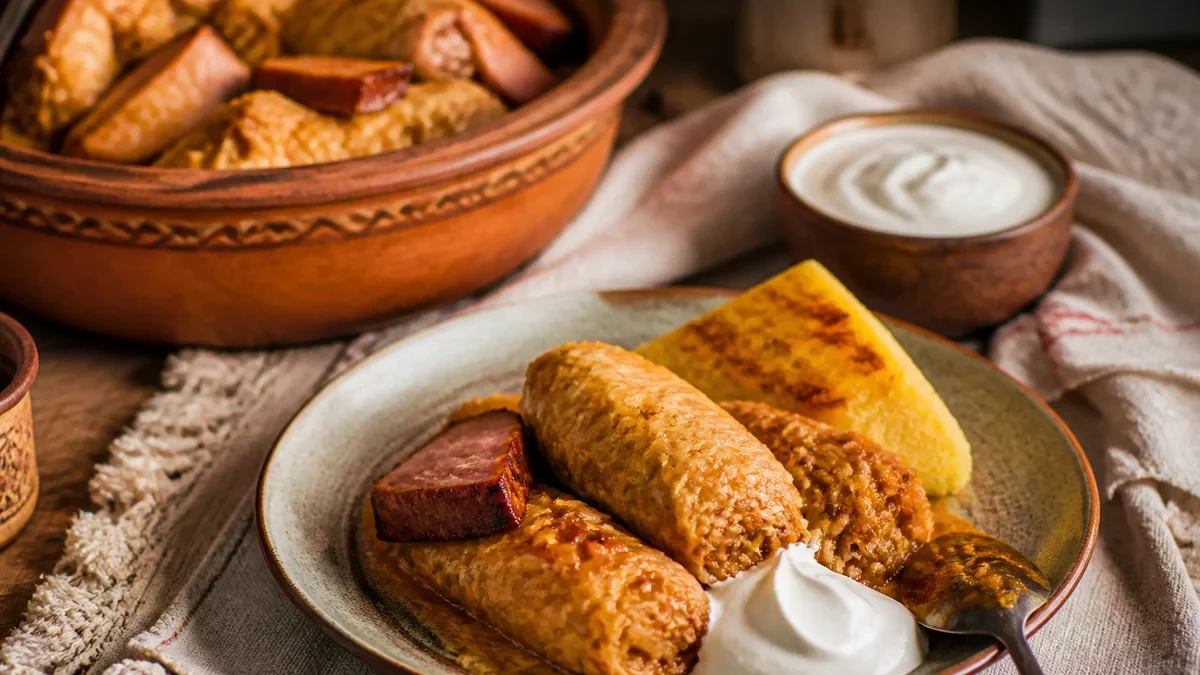
Sarmale are the cabbage rolls that Romanians simmer for hours in a pot, and what makes them unmistakable is not the filling: it is the leaf.
They are wrapped in fermented cabbage, not blanched cabbage, and that is where a sourness comes from that no splash of vinegar can copy. When they turn out bland, watery or tasting of plain boiled cabbage, the leaf was fresh.
What sarmale are: fermented leaf, meat and rice
The Romanian word is sarma in the singular and sarmale in the plural, with the diminutive sărmăluțe for the small ones. They are not a side dish: they are the main course of any meal that gathers more than six people.
A fermented cabbage leaf wraps a mixture of minced pork, raw rice, onion, salt, pepper and some thyme or paprika. The rice soaks up the juices and holds the mixture together: too much and the roll turns mushy, too little and the filling falls apart in the pot. Between layers go pieces of afumătură, Romanian smoked pork (bacon, rib, sometimes a whole smoked sausage), which is what gives the smoky base. The liquid is not water alone: it carries tomato and, in many homes, a little borș, the sour fermented bran liquid.
Size changes the result. Fist-sized rolls need three hours in the pot; small ones cook faster and turn silkier, because there is more leaf for every spoonful of filling.
Where they come from: the Ottoman sarma that stayed in the Balkans
Sarma comes from Turkish and means "wrapped", while dolma means "stuffed": two related techniques of Ottoman cooking, which in turn took up an older tradition of stuffed vine leaves in Persia. From there the recipe spread through the Balkans, the Caucasus and Eastern Europe, and every kitchen changed the leaf, the filling and the sauce.
In Romania the change came from the pantry, not from fashion. The long winter forced families to preserve cabbage in brine from October, and that fermented cabbage was what there was from November to March. Wrapping meat in that leaf was not an aesthetic choice: it was what was available. In summer, in Moldavia and parts of Transylvania, people make sarmale în foi de viță with vine leaves, while the cabbage is not yet in brine.
Fermented cabbage: the step that changes everything
Varză murată is made with whole white cabbages submerged in brine at 2 to 3 % salt. The lactic acid bacteria already living on the leaf do the work: first those of the genus Leuconostoc, then Lactobacillus plantarum. Sugars turn into lactic acid, pH drops below 4.5 and the result keeps for months on its own.
For the cook, two visible changes matter. The leaf becomes translucent and flexible, rolls without tearing, and needs no blanching or stalk trimming. And it already arrives salty and sour, so the filling is salted less than you would expect and no lemon is needed. If it is very salty, rinse the leaves briefly, at the cost of losing some acidity.
When there is no fermented cabbage, the honest route is to boil a fresh cabbage and acidulate the broth with tomato, a little vinegar or sauerkraut juice. That is how the site's sarmale recipe does it, and it works, though the flavour comes out cleaner and shallower: fermentation adds nuances no loose acid reproduces. To see the same principle with another vegetable there is the German-style fermented red cabbage, and the article on the benefits of cabbage for what it gains and loses when fermented.
How they are cooked: layers, smoke and two hours in the pot
Order matters more than the recipe. The bottom of a large pot gets a bed of cabbage leaves so the rolls do not stick. On top, the rolls packed side by side in layers, with the smoked meat between layers. Cover with liquid, add bay leaf, peppercorns and thyme, and set over low heat. From then on you do not stir: you shake the pot by its handles and add hot water if the level drops.
Two to three hours at the lowest heat, or the same time in an oven at 160 °C, is normal for a medium roll. In a pressure cooker 45 to 60 minutes is enough, though the leaf ends up less silky. The sign that they are ready is not the clock: the leaf cuts with the edge of a spoon and the rice is cooked through, with no hard grain in the centre.
The four mistakes that ruin a batch are always the same: overfilling and packing too tight, which leaves the roll hard; too little liquid, which burns the bottom; high heat, which tears the leaves before the rice is done; and fresh cabbage without blanching, which falls apart and brings no acidity. One detail almost nobody mentions: they are better the next day, when leaf and filling settle and the broth rounds out.
On the table: mămăligă, smântână and mujdei
The classic companion is mămăligă, the Romanian cornmeal polenta, served soft beside the roll rather than underneath. On top goes smântână, sour cream, and on the side a mujdei of garlic with oil and salt. Many tables add a pickled chilli and bread to mop the broth. To make the polenta at home there is the mămăligă recipe and the guide on how to cook polenta.
In Romania they are the dish of the big dates: Christmas, New Year, Easter, baptisms and funerals too, because they can be ready for a crowd. A normal serving is three to five rolls per person, two if there are starters. The broth left over becomes soup the next day, with polenta or noodles.
Sarmale, gołąbki, holubtsi and dolma: the table that separates them
| Kitchen | Leaf | Filling | Cooking |
|---|---|---|---|
| Sarmale (Romania) | Fermented cabbage | Pork, rice, onion | Pot, 2 to 3 hours, with smoked meat |
| Sarma (Serbia, Bulgaria, Turkey) | Fermented cabbage | Rice and meat, sometimes rice only | Pot or oven, with smoked ribs |
| Gołąbki (Poland) | Blanched fresh cabbage | Pork and rice | Oven, with tomato sauce |
| Holubtsi (Ukraine) | Fresh cabbage or sauerkraut | Rice or buckwheat | Oven, with tomato or cream |
| Lahanodolmades (Greece) | Fresh cabbage or vine leaves | Rice and herbs | Pot, with egg and lemon sauce |
| Dolma (Turkey, Levant) | Vine leaves | Rice, pine nuts, raisins | Olive oil, served cold |
The table shows what really sets sarmale apart: the fermented leaf and the smoked base. A gołąbki is a tender cabbage roll with tomato, sweeter and softer, and the site has its own version of stuffed cabbage leaves without fermentation, useful for comparing the two techniques up close.
How many calories they have and how to lighten them
A reasonable estimate for a cooked roll is 160 to 190 kcal per 100 g. A medium roll weighs about 50 to 60 g, so four or five with a spoonful of sour cream land between 500 and 650 kcal. The count rises with fatty pork, smoked meat and cream.
Three adjustments lighten the dish without changing it: half lean pork and half chicken or turkey, keeping some fat so the filling does not dry out; smoke from smoked paprika instead of bacon; and plain Greek yoghurt instead of sour cream. What you should not ignore is salt: fermented cabbage is already salty and the broth concentrates it, so anyone watching sodium can rinse the leaves and taste the broth before adding salt.
Frequently asked questions about sarmale
How long do they cook?
Two to three hours over low heat, in a covered pot with the rolls always under liquid. In a pressure cooker, 45 to 60 minutes. The real test is that the leaf cuts with a spoon.
Can they be frozen?
Yes, for up to three months, cooked and with a little of their broth. Thaw in the fridge and reheat over low heat; in a high-power microwave the leaf toughens.
What cabbage do I use if I cannot find fermented?
Fresh white cabbage, blanched for two or three minutes so the leaves separate without tearing, and a broth acidulated with tomato, vinegar or sauerkraut juice.
Do they have rice or only meat?
They have rice, about a third of the filling by volume. Meat-only versions exist in the Balkans, but in Romania rice is part of the definition.
Can they be made without pork?
Yes, with beef or chicken, and also as a vegetarian version with rice, mushrooms and onion. What cannot be removed without changing the dish is the smoked element.