Shelpek: The Central Asian Flatbread and How to Make It
 By
Diego Cortés
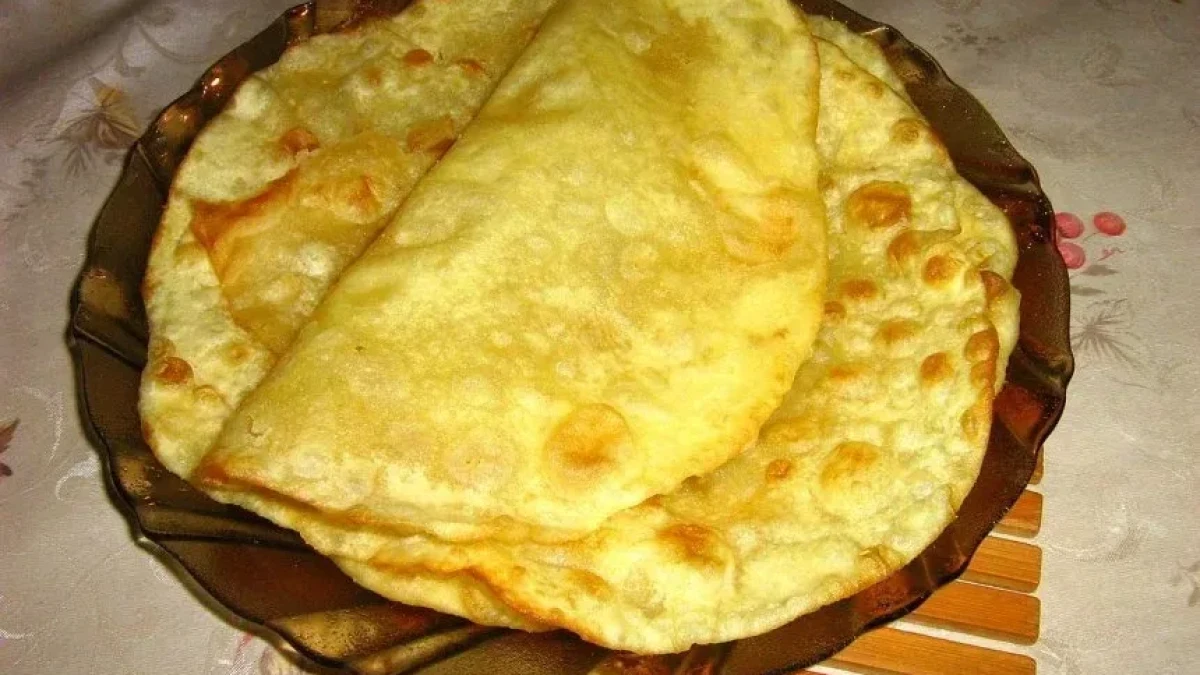
Shelpek is not a börek and it is not a baked bread: it is a thin round of dough cooked in a pan for about a minute per side, and in Kazakhstan it is fried in sevens. It is a Central Asian flatbread, soft and blistered, eaten hot and folded by hand.
What shelpek is (and why it is not a börek)
Shelpek is a thin, round flatbread rolled with a pin and fried in oil. The dough is simple: wheat flour with milk or water and salt; depending on the household, also sugar, baking soda, butter or thick sour cream, the kaymak of many kitchens in the region. The result is a tender bread with bubbles and golden spots. Exact amounts and steps live in the shelpek recipe: this article tells the story of the dish, not the cooking.
The most common mistake in English is to call it a börek or to treat it as baked bread. A börek is stretched, layered dough with a filling inside; shelpek has nothing inside and is cooked in a pan. Its texture comes from hot oil and seconds of cooking, not from a 220 degree oven.
At the table it is easy to spot: discs 20 to 25 centimetres across, very thin, stacked and covered with a cloth so they do not dry out.
Where it comes from: Central Asia, wheat and the Turkic peoples
The map of shelpek is the map of the Turkic kitchens: it is everyday bread in Kazakhstan and Kyrgyzstan and it appears under the same or a similar name in Uzbekistan, Turkmenistan and among the Uyghurs. Sources link it to the peoples of the steppe and to the arrival of wheat flour in a cuisine that had been mostly meat and milk.
The names: in Kazakh, shelpek; in Turkmen, çelpek; in Uzbek, chalpak; in Uyghur, chalpyak; in Kyrgyz, chelpek or may tokoch, which translates as butter bread.
No invention year and no single owner country can be claimed. The honest description is a family of fried breads from the steppe that shares technique with baursak and qattama. In some areas the word also names the boiled dough served with beshbarmak: that is regional usage, not the definition.
The seven breads: why shelpek is fried in sevens
The tradition behind the dish is the number. In Kazakhstan people fry seven shelpeks, a practice called zheti nan, and each bread is tied to one ancestor of the family. The traditional belief says the smell of the frying bread feeds the spirits of the relatives, the aruakhs; it is told as a belief, not as a fact.
The day has nuance: some sources place it on Thursday, others on Friday. What is constant is the seven and the gesture of sharing the bread with neighbours or with people in need. Sources describe it as a practice older than Islam in the region, and today it lives alongside it.
Beyond the ritual, it is breakfast and tea bread, and it shows up at gatherings and remembrance meals. It is not a restaurant dish: it is home bread.
What goes into the dough (and what changes from house to house)
As a reference, a batch of six or seven breads takes about 300 g of flour, 180 ml of milk or water, a tablespoon of oil, a teaspoon of sugar, half a teaspoon of baking soda and a pinch of salt. It is a soft, not elastic, dough: worked briefly and left to rest. To choose flour without guessing there is the guide to types of flour and their uses.
Variations that really exist: with kaymak and butter in the dough, which makes it more tender; with yeast, which keeps it soft for longer; and mai shelpek, heavy on butter and thicker.
The critical point is thickness: one to two millimetres gives a crisp bread that hardens as it cools; two to three gives the soft shelpek that folds. If the dough shrinks while rolling, rest it ten more minutes instead of forcing it.
How it is made, in order
First you mix and rest: sift the flour with the baking soda, dissolve salt and sugar in warm milk, knead about five minutes until the dough stops sticking and leave it covered between ten and thirty minutes. Without that rest the gluten does not relax and the discs shrink.
Then you roll and fry: balls of dough, seven for the traditional version, thin discs on a floured surface with the rest kept covered. Pan with one centimetre of hot oil and about a minute per side, until bubbles and golden spots appear. Too dark means hard bread once cold.
Finally you drain on paper and stack them covered with a cloth: the steam between them is what keeps them soft. Serve warm.
How it is eaten: tea, butter, honey or broth
The classic pairing is milk tea with the bread spread with butter, honey, jam or kaymak; fresh cheese works too. In Kazakhstan and Kyrgyzstan it is breakfast and tea-time food, not a luxury side.
Savoury works just as well: table bread for dipping in meat broth, for stewed meats and for wrapping whatever is around. At a celebration table it appears with kymyz, the fermented mare milk. It works with a meat beshbarmak, a rice plov or filled manti.
If it went cold, keep it out of the microwave: thirty seconds per side in a dry pan and it folds again.
How it differs from baursak, börek and qattama
Against baursak, the difference is shape: baursak is a ball of dough, often yeasted, fried in plenty of oil until hollow; shelpek is a thin disc made in a pan with little oil, and stays soft. They share dough and oil, not form.
Against börek, the difference is the filling: a börek carries cheese, meat or vegetables between sheets of dough; shelpek carries nothing inside. A similar dough does not make them the same dish.
Against qattama and quymaq, technique: qattama is layered with fat, rolled and cut, and comes out flaky; quymaq is a thick flat cake. Shelpek is the simplest of the family: flour, liquid, salt and a pan.
How many calories it has, how to store it and FAQ
The calculation, in the open, for a batch of seven breads: 300 g of flour adds about 1,092 kcal, 180 ml of whole milk about 110, the 14 g of oil in the dough about 124 and the 4 g of sugar about 16. That is 1,216 kcal and 498 g of dough. Add the oil absorbed while frying, estimated at 12 percent of the weight, and you get 1,744 kcal and 558 g: 313 kcal per 100 g and 250 kcal per 80 g bread. It is an estimate: absorption changes with temperature and thickness.
They keep two or three days in a closed container at room temperature, with kitchen paper inside so they do not sweat; they freeze well once fried, separated with paper, and come back in a pan. In the fridge they harden faster. More tricks in the guide on how to keep bread fresh longer.
Two notes without drama: it is fried bread, heavy on flour and fat, eaten in small pieces and not as a meal on its own; and it contains gluten and dairy, although the water-and-oil version exists. More breads of the family, under breads and pastries.
Is shelpek the same as börek?
No. Börek has a filling and is built from stacked sheets of dough; shelpek has nothing inside.
Does it contain yeast?
It can, but baking soda or baking powder is the common choice. With yeast it stays soft for longer.
Can it be made without milk?
Yes, with water and oil. That is the version for anyone avoiding dairy.
Why are seven fried?
Because of the seven breads custom, one for each ancestor. The day varies: Thursday in some sources, Friday in others.
Is it eaten sweet or savoury?
Both ways: with honey or kaymak at tea time, and as table bread for dipping in broth.
How many calories does it have?
About 250 kcal per 80 g bread, with the frying oil included as an estimate.
How is it different from baursak?
Baursak is a fluffy ball fried in plenty of oil; shelpek is a thin disc made in a pan.
Can it be baked?
You can, but then it is no longer shelpek: flavour and texture come from the hot oil.
Does it contain gluten and dairy?
Gluten always, because it is wheat based, and dairy when made with milk, butter or kaymak.