What Is Balut? The Fertilized Duck Egg Explained
 By
Diego Cortés
By
Diego Cortés
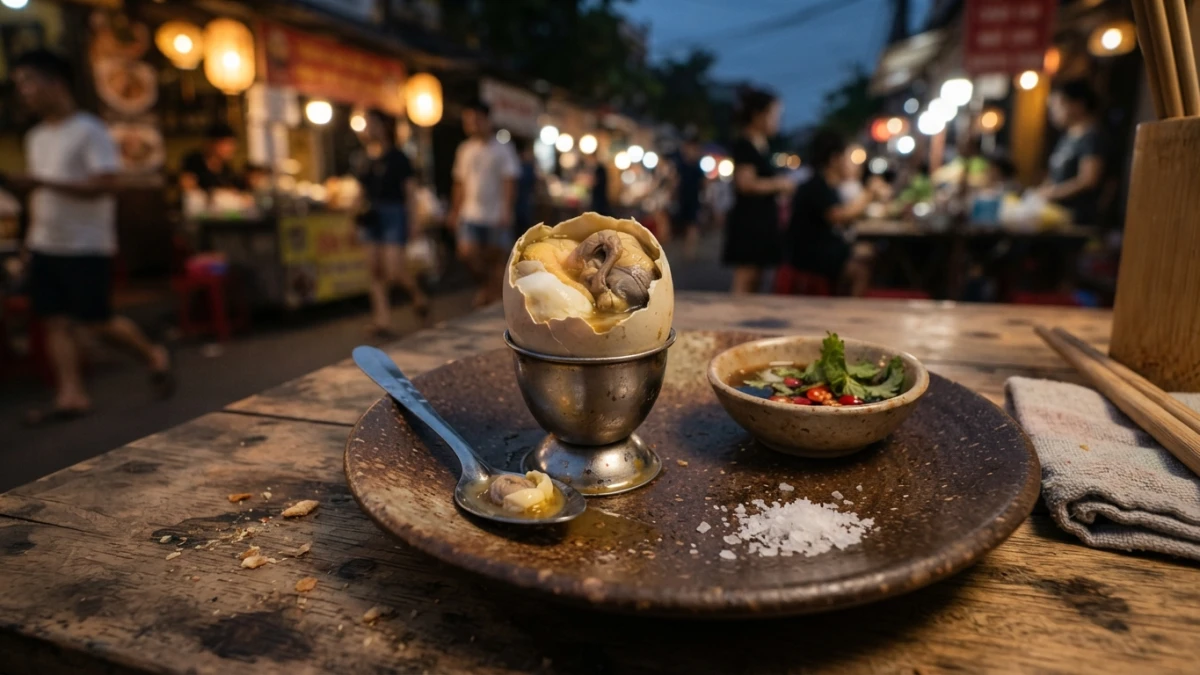
What is balut? A fertilized bird egg, almost always duck, incubated for 14 to 21 days and then steamed or boiled to be eaten straight from the shell. It is not a spoiled egg or an internet stunt: it is classic street food from Southeast Asia.
What Is Balut: Definition and Where It Comes From
A balut is a fertilized bird egg, almost always duck and sometimes chicken, incubated for 14 to 21 days and then steamed or boiled. The contents are eaten straight from the shell, without peeling it completely: first the warm broth left inside, then the embryo and the yolk with salt and vinegar.
It is classic street food across Southeast Asia. The Philippines is its showcase, where it works as a cultural icon and a driver of the duck industry, with versions in Vietnam (trứng vịt lộn), Cambodia (pong tea khon), Thailand and Laos. In the Philippines it is sold from night carts, often out of buckets of sand that keep it warm, with little packets of salt for the customer.
Its Filipino name translates as wrapped and refers to the traditional way of incubating the eggs in bags or fiber cloth. The technique arrived from China and took root in the country, above all in Pateros, in Metro Manila, the town famous for its ducks.
The Incubation Days: The Clock That Defines Balut
Every day counts. At 14 to 16 days the embryo floats on the white and the yolk: this is the mamatong, softer, with barely differentiated parts. In the Philippines the selling range runs from 14 to 18 days and the ideal for producers is around 17 to 18.
At 18 days you get balut na puti, wrapped in white: a barely developed beak, no feathers and soft bones, the texture locals prefer. More days mean a recognizable duckling and a firmer, chewier texture.
Outside the Philippines the clock changes: Cambodia incubates for 18 to 20 days and Vietnam for 19 to 21, when the embryo is clearly a small duckling. Eggs that did not develop properly, between 9 and 12 days, are sold as penoy and taste like hard-boiled egg.
How Balut Is Produced (and Why It Is a Craft)
It starts with duck eggs less than five days past fertilization, with a thick, crack-free shell. A duck's shell and membrane withstand handling better than a chicken's, which is why it is the standard bird.
The eggs are dried in the sun for a few hours to remove the moisture of laying and then go into incubators or bamboo baskets, with 100 to 120 eggs per basket, in the dark and at a constant temperature, using warm rice hulls as the heat source. They are turned a couple of times a day and reordered by age.
The craft, the magbabalut, is still manual across much of the country: the temperature has to be high enough for the embryo to grow, but never so high that it cooks. An overheated egg is a lost egg.
What Balut Tastes Like and How It Feels
The first contact is the warm broth inside the shell: a mild flavor, close to watered-down chicken consommé, which you drink before opening the egg. It is the part that surprises first-timers the least.
The yolk is creamy and more intense than a hard-boiled egg's, and the embryo brings the gamey note that many compare to liver, sweetbreads or offal. Those who defend it point precisely to that mix of broth, egg and meat.
The texture runs from the nearly liquid extreme of a young balut to the chewiness of an 18 to 21 day one. If it puts you off, ask for the least incubated option and eat it with salt, vinegar and chili to balance it out.
How to Eat Balut, Step by Step
- Crack the wide end of the egg with the back of a spoon until the shell splits and remove only a small window: the broth comes out through it. Drink it first, while it is hot.
- Widen the opening, add coarse salt and, if you like, vinegar with garlic and chili. Eat the contents with a small spoon, dipping every bite.
- In the Vietnamese version it is served in a small bowl with salt, pepper, lime and ginger, and eaten with rau răm.
- It is eaten warm and freshly made, never cold. Some people open the egg at the wide end and eat the yolk first, and veterans take the whole contents in a single bite.
To make it at home, the cooking steps are in our balut recipe, with boiling times by incubation days. If you are boiling regular eggs, our guide to exact timings for boiling eggs helps you calibrate the doneness.
Calories and Protein in a Balut
The values change with egg size and incubation days, so they are handled as ranges. The figures below are rough estimates per unit, not nutritional advice:
| Nutrient | Approximate amount |
|---|---|
| Calories | 130 to 190 kcal |
| Protein | 13 to 14 g |
| Calcium | about 100 mg |
| Iron | moderate amount |
| Fat and cholesterol | concentrated in the yolk |
Protein runs around 13 to 14 g per egg, more than a boiled chicken egg. Fat and cholesterol are concentrated in the yolk: it is not a light food, but it is cheap and a very efficient source of animal protein.
In Vietnamese folk medicine it is recommended to pregnant women and new mothers as a restorative food, and in the Philippines it is associated with hangovers and night shifts. Its reputation as an aphrodisiac has no scientific backing: it is folklore, and it is worth saying so.
Is It Safe to Eat Balut? The Cautions That Matter
Incubation creates the perfect environment for bacteria such as Salmonella enteritidis, and the shell can carry fecal pathogens. In Canada balut is classified as a hazardous food, and the advice is to buy it only from known producers with good turnover.
The risk lies in eating it raw or barely warmed, not in a properly cooked dish: it must be cooked through, steamed or boiled, and eaten hot. The US FDA food code places cooked balut in the safe zone at 57 degrees Celsius or above, or at 5 degrees or below if refrigerated.
Once cooked it is eaten the same day; in the fridge it keeps for up to a week in good conditions. Do not use eggs with a cracked shell, and wash your hands when handling them, just as with any fresh egg. If you are unsure about a regular egg, our tests to tell if eggs are fresh settle the question in a minute.
Penoy, Adobo and Other Ways to Eat Balut
Penoy is the unfertilized or poorly developed duck egg, tasting much like a hard-boiled egg. In the Philippines it is served with vinegar, whipped and fried like scrambled eggs, and also cooked into an omelette.
Cooked balut is also prepared adobo style, breaded and fried, in omelettes and as a pastry filling; in Vietnam it shows up alongside breakfast in noodle stalls. In Pateros, 1,000 baluts were cooked in adobo for a record for the world's largest serving, at 117.5 kilos, in 2015.
And the debate exists: eating a fertilized embryo opens an ethical discussion about the animal's development and the stage at which it is cooked. It is part of the region's food culture and can be mentioned with respect, without ghoulish detail and without turning it into a dare.
Can You Eat It Cold or Reheated?
The tradition is to eat it warm and freshly made. If you have leftovers, keep them refrigerated for up to a week and reheat only what you are going to eat, making sure it is piping hot all the way through.
Is It the Same as a Regular Duck Egg?
No. A regular duck egg is neither fertilized nor incubated: it has no embryonic development. Balut, by contrast, has gone through days of controlled incubation, and that changes its flavor, its texture and its composition.
Where Can You Buy It Outside Southeast Asia?
At Asian markets and Filipino stores, almost always already cooked. If you find it raw, check that the shell is intact, that the seller has good turnover, and cook it through before eating. Eggs are a very efficient food at any age: in the egg in older adults we go over the mistakes worth avoiding.