Christmas Turkey: How Long to Roast per Kilo
 By
Diego Cortés
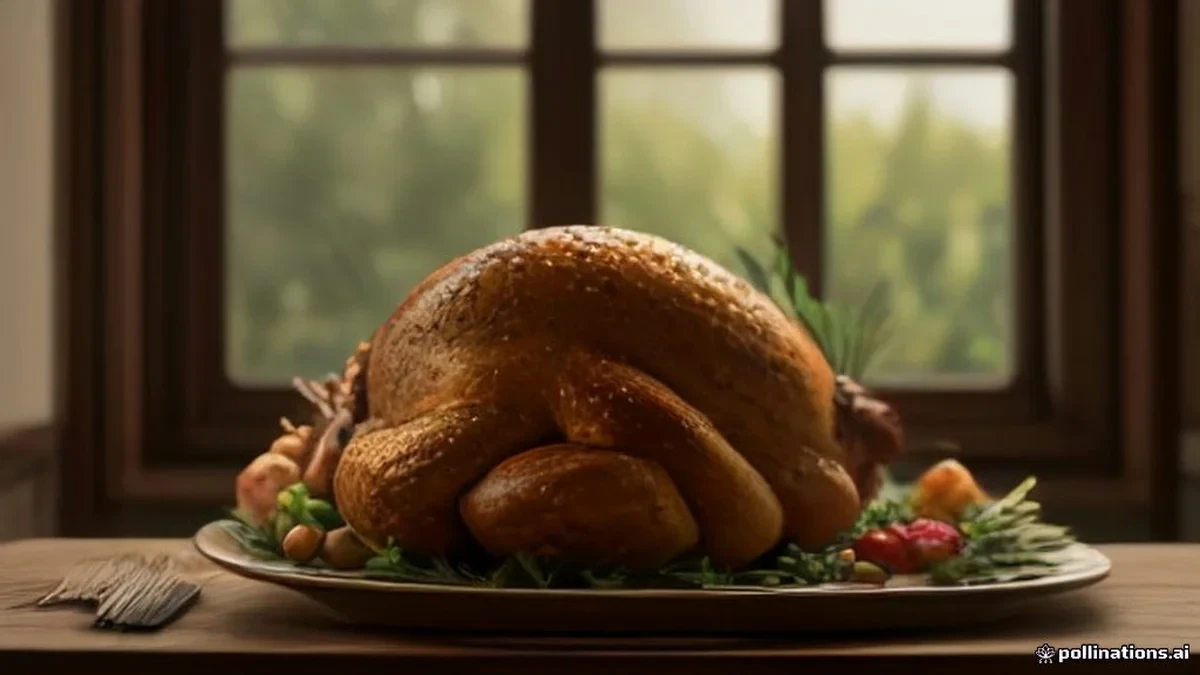
Knowing how long to roast a turkey per kilo comes down to weight, not tradition: a 4 kg bird with no stuffing takes 2 h 45 to 3 h at 163 °C, and a 10 kg one takes 4 h 30 to 5 h. The 45 minutes per kilo rule only works for small birds.
How long to roast a turkey: the short answer
With the oven at 163 °C (325 °F) and no stuffing, the numbers are these: 2 h 45 for 4 kg, 3 h for 6 kg, 3 h 45 for 8 kg and 4 h 30 for 10 kg, plus a 15 to 30 minute margin depending on your oven. These are reference times from the United States Department of Agriculture roasting chart, rounded to 15 minute blocks so they can be followed in a real kitchen.
The pocket rule that does work has three bands: 41 to 45 minutes per kilo for a 4 kg bird, 30 to 38 minutes per kilo between 6 and 8 kg, and 27 to 30 minutes per kilo above 9 kg. Time per kilo drops as the bird grows because surface area does not increase at the same rate as volume: a big turkey has less exposed skin per kilo of meat. And all of it is a clock estimate. The only judge is a thermometer in the thigh at 74 °C.
Why the recipes disagree: 25, 40 and 45 minutes per kilo
At least three rules are in circulation and all sound reasonable: 25 minutes per kilo, 40 and 45. Each was calculated with a different oven temperature, a different bird size and a different idea of what counts as stuffing. The Christmas turkey page on this site shows the problem: it says 45 minutes per kilo and, a few lines later, 3 h 30 to 4 h at 180-200 °C. At 45 minutes per kilo, a 10 kg bird would need 7 h 30, more than double what the official chart asks.
Four variables throw the calculation off: oven temperature, because 163 °C is not 200 °C; stuffing, which adds 20 to 30 minutes; covering, because foil traps steam while an open bird browns; and size, which is exactly where a linear rule fails hardest.
The weight table, in pounds, kilos and Fahrenheit
Reference times for a whole turkey in a 163 °C (325 °F) oven, uncovered, pan on the middle rack. The last column converts the data to minutes per kilo for anyone cooking from a metric recipe.
| Turkey weight | No stuffing | Stuffed | Min per kilo |
|---|---|---|---|
| 8-12 lb (3.6-5.4 kg) | 2 h 45 - 3 h | 3 h - 3 h 30 | 41 - 45 |
| 12-14 lb (5.4-6.4 kg) | 3 h - 3 h 45 | 3 h 30 - 4 h | 30 - 38 |
| 14-18 lb (6.4-8.2 kg) | 3 h 45 - 4 h 15 | 4 h - 4 h 15 | 28 - 36 |
| 18-20 lb (8.2-9.1 kg) | 4 h 15 - 4 h 30 | 4 h 15 - 4 h 45 | 28 - 30 |
| 20-24 lb (9.1-10.9 kg) | 4 h 30 - 5 h | 4 h 45 - 5 h 15 | 27 - 30 |
To read it with a margin: start probing 30 minutes before the low end of the range and do not open the oven during the first hour, because every opening drops the cavity temperature and stretches the roast. If your oven has a fan, go down 15 to 20 °C or shorten the time and watch the browning, since forced air dries the surface.
Conversions, once: 325 °F is 163 °C and 165 °F is 74 °C. It is the same schedule on another scale.
The thermometer decides: 74 °C in three places, not one
The probe goes into the innermost part of the thigh without touching bone, and the reading is confirmed at the innermost part of the wing and the thickest part of the breast. All three must reach 74 °C (165 °F). If one falls short, the bird goes back in.
Do not trust the pop-up timer: it trips at a fixed temperature and can fail without warning. Pink juices are not a reliable signal either, and skin colour tells you how much the bird browned, not whether the meat is cooked through. The rule is simple: nothing comes out of the oven before the thigh reads 74 °C, and if you are unsure, keep roasting.
Thaw it properly: 24 hours per 2 kilos, in the fridge
This calculation happens the day before: the refrigerator needs 24 hours per 1.8 to 2.3 kg, which means about 3 days for a 6 kg bird and 4 to 5 days for a 10 kg one. Never on the counter and never at room temperature, which is where bacteria find their best conditions.
If time has run out, the emergency route is a cold water bath with the turkey inside a sealed bag, changing the water every 30 minutes and allowing 30 minutes per pound. It works, but someone has to watch the clock. The full method is in the article on how to thaw food safely.
Three mistakes almost nobody corrects: do not rinse the raw bird under the tap, because splashing spreads bacteria across the sink and the counter; read the net weight on the label rather than the gross weight; and check whether it is injected with brine or glaze, because it already carries salt and weighs more than it appears.
Stuffing inside or outside: what changes the clock and the risk
If the stuffing goes inside, the cavity also has to reach 74 °C, and by then the breast has been overcooked for a while. That is why standard food safety advice is to bake it separately, in a dish, where it cooks evenly without dragging the bird along.
If you still want a stuffed turkey: stuff it right before it goes in, do not pack it tight, add 20 to 30 minutes to the table time and check the centre of the stuffing with the thermometer. The middle path that works best is roasting the bird unstuffed and serving a separate stuffing made with the pan juices. The roast turkey with stuffing page shows the traditional version, written in pounds and Fahrenheit.
Resting, carving and leftovers: the 20 minutes that save the meat
When the turkey comes out, cover it with foil and let it rest 20 to 30 minutes before carving. Hot meat releases its juice the moment you cut it; during the rest, the fibres pull it back in. It is the most skipped step and the most noticeable one.
Count 400 to 450 g of raw bone-in turkey per person: a 6 kg bird serves 13 to 15 people and an 8 kg one serves 18 to 20. Edible meat ends up around 55 to 60 % of the raw weight, so the bones take their share. Leftovers keep 3 to 4 days in the fridge and deliver a second meal: buds stuffed with leftover Christmas turkey or Christmas pot croquettes. For the table, the punch a la romana, the sweet Christmas bread, the Christmas pudding and the yule log complete the menu, with more ideas in the Christmas recipes section.
Frequently asked questions
How long do you roast a turkey per kilo?
41 to 45 minutes per kilo for a 4 kg bird, 30 to 38 between 6 and 8 kg and 27 to 30 above 9 kg, always at 163 °C and unstuffed. The figure drops as the bird grows.
What oven temperature should I use?
163 °C (325 °F), preheated, pan in the middle. With a fan, go down to 145-150 °C or shorten the time and watch the browning.
How do I know it is done without a thermometer?
With difficulty, which is why one is worth buying: it is cheap and it protects the most expensive dish of the year. Without it, the only acceptable hint is clear juice running from the thigh when you pierce it to the bone.
Can I roast it the night before and reheat it?
Yes, and it frees up the oven on the day. Carve the meat, store it covered with its juices in the fridge and reheat with stock and foil until it reaches 74 °C again.
How much turkey should I plan per person?
400 to 450 g of raw bone-in turkey. A 6 kg bird serves 13 to 15 people and an 8 kg one serves 18 to 20; for leftovers, go one size up.
Why did my turkey come out dry?
Almost always because it was roasted too long by following the 45 minutes per kilo rule on a large bird, or because it was carved without resting. Covering the breast with foil for the last hour, or injecting it with rum and salt before roasting as the Christmas turkey page does, helps hold moisture.
Can I cook it in a pressure cooker?
For pieces, yes: thighs, boneless breast and wings stay juicy. For the whole 6 kg bird, no: it will not fit and the skin would never brown.