Cocktail Basics at Home: Ratios, Ice and Common Mistakes
 By
Diego Cortés
By
Diego Cortés
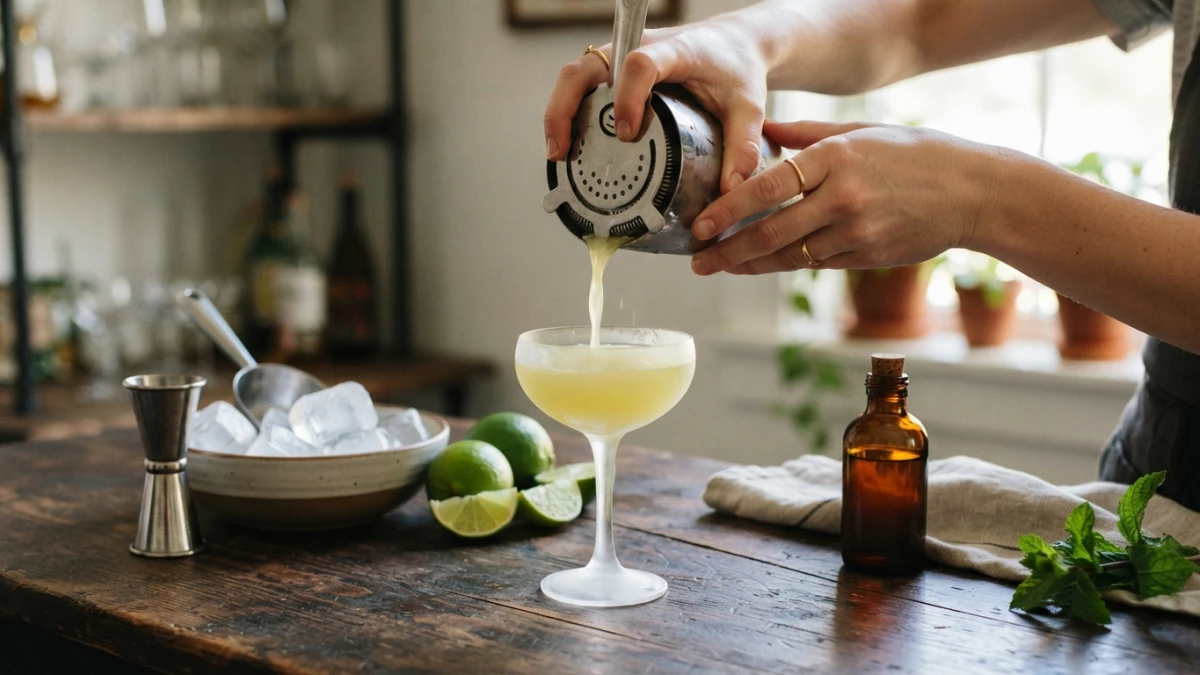
Cocktail basics at home do not fail for lack of gear: they fail because nobody measures, because the ice gets rationed or because what should be stirred gets shaken. With a jigger, plenty of ice and three base ratios you cover almost every classic. Here are the measures and the technique.
Cocktail basics at home: the minimum gear and why the jigger is not optional
To start you need two things: a shaker (or a mixing glass with a bar spoon and a strainer) and a jigger, the two-sided measure. The measure is the only thing that makes a drink come out the same twice; without it, the home equivalents are 1 tablespoon for 15 ml and 1 teaspoon for 5 ml, and a "generous splash" is not a measure.
If there is no shaker, a jar with a tight lid shakes well and does not freeze your hands, and a fine mesh strainer at the end keeps crushed ice and pulp out of the glass. On glassware: a low rocks glass for drinks served on ice, a tall glass for anything with fizz and a cocktail glass for strained drinks without ice. Chill the glass 10 minutes in the freezer, or fill it with ice and water while you build the drink: a room-temperature glass melts the ice all at once.
The three cocktail families and their base ratio
Almost every classic falls into three families. The sour family uses the 2:1:1 ratio, two parts spirit, one part freshly squeezed citrus and one part syrup; pushing that ratio around is what makes a drink taste like pure lemon or like candy. The highball family runs one part spirit to two or three parts of a fizzy mixer, with plenty of ice and a tall glass. And the spirit-forward family is all spirit, liqueur and bitters, with no juice and no soda.
| Family | Base ratio | Classics and official measure |
|---|---|---|
| Sour | 2:1:1 (spirit, citrus, syrup) | Pisco sour and margarita (50 spirit, 20 citrus, 15 liqueur or syrup) |
| Sour | 2:1:1 with sugar | Daiquiri: 60 spirit, 20 lime and two teaspoons of sugar |
| Highball | 1:2 to 1:3 with soda | Screwdriver and rum and lime (1:3); moscow mule: 45 vodka, 120 ginger beer and 10 lime |
| Highball | 1:2 to 1:3 with herbs | Mojito: 45 rum, 20 lime, sugar and soda water |
| Spirit-forward | Equal parts | Cosmopolitan 40/15/15/30 and black pearl, 30 coffee liqueur with 30 vodka |
| Spirit-forward | 6:1 spirit and vermouth | Old fashioned: 45 bourbon with a sugar cube and angostura |
| Tropical | 2:1:1 cream and juice | Pina colada: 50 rum, 30 coconut cream and 50 pineapple |
Sweetness: simple syrup instead of granulated sugar
Simple syrup is 1:1, one measure of sugar to one of hot water, stirred until dissolved and left to cool; the rich version, 2:1, sweetens with less volume and adds body. The key point is that granulated sugar does not dissolve in a cold drink: it sinks to the bottom of the glass, so you get sweetness at the end and none at the start.
A jar of syrup keeps for several weeks sealed in the fridge and gets thrown out if mold, cloudiness or a strange taste shows up, so it is worth keeping it in a bottle with a pourer. As alternatives, honey diluted in hot water brings its own aroma, agave works well with tequila and fresh fruit juice adds sweetness with acidity. Powdered sweetener does not dissolve the same way and changes the texture of the drink.
Ice: the ingredient that changes a drink the most
Three types of ice are enough: regular cubes for shaking and for tall glasses, one large cube of about 5 cm for short drinks you sip slowly, and crushed ice when texture is part of the recipe. There is no need for a collection of molds.
The rule that surprises almost everyone is counterintuitive: more ice chills faster and dilutes less. That is why the shaker gets filled two thirds of the way and the serving glass to the top. Rationing it, three or four cubes in a warm shaker, gives the worst possible result: a warm, watery drink.
Ice mistakes show up in the first sip: old ice that absorbed freezer smell (keep it in a sealed bag), wet half-melted cubes that dilute immediately, and small cubes in a tall glass that are gone before you are halfway through the drink.
Shake or stir: the one-line rule
The rule that settles almost everything: shake if the drink has citrus, cream, egg or fruit pulp, and stir if it is all spirit, liqueur and bitters. Shaking a martini or a manhattan leaves it cloudy, with bubbles and a texture the recipe is not after.
The timings: shake hard for 10 to 15 seconds, until the metal frosts your hands; stir for 20 to 30 seconds with a bar spoon in a mixing glass full of ice. Shake with intent, because a timid shake leaves the drink warm and strong.
Dilution is the number almost nobody knows: shaking adds in the order of 20% to 30% water by volume, stirring adds 15% to 20% and building the drink in the glass adds 15% to 25% over two or three minutes. That takes a drink of two measures of 40% spirit down to the 18% to 22% range, which is where it tastes round instead of harsh.
The mistakes that ruin a drink (and how to fix them fast)
Ingredient mistakes are the expensive ones: not measuring and trusting your hand, using bottled lemon or lime juice instead of fresh, and leaving vermouth open at room temperature. Vermouth is fortified wine and it oxidizes: into the fridge when you open it, and replace it every month or month and a half.
On technique and glassware: too little ice, a glass that was not chilled, shaking what should be stirred, stirring a drink that has fizz, and piling on too many ingredients. The range that works is three to five components, with the spirit in the lead.
The fixes: if the drink came out harsh or too strong, shake or stir a little longer, which means more water and more cold; if it is too sweet, a few drops of fresh citrus; if it is watery, it was built on too little ice or on ice that had already melted, and there is no fix, so rebuild it. One trick that is not just garnish: a citrus peel squeezed over the surface adds aroma to the first sip.
Alcohol-free versions: the same technique, no spirit
The technique is the same and the weight of the drink is what changes. In an alcohol-free cocktail, bitterness and acidity replace the spirit: coconut cream and pineapple give the tropical texture, tonic water and ginger beer bring bitterness with fizz, and a pinch of salt or a few drops of alcohol-free bitters lift the flavor so it does not fall flat. A citrus peel does the same aromatic work.
The site already has recipes in that category to take the technique to one specific drink: alcohol-free pina colada, alcohol-free daiquiri, terremoto for children and papelon with lemon.
On the alcoholic side, the usual warning in one line: do not serve it to minors or pregnant women, and do not combine it with driving.
How to build your first three-drink menu without overthinking it
A three-drink menu that covers all three families and can be made with a single shaker: one sour, one highball and one alcohol-free. With the syrup and the ice ready before guests arrive, there is nothing to improvise.
The prep sequence is simple: squeeze all the citrus together, keep the syrup in its bottle, chill the glasses and only then start measuring. That way nothing dilutes while you hunt for an ingredient and the drinks come out the same one after another.
If three sentences are all you keep, make them these: measure with a jigger, fill with ice, and shake or stir by the rule. For the menu, the recipes are pisco sour, screwdriver and alcohol-free pina colada. And to put the drink's calories in context on a full table, the chart of calories in Chilean dishes is a useful reference.