Puto Maya and Sikwate: The Filipino Breakfast Explained
 By
Diego Cortés
By
Diego Cortés
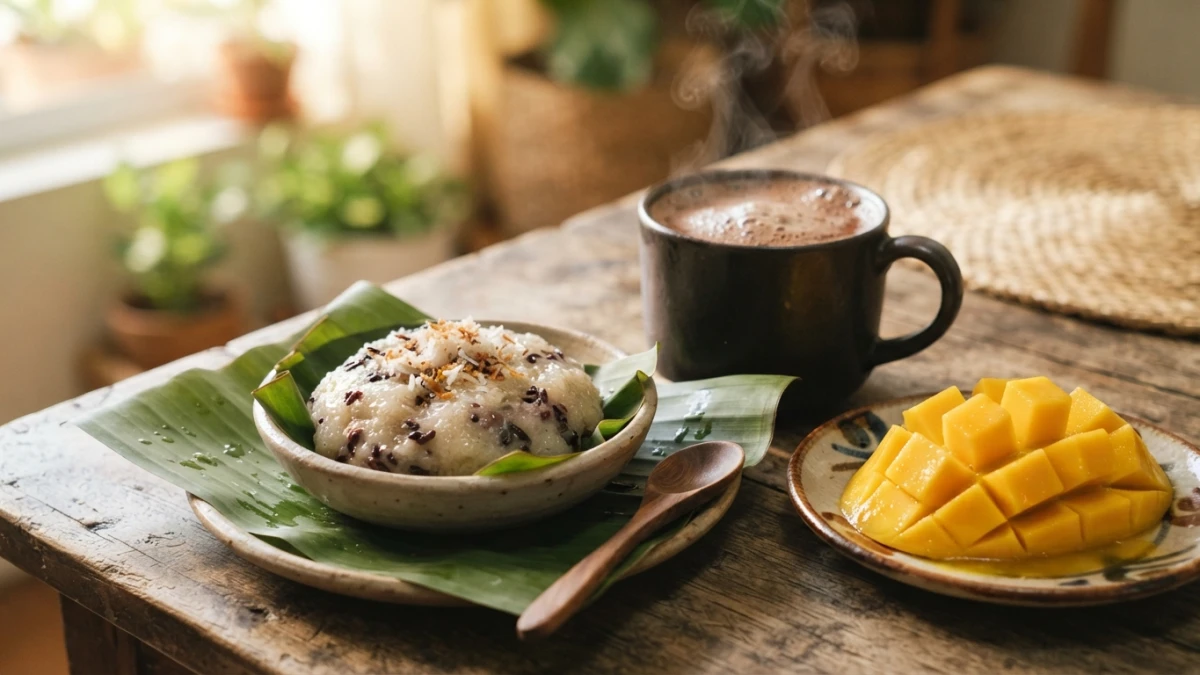
Puto maya is glutinous rice steamed with coconut milk, sugar, ginger and salt, served warm on a banana leaf. Its constant companion is sikwate, a thick tablea chocolate beaten by hand: together they are the most recognizable breakfast in Cebu, in the Philippines.
The two are sold together from early morning in the markets and eaten with ripe mango. Here is what each one is, where the pair comes from, how it differs from puto, suman and champorado, and how many calories it adds up to; the step-by-step lives on the site's recipe page.
What puto maya is: glutinous rice, coconut milk and ginger
Puto maya has no flour and no yeast. The glutinous rice, called malagkit in Filipino markets, is soaked, cooked with coconut milk, sugar, grated ginger and a pinch of salt, and finished in a steamer. The result is a buttery, compact rice, sweet without being a dessert.
In the traditional version a handful of black or purple glutinous rice, pirurutong, is mixed with the white rice, and that gives the grayish violet tone many people associate with the dish; without it the rice stays cream white. It is a dish from the Visayas, with Cebu as its best-known home, and it also shows up in markets in Mindanao and in local versions such as budbud.
What sikwate is: tablea chocolate beaten with a batirol
Sikwate is the Cebuano name of Filipino tsokolate: a thick chocolate drink made with tablea or tabliya, discs of pure roasted and ground cacao, dissolved in hot water and sweetened with sugar, often muscovado. The traditional version is water and cacao; milk is an addition some kitchens make.
What defines it is the technique: the tablea is dissolved and beaten with a wooden whisk, the batirol, inside the tall pot called a tsokolatera, until it foams. Without that beating it stays like watery chocolate. It is not instant cocoa powder or baking chocolate. The Mexican hot chocolate mocha is its closest relative on the site, and champorado is the same cacao in rice-dish form.
Where the pair comes from: Cebu, the painitan and the snack
They are breakfast and mid-afternoon merienda in Cebu, sold together from early morning in stalls and markets; the Carbon market is the name that comes up most. In Cebuano those kakanin stalls with a hot drink are called painitan, and the word also names the habit of going out for breakfast.
The pair appears in the Cebuano calendar of Kalag-Kalag, the days of the dead, and in markets in Cagayan de Oro, in Mindanao. Even the name has a Cebuano root: "puto maya" is recorded as a shortening of the children's rhyme gaya-gaya puto maya. Today tablea chocolate is back as a drink of origin and the dish is part of Filipino brunch menus abroad.
How it is served: banana leaf, ripe mango and a contrast of temperatures
The classic setup is a portion of warm rice on a banana leaf, a steaming cup of sikwate and slices of ripe mango. The rice brings sweetness and a sticky texture, the chocolate brings bitterness and heat, and the mango lends acidity and juice.
The rice is served warm and never cold from the fridge, because glutinous rice hardens as it cools and only softens again with steam; the cup goes in hot and unstrained; the mango goes in thick slices. If the mango is green, it helps to know how to ripen mangoes and, if the doubt is the cut, how to peel a mango.
The usual additions are grated coconut, muscovado sugar on the side and, in savoury versions, longganisa or cheese. The exact steps and amounts are in the site's puto maya and sikwate recipe page, which this article does not repeat. For the breakfast table, Spanish bread is a good neighbour.
Puto maya is not puto, suman or budbud
Regular puto, including puto bumbong, is made from rice batter, sometimes fermented, and comes out spongy; puto maya is whole glutinous rice steamed, unfermented, sticky and heavy. Suman is cooked wrapped tightly in leaves and eaten compressed; budbud is the Visayan name for that family, with the millet budbud kabog as its famous cousin.
| Dish | Base | Texture | How it is eaten |
|---|---|---|---|
| Puto maya | Glutinous rice steamed with coconut milk | Sticky, whole grain | Loose, warm, with a spoon and sikwate |
| Regular puto and bumbong | Rice batter, sometimes fermented | Spongy | Like bread or a snack |
| Suman and budbud | Glutinous rice with coconut, wrapped in leaves | Compressed and firm | In wrapped portions |
| Champorado | Glutinous rice cooked in chocolate | Creamy | Sweet-savoury breakfast with dried fish |
And the last trap: champorado is glutinous rice cooked in chocolate, a sweet-and-savoury breakfast with dried fish, not a drink. The other Filipino pieces on the site, such as halo-halo, bibingka or taho, follow the same logic of rice, coconut and sugar.
Glutinous rice: why it sticks and why it has no gluten
The surprising fact: glutinous rice contains no gluten. Its name comes from the way it behaves like glue when cooked, because its starch is almost all amylopectin, the branched fraction that holds water and gives the gummy texture. That is why it works for puto maya, for mochi or for Thai sticky rice, and not for a loose side dish of rice.
In practice: it is soaked for several hours before cooking, or it stays hard in the centre, and it is steamed rather than boiled, because it absorbs water and turns into a lump. It is sold as malagkit, sweet rice or sticky rice, and ordinary white rice will not replace it.
How many calories puto maya and sikwate add up to
There is no official figure for puto maya, so the estimate is our own: cooked glutinous rice at 100 to 130 kcal per 100 g, canned coconut milk at 170 to 230 kcal per 100 ml, and sugar at 4 kcal per gram. A portion of 120 to 150 g lands between 250 and 350 kcal.
| Component | Assumption | Approximate calories |
|---|---|---|
| Puto maya, 120 g | Light sugar, moderate coconut | 250 to 280 kcal |
| Puto maya, 150 g | Sweet and generous with coconut | 320 to 350 kcal |
| Sikwate, 200 ml cup | Tablea, water and one tablespoon of sugar | 80 to 100 kcal |
| Coffee-shop sikwate | Whole milk and extra sugar | 150 to 220 kcal |
The full combo comes to roughly 330 to 450 kcal for the plate and the cup, in line with a carbohydrate breakfast that carries little protein. To read that in context, the site's Chilean food calories chart works as a reference for method. Lightening it is possible: less sugar, more pure cacao and less sweet tablea, coconut milk thinned with water, portions of 80 to 100 g and protein on the side, such as egg or pan-fried longganisa.
How to store and reheat puto maya
It is eaten the same day. What is left goes in a sealed container in the fridge for up to about 3 days, and in the cold it hardens: that is normal. Reheat it by steaming for 5 to 10 minutes, or in the microwave covered with a damp cloth; never dry in the oven. Wrapped portions freeze for up to 3 months and thaw overnight.
If a sour smell, threads or strange sticky moisture appear, throw it out. Tablea lasts a very long time: one Filipino shop reference puts it at up to 2 years in an airtight container, in a cool, dry, dark place, never in the fridge, because moisture makes it clump. Grating it before dissolving speeds up the beating.
Frequently asked questions about puto maya and sikwate
Is it a dessert or a breakfast?
Breakfast and a snack: it is served warm with a hot drink, not as the end of a meal.
Does it have gluten?
No. Glutinous rice contains no gluten; the word refers to the way it sticks when cooked.
Can it be made with regular rice?
Better not: ordinary white rice does not absorb the same way or give the gummy texture. You need malagkit or sticky rice.
The tip that saves the breakfast
If you take away one idea, make it this one: puto maya is served warm and sikwate, freshly beaten. Rice that has been in the fridge needs steam, not a quick microwave burst, and chocolate that stopped being beaten loses the foam that makes it thick. Prepare the tablea last, while the rice reheats, and have the mango cut before you serve: with those timings in order, the breakfast comes out like the one from a painitan. To keep exploring, the site's Philippines tag gathers the country's recipe pages and the article on balut is the other classic explained the same way.