Egg in a Cup: Exact Boiling Times, Origin and Calories
 By
Diego Cortés
By
Diego Cortés
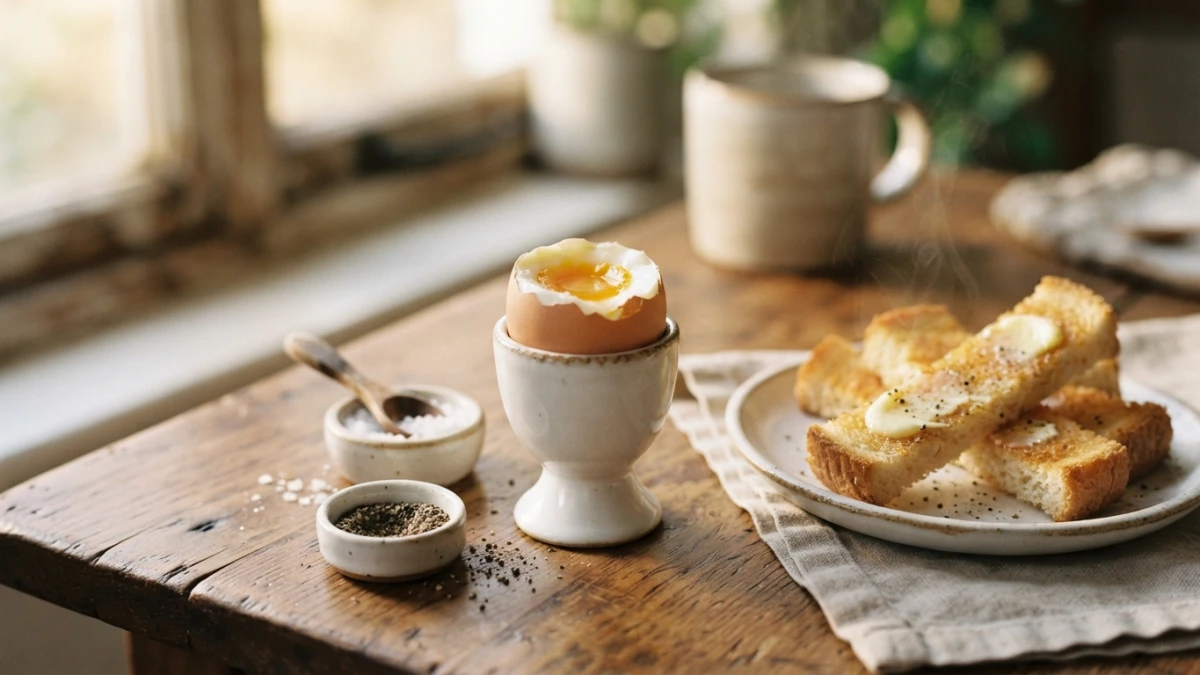
An egg in a cup is an egg boiled in its shell with the white just set and the yolk still runny, served hot in an egg cup with the top cut off so you can eat it with a spoon and dip bread into it.
In Chile and Argentina it is called huevo tibio and it is a classic breakfast and afternoon tea dish. This guide answers what a recipe does not: where the custom comes from, how many minutes to boil it for the texture you want, how to keep the shell from cracking, how many calories it adds and what precautions to take with a runny yolk.
What an egg in a cup is and why it is also called a soft-boiled egg
Three names get mixed up every day, so it helps to sort them out. Egg in a cup names the serving style: the egg sitting in its egg cup. Soft-boiled egg names the cooking point: set white and liquid yolk. And huevo tibio is the popular name in Chile and Argentina. All three can describe the same egg, but each word looks at something different.
On the plate you recognise it instantly: a white egg standing upright in the egg cup, a cap cut off the top, salt and pepper and, next to it, toast soldiers with butter for dipping into the yolk. The quantities and the step-by-step are in the site's egg in a cup recipe; here we keep the technique, the history and the numbers.
Where it comes from: the French oeuf à la coque and the egg cup as tableware
The custom comes from French cooking, where oeuf à la coque is the egg boiled in its shell, served in a coquetier (egg cup) and eaten with mouillettes, strips of buttered bread for dipping into the yolk. Spanish translated it almost literally as huevo pasado por agua, and European breakfast tableware did the rest.
The object has a history too: an early silver egg cup has been found among the ruins of Pompeii, and it exists for a practical reason, because a hot egg burns and rolls, and holding it upright is half the experience. In Chile and Argentina it is served for breakfast and afternoon tea with pan amasado or marraqueta.
How many minutes to boil an egg in a cup: texture chart
The short rule, counting from the moment the water boils and with the egg at room temperature: 3 minutes give a barely set white and a completely liquid yolk; 4, a firm white and a hot liquid yolk; 5, a firm white and a creamy yolk (the point the site's recipe declares); and 6 is already the edge of a mollet egg, with a thick yolk. French cooking sums up the scale as the 3-6-9 rule: 3 for à la coque, 6 for mollet, 9 for hard-boiled.
| Minutes | White | Yolk | What this point is good for |
|---|---|---|---|
| 3 | barely set | completely liquid | the classic egg cup, with toast soldiers |
| 3.5 | taking shape | very runny | eating with a small spoon |
| 4 | firm | liquid and hot | the most popular point for dipping bread |
| 5 | firm | creamy | the point of the site's recipe |
| 6 | firm | thick, mollet limit | salads and ramen |
The timer alone is not enough: a large egg needs more time than a small one and an egg straight from the fridge delays cooking by a few seconds. To get the same result every day, leave the egg out of the fridge for 20 to 30 minutes before boiling it: it reduces the thermal shock and helps keep the shell from cracking.
Cold water or boiling water: how to cook it without cracking the shell
Both ways work, but the timer changes. In boiling water the control is more precise: lower the egg in with a spoon and count from the moment the boil resumes. From cold water there is less thermal shock and fewer cracks, but the time still counts from the first boil.
Cracks have concrete causes: the air in the pocket at the wide end expands and presses on the shell, a cold egg dropped into boiling water cracks from the temperature jump, and a violent boil makes it knock against the pot. The fix: prick the wide end with a clean needle and keep a gentle simmer. And one myth fewer: salt in the water does not stop the egg from cracking, it only sets the white faster if it has already cracked.
How to open and eat an egg in a cup
Sit the egg with the wide end down, tap with the spoon all the way around the top until the shell gives, lift off the cap, then add salt and pepper. You tap around, never at a single point: that way the crack does not run down the side. If the egg is very hot, wait a minute; the shell cools fast while the egg keeps cooking inside.
Then come the two possible endings: the egg with bread, scooping the yolk out with a small spoon or dipping toast soldiers, and the emptied egg, running a small spoon around the inside edge of the shell to tip all the contents over a soup, a stew, a salad or a piece of toast. On the table: salt, freshly ground pepper, butter and, if you like, chives.
How many calories are in an egg in a cup
The starting figure is simple: a whole egg provides around 143 kcal per 100 g of edible portion (USDA reference value), with no oil or butter. Translated into sizes, the estimate looks like this:
| Size | Weight in shell | Edible portion | Approx. calories |
|---|---|---|---|
| S | ~53 g | ~47 g | ~67 kcal |
| M | ~58 g | ~52 g | ~74 kcal |
| L | ~64 g | ~57 g | ~82 kcal |
| XL | ~73 g | ~65 g | ~93 kcal |
Inside the egg, the yolk concentrates the fat and most of the calories (about 55 kcal in a large egg) and the white provides protein with almost no fat (about 20 kcal). An egg in a cup delivers 6 to 7 g of high-quality protein, about 5 g of fat and practically no carbohydrates: the same figure as a boiled egg, because no added fat is involved.
What pushes the count up is what you dip: butter (5 g) adds about 36 kcal and a slice of white bread (25 g) about 65 kcal. An egg with two buttered soldiers lands between 210 and 250 kcal, and two eggs with two buttered slices come in around 320 to 350 kcal. To lighten it: skip the butter and use wholegrain bread.
Safety: runny yolk, salmonella and who should avoid this dish
The shell can carry salmonella and cooking is what eliminates it, so any preparation with a runny yolk sits in the higher-risk zone. The FDA advises against lightly cooked eggs for very young children, older adults, pregnant women and people with weakened immune systems; for them, an egg in a cup is made with pasteurised egg or cooked until the yolk sets.
At home, what does reduce the risk: eggs kept refrigerated in their carton, an intact and clean shell, hands and utensils washed after touching raw shell, cooking that brings the yolk to about 71 °C and eating it straight away. An egg left on the table for more than two hours is thrown out. And the egg you can actually store is the hard-boiled one, not the egg cup one: refrigerated and in its shell it keeps for up to a week. If the dish is for an older person, check first the article on eggs in older adults and how to tell whether an egg is fresh.
Variations and what to serve with it
Sorted by cooking point: the egg in a cup (3 to 5 minutes), the mollet egg (6 minutes, creamy yolk, peeled and used in salads or ramen) and the egg en cocotte (firm white and runny yolk, set in a ramekin in the oven with cream or vegetables). They share the same idea and change only the container and the point.
To keep going with the theme there are the exact egg boiling times, steamed eggs and the reasons eggs are a superfood. And to move into the kitchen: stuffed eggs, fried toast with egg, shakshuka and homemade spun egg; the bread for the soldiers can be pan amasado. The whole family lives in the Eggs category.
Note: the trick that changes the result most is the clock: set the timer before lowering the egg in and count from the moment the water returns to the boil, not from when you put the pot on the heat. And if your eggs are very fresh, still leave them out of the fridge for 20 minutes: those are the ones that crack most.