Mole Poblano: What It Is, Where It Comes From and Why It Has Chocolate
 By
Diego Cortés
By
Diego Cortés
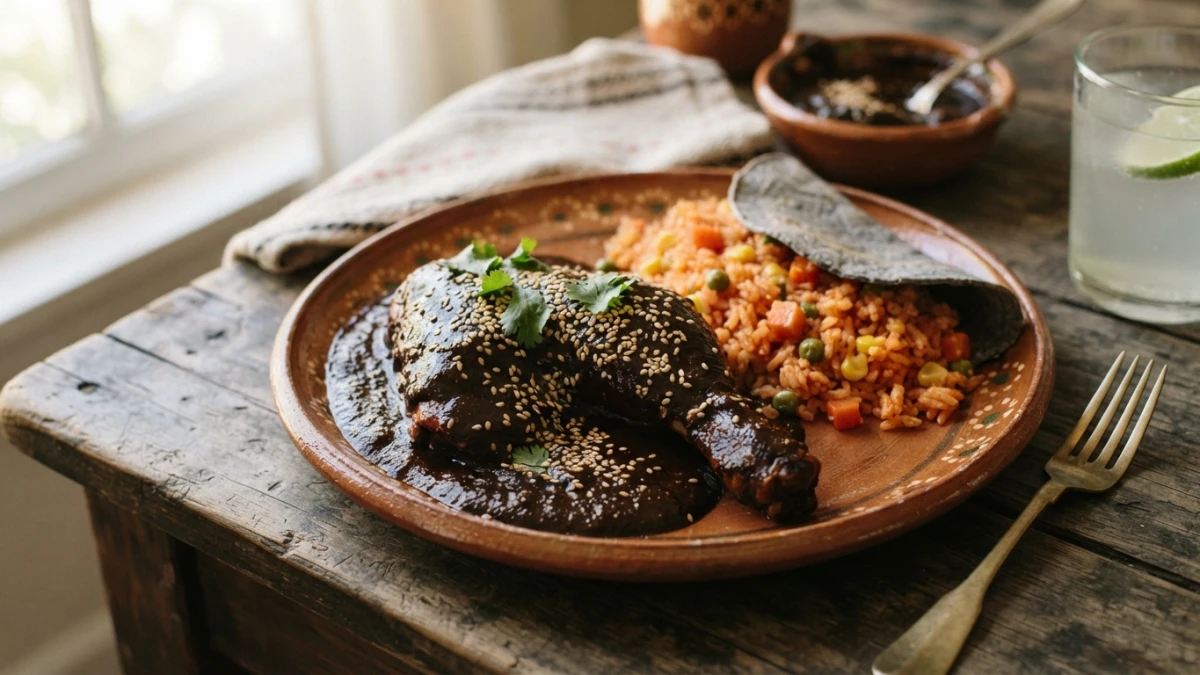
Mole poblano is the most famous sauce in Mexican cooking: dark, thick and made with more than twenty ingredients, chocolate among them. It comes from Puebla and is traditionally served over guajolote (turkey), although today it is almost always paired with chicken.
It helps to say this up front: it is a sauce-stew served over or alongside meat, not a chocolate dish and not a dessert. Nor is "mole" a single recipe. In Nahuatl, molli means sauce or stew, so the name covers a whole family of Mexican preparations: before ordering "mole" in a restaurant, the first question to ask is which one.
What mole poblano is (and what it is not)
Mole poblano is a sauce of dried chiles, seeds, nuts, spices and a touch of chocolate that is ground into a paste and cooked down until it thickens. Its color is dark brown with reddish highlights, it shines with the fat from frying, and its texture is smooth, almost creamy. On the palate it is spiced, slightly sweet and only mildly hot, and that balance is its signature.
What sets it apart from other Mexican sauces is not a star ingredient but the blend. It is not a "chocolate sauce": chocolate is one component among dozens. It is not a dessert and not a fixed recipe, but a family of household and regional versions that share one idea: many toasted ingredients ground together.
Where it comes from: the convent legend and the real history
The most famous version dates the dish to 1681, in the convent of Santa Rosa de Lima in Puebla. In that story, the nun sor Andrea de la Asunción created mole to honor bishop Manuel Fernández de Santa Cruz and the viceroy Conde de Paredes. The kitchen of that former convent is today part of the Museo de Arte Popular Poblano. It is the most widely told version, not a documented fact.
The historical basis is simpler. The pre-Hispanic molli was already a sauce of chiles and tomato served over meat. What colonial cooking did, above all in the Puebla convents of the seventeenth and eighteenth centuries, was add spices, seeds, nuts, dried fruit and chocolate arriving from Europe. That encounter produced the blended sauce we know today.
Today's backing is solid: traditional Mexican cuisine, with mole among its most representative dishes, was inscribed by UNESCO on the list of Intangible Cultural Heritage of Humanity in 2010.
What mole poblano contains: the four chiles and the other families
The base that defines the flavor is the dried chiles. Mulato brings the dark tone and a bitter-chocolate undertone; ancho adds sweetness and body; pasilla gives notes of dried fruit and a slight bitterness; chipotle or morita adds a smoky edge and the final heat. They are toasted, soaked and ground. That blend, not the chocolate, is what makes a mole taste like mole.
Several more groups go in on top of that base: seeds and nuts (sesame, almonds, peanuts, pumpkin seeds, walnuts), dried and sweet fruits (raisins and plantain), aromatics (tomato, onion, garlic), toasted thickeners (burnt tortilla and fried bread or tortilla chips) and spices (cinnamon, clove, anise, black pepper, cilantro, cumin). All of it is fried in lard before being ground together.
A traditional recipe runs to between twenty and thirty ingredients, and the convent legend speaks of as many as a hundred. Each group is prepared separately, toasted, soaked or fried, before everything is ground: that is where nearly all the work lies.
The role of chocolate (and why it does not taste of chocolate)
Yes, mole poblano contains chocolate. But it is bitter tablet chocolate meant for cooking, not a dessert bar. Its job is not to sweeten but to add body and nuance: the cocoa and its fat help bind the sauce and round off the heat and the spices.
Hence the most common confusion. If a mole tastes of dessert chocolate, something went wrong: what you should perceive is a toasted, spiced base with a mild sweetness that comes mostly from the raisins, the plantain and a little sugar or bread. Quantity explains it too: chocolate is a small part next to the volume of chiles, seeds and spices. That is why a homemade mole that "tastes of chocolate" almost always has too much chocolate or too little chile. In short: it is a savory, spiced sauce with a sweet undertone, not a dessert.
How it is served and how many calories it has
The traditional service is simple and filling. The sauce is served hot and thick, coating a piece of turkey or chicken, dusted with toasted sesame and paired with red rice and tortillas. In Puebla it is a dish for weddings, baptisms and celebrations, and it is usually the heaviest thing on the table. If you want to round out the table with another Mexican sauce, guacamole is the most dependable companion.
For calories it is better to add up by parts. The sauce alone is around 118 kcal per 100 g, so two ladles come to about 180-250 kcal. A piece of chicken with its sauce (roughly a 300 g plate) lands between 400 and 510 kcal, with 25-30 g of protein, 20-27 g of fat and 20-25 g of carbs. These are estimates based on reference values: everything depends on the ratio of mole paste, the fat used for frying and the cut of meat. Three clear levers lighten it: less paste per portion, breast instead of thigh, and rice without refrying.
Mole poblano, mole negro, mole verde and mole de olla: how they differ
The mole family sorts out with one simple rule. Poblano is the Puebla version: reddish brown, spiced and slightly sweet. Negro is from Oaxaca, darker and smokier, with more chocolate and chiles toasted until nearly charred. Verde is made with herbs and fresh tomato, and contains no chocolate. Coloradito leans red from more chile and plantain, and is sweeter. Oaxacan moles are usually counted as seven, with poblano kept apart because it belongs to Puebla.
The most confusing name is mole de olla: it is not a thick mole over meat but a beef broth with ancho, pasilla and guajillo chiles, xoconostle, corn, zucchini, green beans and chochoyones. It shares the word but belongs to another family of dish. The practical rule: if the sauce is thick, dark and served over meat, it is mole poblano or negro; if it is a broth with vegetables and meat, it is mole de olla; and if it is green and herbal, it is mole verde.
How to make it at home (the real process and the shortcut)
The traditional process is easiest to follow in stages. First the chiles are toasted and soaked. Separately, the seeds, nuts, aromatics, tortilla and bread are fried. Then the spices are toasted. Everything is ground with the chocolate into a paste, which is fried in lard until it darkens and releases its aroma, and only then thinned with broth and simmered over low heat until it thickens. It is several hours of work, traditionally a full day.
What is hard is not the ingredient list but the timing of each step: every group is browned separately to just the right point and the paste is "burned" without burning as it fries, which is where the flavor rounds out. Grinding by hand on a metate gives the reference texture, and a blender works well if the sauce is strained afterwards.
The homemade shortcut is perfectly respectable: start from a good-quality mole paste, fry it briefly in lard, thin it with chicken broth and simmer it gently with the meat. With exact quantities and steps, the mole poblano recipe is the place to start; if you prefer a lighter version, the chicken mole is the quickest.
Common mistakes and questions about mole poblano
The most searched misunderstandings clear up fast. It is not a dessert or a "chocolate sauce". It is not very hot by default: the heat is adjusted with less chile or more chocolate. It is not the same as mole de olla. And there is no single recipe, only household and regional versions within the same family.
In the kitchen, the sauce can be made ahead and freezes well, in portions, for up to three months. When reheating, loosen it with a little hot broth. The dark color does not mean burnt, it means toasted chile; if it turns bitter, it is almost always because chiles burst during toasting.
One sentence sums it all up: mole poblano is a sauce of chiles and spices with a touch of chocolate, not the other way around. And if you want to use it in other preparations, the mole tamales page shows a classic use of the sauce.