Maguro Zuke: What Soy-Marinated Tuna Is and How to Marinate It
 By
Diego Cortés
By
Diego Cortés
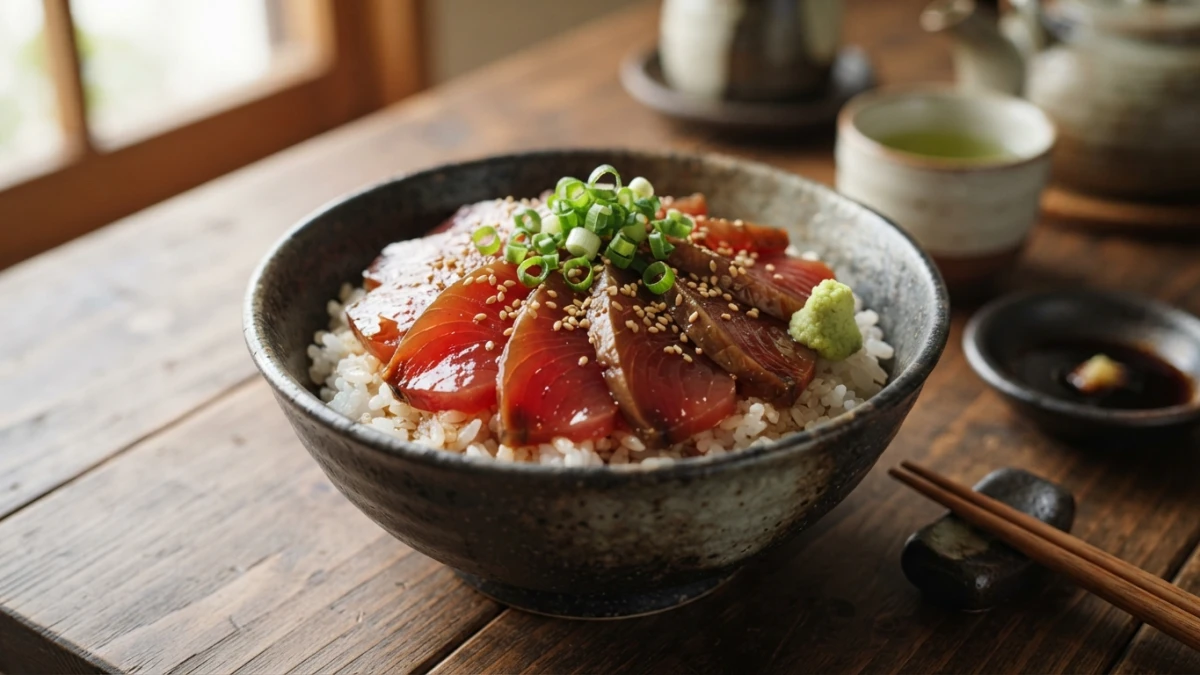
Maguro zuke is raw tuna marinated in soy sauce, sake and mirin. It is one of the classic techniques of Edomae-style sushi and the origin of the cured tuna nigiri served at sushi bars all over the world.
In Japanese, zuke means soaked or pickled, so maguro zuke translates literally as pickled tuna. On menus and food blogs it appears spelled several ways: tuna zuke, zuke tuna, zuke maguro or, as it sounds, dzuke. They all name the same dish. It is also described simply as soy-marinated tuna, which says exactly what it is.
What maguro zuke is (and what it is not)
Maguro zuke is a cut of tuna, usually the lean loin or akami, dipped for a few minutes or hours in a mix of shoyu (soy sauce), sake and mirin. The salt in the soy sauce draws some water out of the surface of the fish, the flesh firms up, the flavour concentrates and the colour deepens: the inside stays bright red while the outer layer darkens slightly. That contrast in colour and texture is the signature of the dish.
It is worth separating it from preparations it gets confused with. It is not a ceviche: there is no lemon or any citrus cooking the fish here. It is not a tataki either, because nothing is seared on a griddle. Nor is it a long marinade used to add flavour, but a Japanese technique with its own name and its own timing, and that timing is exactly what decides the result.
Where it comes from: an Edomae technique born without refrigeration
Zuke is one of the classic preparations of Edomae-style sushi, the style that developed in Tokyo in the 19th century. Back then the fish reached the city with no cold chain, and cooks had to buy themselves hours before serving it, so they soaked it in soy sauce.
The soy acted as a mild preservative, through salt and the absence of oxygen, and at the same time improved tuna that was not always at its best. When refrigeration arrived, the method was no longer needed to preserve anything, but it stayed on the menus because the flavour it produces cannot be achieved with fresh fish. The same idea was applied to other lean fish, such as bonito (katsuo no zuke). Oily fish take another route: mackerel is cured with salt and vinegar in shime-saba, a different technique that should not be mixed up with this one.
Which tuna to use and why only the lean cut
The starting piece matters more than the marinade. Akami is the lean, red flesh, the cut that takes soy sauce best: it holds up to soaking without losing texture and its flavour concentrates instead of becoming saturated. The fatty belly cuts, chutoro and toro, are almost always served as they are, because their fat and texture are lost in a marinade. To see that contrast, the toro sashimi page shows the fatty cut in its natural form.
When you buy it, the tuna has to be suitable for raw consumption (sashimi grade), with a clean red colour, a neutral smell and no streaks or brown patches. If the piece is very sinewy, trim that away before marinating. Canned tuna or ordinary frozen tuna are for cooking, not for zuke, because their flavour and texture are already transformed; if that is what you have at hand, see how to cook frozen tuna steaks.
The marinade: shoyu, sake and mirin
The basic marinade has three components and each one adds something different. Shoyu brings the salt and the umami; sake brings alcohol, which carries aromas and softens the flavour; mirin adds sweetness and shine. Many cooks prepare it as nikiri, briefly heating the soy sauce, sake and mirin to evaporate the alcohol before letting it cool and using it.
There is no single correct ratio, but the most repeated one is 3 parts soy sauce to 2 parts sake and 1 part mirin, with variations such as 2:1:1 or simply soy sauce and mirin. What matters is the balance between salt and sweetness. Ginger, garlic, spring onion, a piece of kombu seaweed, a touch of sesame oil or a little dashi all work as additions. Too much garlic and ginger will mask the tuna, so use them lightly. And one hygiene rule: a marinade that has touched raw fish is not reused for cold serving; if you want to keep it, boil it first.
How long to marinate it (and what happens if you overdo it)
Timing depends on thickness. Thin slices: 10 to 30 minutes. Thick blocks or cubes: from 1 hour to several, always covered and in the fridge. In professional sushi there are blocks that spend the night in the marinade for a deep cure. The soy-marinated tuna recipe on this site uses 10 minutes, which is the express version and perfectly valid.
The most common mistake is leaving it too long. After about 30 to 60 minutes, thin slices start to cure too far: the surface turns grey, tough and cooked in texture, and there is no way back. If the fish has gone too far, lift it out, pat it dry and serve it anyway, but the point of the dish is gone. Two tips decide the result: always marinate in the fridge, never at room temperature, and dry the fish as soon as it comes out of the marinade, because excess liquid makes the rice soggy and the dish falls apart.
How to serve it: nigiri, zuke don and other ways
The best known form is nigiri zuke: a slice of tuna over a ball of rice with a touch of wasabi. At home, the easiest option is maguro zuke don, a bowl of rice topped with the tuna, sometimes with nori seaweed, sesame and spring onion. It also works in chirashi, in hand rolls or as an onigiri filling, where the concentrated flavour goes a long way.
Rice is where most people go wrong. The traditional choice is sushi rice (shari), meaning vinegared rice brought to room temperature, not hot rice straight out of the cooker: if it is served hot, the fish cooks from the residual heat. The sushi rice page and the article on onigiri fillings help here.
Assembling it at home is simple: cut the slice across the grain, lay it over the rice and finish with spring onion, sesame and a little wasabi or shiso. Serve it with miso soup and tea; creamy sauces cover up exactly what this dish is about. If you want the wider context, the pages on nigiri sushi and Japanese sushi go further.
How many calories maguro zuke has
It is better to add it up piece by piece than to give a single number. Lean tuna is around 110-130 kcal per 100 g, so a 150 to 200 g portion provides about 190-270 kcal. Vinegared rice adds around 200 kcal per 150 g, the marinade left on the fish contributes little (about 15-30 kcal) and sesame, roughly 15.
With those figures, a homemade maguro zuke don lands around 400-550 kcal per serving, in line with the databases that put a 250 g bowl at about 400 kcal. As nigiri, each pair of pieces adds about 90-110 kcal, almost all of it rice. These are estimates based on reference values, not a laboratory analysis. The good news is that it is a high-protein, low-fat dish: what makes it heavy is not the tuna, it is the amount of rice, the sesame and any extra sweet dressing.
Raw fish safety and common mistakes
If you are going to eat raw fish at home, the most important question is preventive freezing. Standard food safety guidance calls for freezing the fish before eating it raw: -20 °C for at least 7 days, or -35 °C for 15 hours, unless it already comes treated for sashimi. The procedure is the same one we explain for freezing raw salmon.
There are two real risks and there is no need to dramatise them. Anisakis is a parasite that dies with intense cold or with cooking above 60 °C. Scombroid poisoning, on the other hand, is the histamine reaction typical of tuna, bonito and mackerel when the cold chain breaks, and it is not destroyed by freezing or cooking. The answer in both cases is the same: very fresh fish, kept cold at all times and never left to come up to room temperature.
Pregnant women, the elderly, immunocompromised people and small children should avoid raw fish. And a handful of mistakes ruin the dish: marinating at room temperature, reusing the raw marinade, serving zuke over hot rice, leaving it in too long and using a fatty cut instead of akami. For the exact amounts and steps, the soy-marinated tuna (maguro zuke) recipe is the place to start.