Iskender Kebab: What It Is, Where It Comes From and How It Differs from Döner
 By
Diego Cortés
By
Diego Cortés
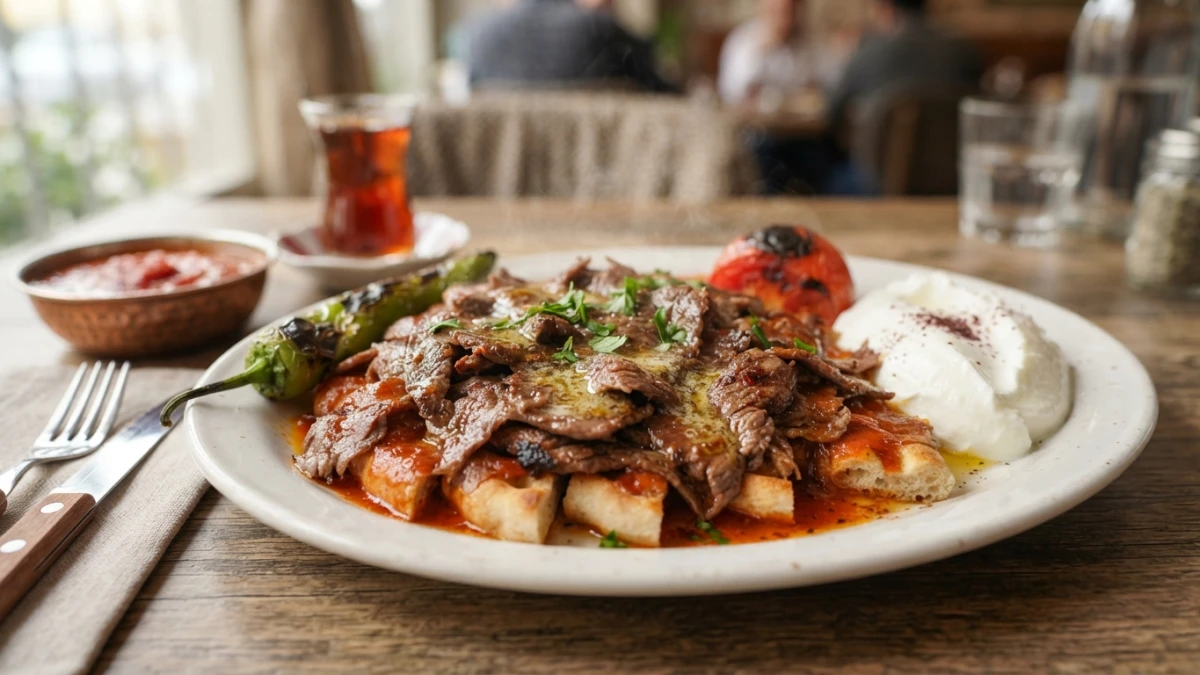
Iskender kebab is doner meat sliced thin over pieces of pide bread, with hot tomato sauce, melted butter and yogurt on the side. It is a plated dish from Bursa that you eat with a fork and knife, not a sandwich and not a dürüm.
What defines the dish is how it is built: a base of torn flatbread, the meat on top, then the tomato sauce with golden butter poured over it and, on the side, the yogurt. Each element arrives in its own layer and the diner mixes them bite by bite. Without bread, without yogurt and without butter there is no iskender, only roast meat. In Turkish it is spelled "kebap" and the dish also travels as iskender döner or "Bursa kebabı"; "Iskender" is not a technique or a flavor, it is the proper name of the butcher the dish is attributed to.
What iskender kebab is (and what it is not)
Iskender is a way of serving doner, not a different meat. The meat comes off the same vertical rotisserie and is cut into thin slices; the difference is what happens next: the dish is built on bread, dressed with tomato sauce and butter, and served with yogurt. That is why you eat it with a fork and knife. It is not a light starter either, but a substantial main course meant for one hungry person. And it is not spicy by default: the heat is added separately, with pepper flakes.
The same confusion follows the names of the family. Doner is the meat from the rotisserie; dürüm is that meat rolled in a thin flatbread; iskender is the plated dish. All three come from the same vertical rotisserie and none of them means the same as the others.
Where it comes from: Bursa, 1867 and a butcher named İskender
The most widely told account places the origin in Bursa, in northwestern Turkey, and dates it to 1867, in the Kayhan market (Kayhan Çarşısı). It is the version the İskender family business itself promotes and the one repeated in accounts of the dish. According to that story, İskender Efendi, the son of a butcher in Bursa, is credited with the idea of separating the meat from bones and sinews and cooking it while turning on a vertical spit in front of the fire, instead of roasting a whole lamb parallel to the ground. It is best taken as the most widely spread version rather than a settled academic fact.
What does hold up is the weight of the place: Bursa remains the reference point for iskender, and the lamb of the area, fed on mountain herbs on the Uludağ plateau, is part of its identity.
What it contains and how it is served at the table
The dish rests on four pillars. The meat: lamb, beef or a mix of both, cut into thin slices and served hot. The bread: torn pide, the Turkish flatbread that also serves as the base for other dishes. The sauce: tomato cooked with paprika, salt and a touch of sweetness, served very hot. And the golden butter, poured over the sauce at the moment of serving, plus the thick natural yogurt, ideally strained, which arrives separately on one side.
In a restaurant the plate arrives steaming, with the butter sizzling, the yogurt in its corner and, often, roasted tomato and pepper alongside; some places add a köfte, a meatball, on top of the meat. In Turkey it is served with ayran (the cold yogurt drink) or şıra (grape must), and tea afterwards; outside Turkey, a cold soft drink is enough. The right move is to mix a little of everything into each bite, not to douse the whole plate at once.
How it differs from doner, dürüm and shawarma
The four terms get confused because they share the rotisserie, but they describe different things. Doner is the meat from the vertical spit, on its own, in bread or on a plate; dürüm is that meat rolled in a thin flatbread; shawarma is the Arab cousin, with other spices, other sauces and another bread, and even though the rotisserie looks similar, it is another cuisine; and iskender is a plated dish with bread, sauce, butter and yogurt, eaten sitting down. To compare the calorie load of that Arab cousin, the site has a separate article on mixed shawarma calories, and the mixed Arabic shawarma recipe covers how to make it.
The rule for deciding is simple: with cutlery and with the contrast of hot and cold on the same plate, iskender; for takeaway or on the go, doner or dürüm; and if what you want is the spiced, tangy flavor of shawarma, that is another cuisine, even if the rotisserie looks the same.
How many calories iskender kebab has (and what pushes them up)
There is no official table for the dish, so the reference has to be built piece by piece from cooked food values. A restaurant portion with 150-200 g of sliced meat comes to roughly 400-560 kcal; the torn pide adds about 220-280; the golden butter, 100-150; the tomato sauce, 30-60; and the whole-milk yogurt, 60-110. The total usually lands between 700 and 1,000 kcal, and generous servings go past 1,000. It is an estimate based on reference values, not a laboratory analysis.
What pushes the number up is easy to spot: the butter, the amount of bread, the whole-milk yogurt (strained yogurt is fattier than light natural yogurt), the size of the meat portion and the extra köfte. To bring it down you can ask for more yogurt and less butter, choose the chicken version, cut back on bread and add a salad on the side.
Be wary of the figure that circulates in several online tables: when one of them says "212 kcal" for iskender kebab, it almost always refers to 100 g, not to the whole dish. That is one reason the published numbers look so contradictory, and also why the site's recipe card still does not declare calories in its nutrition data.
How to order it and how to eat it in a Turkish restaurant
The menu translates easily: ordering "an iskender" means ordering the full dish; if you order "doner", something else will arrive, meat in bread or on a plate, without the characteristic sauce and yogurt. The yogurt comes separately so each diner can mix it to taste, and if you want less butter or less sauce, you ask when ordering.
How you eat it also has its logic: take a little yogurt with meat and bread in each bite, so the contrast between hot and cold happens in your mouth rather than on the plate. At the end you order ayran or tea, which cut through the fat; and for anyone without a Turkish restaurant nearby, the dish can be assembled at home with sliced meat and flatbread.
Variations and the homemade version
The real variations are few: chicken iskender, the version with Turkish white cheese, the one with an added köfte and the no-butter version. Outside Turkey there are dishes called iskender that are really plated doner without yogurt or sauce: the name stretches further than the recipe allows.
At home the shortcut is to use homemade doner or very thinly sliced, quickly seared meat, warm torn bread and build it in layers: bread, meat, tomato sauce with paprika and yogurt whisked with garlic. The quantities and steps are in the site's iskender kebab recipe, and for the parts separately the dürüm chicken kebab covers the meat. If the base is homemade flatbread, pita bread works just as well as pide.
There is one texture detail worth copying: the meat goes in slices and not in chunks, the bread has to be warm and the butter must melt as it is served. The dish cools quickly and the bread goes soggy, so the assembly happens at the very end, with everything else ready.
Common mistakes and frequent questions
Three misunderstandings come up again and again. Pide is not pita: pide is a Turkish flatbread torn into cubes and soaked by the sauce, while Greek or Arab pita is another bread, thinner and meant for filling. Kebab does not name a single dish but an entire family of preparations. And iskender is not spicy by default: the heat is added separately with pepper flakes.
On preparation: can it be made ahead? The meat yes, the assembly no, because the bread goes soggy; leftovers? reheat the meat separately and toast the bread again; is it a light dish? no, it is a large, fat-rich portion. In short, iskender kebab is a way of serving doner, and before making it at home you should read the site's iskender kebab recipe card, because the proportions of butter, sauce and yogurt are what change the result.