Lyonnaise and Piedmontese Mashed Potatoes: What Goes Into Each and How They Differ
 By
Diego Cortés
By
Diego Cortés
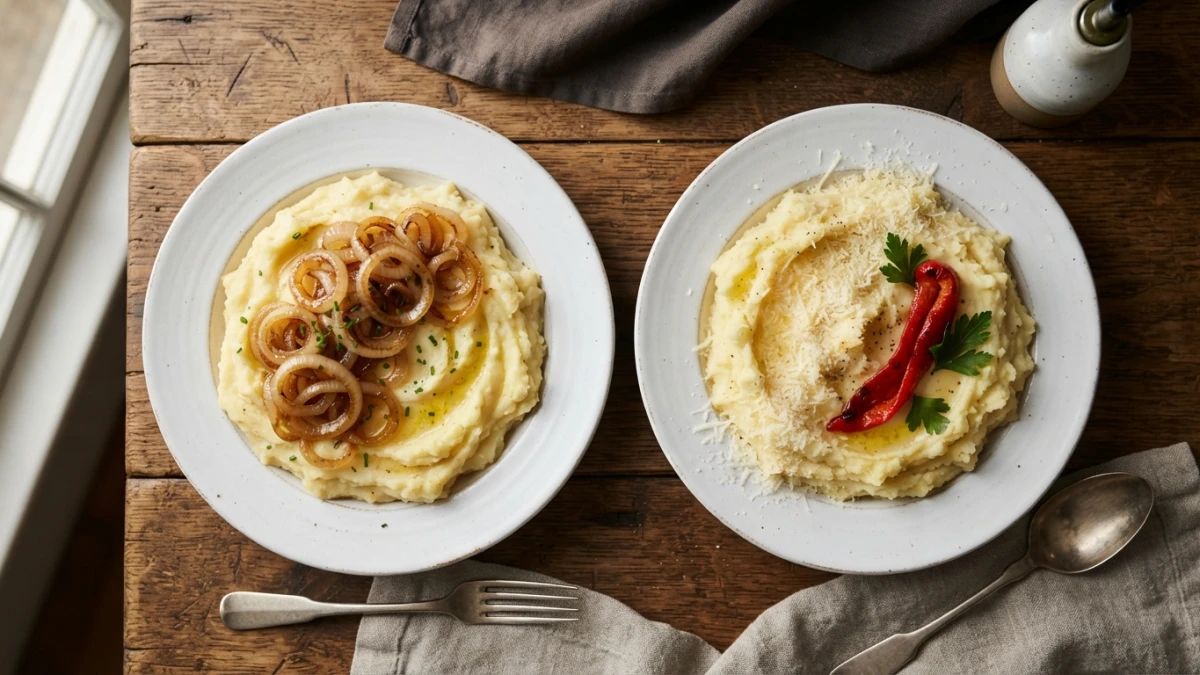
Lyonnaise mashed potatoes are creamy mashed potatoes with caramelized onion folded right in; Piedmontese mashed potatoes are the same mash enriched with parmesan and red pepper. They are not synonyms: each one has its own star ingredient and its own character at the table.
What Lyonnaise mashed potatoes are, and what "à la lyonnaise" means
Saying "à la lyonnaise" means "with onion". It is a French cooking term tied to the city of Lyon, where onion takes the leading role in soups, sauces and side dishes. The dish behind it is a classic preparation of potatoes boiled and then browned in butter with plenty of onion; what gets cooked in Chile is the gentler home version: floury potatoes mashed with butter and warm milk, plus julienned onion cooked slowly until golden and sweet.
It is worth clarifying what it is not: Lyonnaise mash is not an onion sauce poured on top, and it is not plain mash with raw onion mixed through. The onion goes in at the end, folded gently, bringing sweetness, shine and aroma. If the mash turns watery or the onion still tastes raw, the dish loses its reason to exist.
One execution detail most people miss: onion needs time, not heat. It takes twenty to thirty minutes over medium-low heat to release its sugar and turn golden. Garlic, if used, goes in only during the last few minutes so it does not turn bitter.
What Piedmontese mashed potatoes are, and where the name comes from
If the question is what goes into Piedmontese mash, the short answer is potato, dairy and cheese. It starts as a traditional mash with milk and butter, and at the end you fold in grated cheese (parmesan is the classic), a quick saute of red pepper strips with garlic, and the final seasoning of salt, pepper and nutmeg. That red pepper is what sets it apart from any cheesy mash and gives it a sweet, vegetal base that cuts through the fat.
The name points to the Italian region of Piedmont, and the idea it carries is that of a mash enriched with dairy and cheese. That said, the version cooked in Chilean homes, with red pepper strips and parmesan, is a local adaptation: there is no canonical Italian recipe with a protected designation behind it, and there is no documented record of who popularized it. Saying so is more honest than inventing a nice story.
Each ingredient has a specific job. Cheese brings salt and depth, butter brings silkiness, milk brings the right texture and red pepper brings the sweet counterpoint. The useful warning comes with the cheese: add it off the heat and in two or three additions, because if it gets too hot it clumps and the mash turns stringy.
Key differences between Lyonnaise and Piedmontese mash
The contrast makes sense along three axes. The ingredient that leads: caramelized onion in one case, cheese and red pepper in the other. The direction of the flavor: sweet, aromatic and faintly tangy for the Lyonnaise; dairy-rich, salty and lightly toasted for the Piedmontese. And color and texture: the Lyonnaise is more golden, with visible strands of onion; the Piedmontese is paler, even and silky.
The most common mistake is assuming they are the same dish under two names. They are not. A mash without onion is not Lyonnaise, and a mash with parmesan and onion is not Piedmontese: the confusion comes from the fact that both are upgraded mashed potatoes and both get served with the same things.
The decision rule, for anyone cooking today. If the main dish already brings fat or sauce (braised beef, chicken with peas, breaded cutlets), go Lyonnaise, which lightens things with the sweetness of the onion. If the main is dry or plain (roast chicken, fish, a pan-seared chop), the Piedmontese adds creaminess and salt.
How they are served on the Chilean table
Both are lunch sides. The Lyonnaise is the classic partner for meat in sauce, chicken with peas and breaded cutlets; it also shows up in the plate of mash with grilled pork chop and fried eggs, which in many homes is a full meal on its own. The Piedmontese goes next to roast chicken, hake or steak, and handles a fried egg on top just as well.
There is a serving detail almost nobody explains: both are served warm and freshly made. If the mash waits in the pot while the protein finishes, it breaks and loses texture. The practical move is to make it last, cover it while you plate and take it to the table hot, with the side in the plate and the meat on top or beside it.
The 4 steps of a creamy mash (they work for both)
Before the ingredients, technique: a creamy mash is defined by four moments, and they are the same for both.
The potato and the drying
Use a floury potato, the kind that falls apart when cooked, cut into even cubes and cooked in cold salted water, never dropped straight into boiling water. Fifteen to twenty minutes is enough. Then drain well and let it steam for a minute so the trapped water escapes. The pressing that follows, with a ricer or potato press, is what keeps the mash light. Blending it or running it through a food processor overworks the starch and the result turns gluey: that is the number one mistake in any kitchen.
The fat and the liquid
Cold butter cut into cubes, melting from the heat of the potato, then warm milk added in a thin stream while mixing with a wooden spoon or spatula. Cold milk, straight from the fridge, is exactly what makes mash sticky.
The seasoning
Salt, pepper and freshly grated nutmeg, adjusted at the end. Nutmeg is what lifts both dishes.
The folding in
Only now does the star ingredient go in: the caramelized onion of the Lyonnaise or the cheese of the Piedmontese, folded gently rather than beaten hard. Keep a little onion back to scatter on top.
How many calories they add
Do not treat mash as the light part of the plate: it is not. The site recipe for Lyonnaise mash with caramelized onion makes six servings and lists 280 kcal per serving; the one for Piedmontese mash with parmesan makes five and lists 250 kcal. Recalculating from reference values lands in the same range, between 250 and 280 kcal, and it is worth presenting that as a table estimate, not a laboratory analysis.
What pushes the number up: butter and cream (each tablespoon of butter runs around 100 kcal), the oil the onion cooks in, more cheese than needed and, above all, portion size. What pushes it down: more potato and less fat, semi-skimmed milk, onion cooked with very little oil and a measured amount of cheese, which delivers a lot of flavor in a small volume. To compare the whole plate, the article with the per-serving calorie chart of 18 classic Chilean dishes is the natural starting point.
Mistakes that ruin mash (and how to fix them)
Three texture failures. Watery mash usually comes from badly drained potatoes or too much milk: fix it by cooking it a couple more minutes over low heat while stirring, or by adding a little very dry mashed potato. Gluey mash, caused by a blender or over-beating, has no real fix: accept it and serve it with more sauce. Sticky mash is prevented from the start, with warm milk and warm butter.
Two flavor failures. Onion that is colored outside and raw inside comes from high heat: it needs medium-low heat and time. And clumpy cheese is avoided by adding it off the heat in two or three handfuls, not all at once into a hot pot.
And one timing failure: reheating. Reheated mash dries out and breaks. If you have to store it, press film directly onto the surface and refresh it with a splash of warm milk and a knob of butter over gentle heat. Both are same-day dishes, not several-day dishes.
Other mash variations and what to serve them with
Around these two recipes sits a cluster of variations people mix up, and it helps to sort them out. Oven-gratinated mash is for when the oven is already on and you want a golden top. Rosemary mash works with grilled or roasted meat. Duchess potatoes, with egg yolk and butter, are richer and more delicate. Parisian or cream-style mash leans into silkiness. And mash with grilled pork chop and eggs makes a complete one-plate meal.
For exact amounts and steps, the Lyonnaise and Piedmontese recipe cards in the cookbook, linked above, are the place to go. And to see the whole cluster, the Mashed Potato category gathers fifteen variations, with the Chile tag for the local context.