Pancit Batil Patong: What It Is and How to Eat Tuguegarao's Noodle Dish
 By
Diego Cortés
By
Diego Cortés
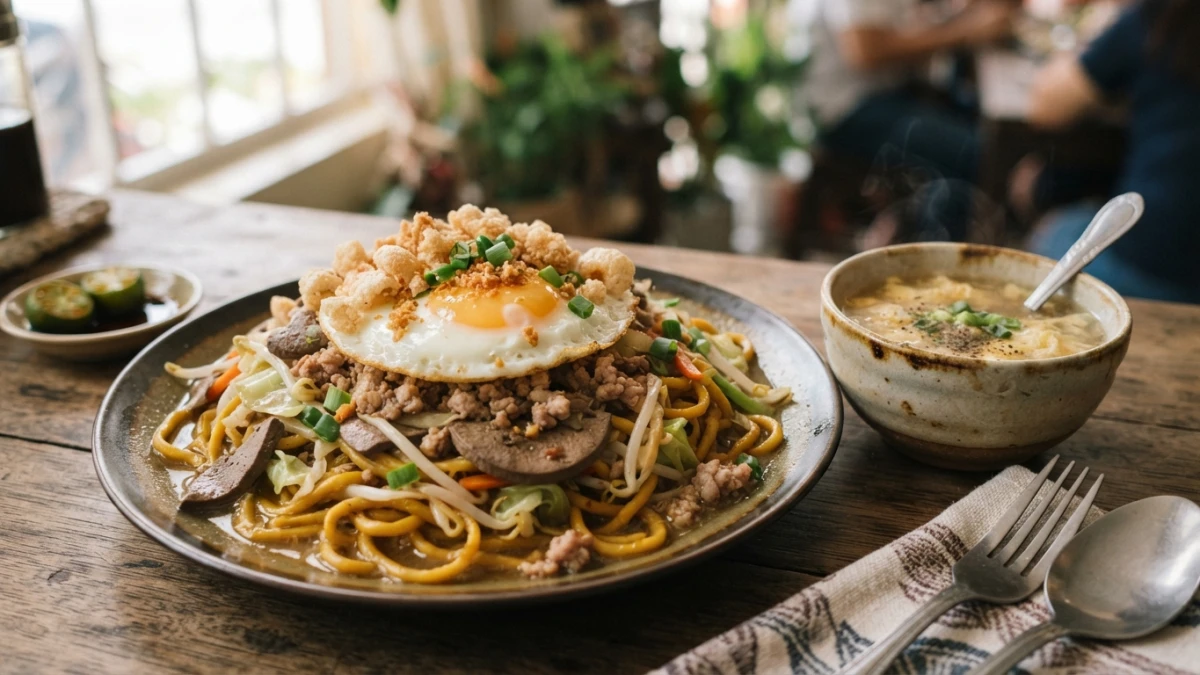
Pancit batil patong is a Filipino noodle dish from Tuguegarao City: fresh miki noodles topped with minced meat, pork liver, bean sprouts and an egg, served with a bowl of broth with beaten egg on the side. It is not a side dish: it is a full panciteria meal.
What pancit batil patong is (and why it is not just another pancit)
What arrives at the table makes sense at first glance: a mound of thick, yellow miki noodles, glossy from the toss, with meat and vegetables on top, an egg crowning it, crushed chicharron and, next to it, a steaming bowl of broth with beaten egg. You break the yolk and mix it while eating: that is the sauce. It comes from Tuguegarao, the capital of Cagayan in northern Luzon, and it is exactly what does not show up in photos of other pancit.
This article covers where it comes from, what the name means, what goes into it, how it is eaten in a panciteria, how many calories a plate has and how it differs from bihon, canton and palabok. Anyone looking for amounts and steps will find them in the step by step pancit batil patong recipe, which this article does not repeat.
Where it comes from: Tuguegarao, Cagayan and the pancit of the valley
Pancit reached the Philippines with Chinese influence, but batil patong is a local invention of Tuguegarao, the capital of Cagayan, in the valley of the same name in northern Luzon. What has been researched about its history places the modern dish in the city's panciterias in the 1960s; the name of the first pancitero is not documented, so it is worth saying plainly: there is no proven inventor.
What gives it character is how it adapted to what the area had: the cooking of the valley took wheat noodles and turned them into a dish of its own with carabeef and beef broth, instead of the meats and sauces of the urban pancit of Manila. It is served all year round and at any hour, and it is both panciteria fare and a local celebration dish.
Outside Tuguegarao and the Cagayan valley it is little known: it travelled with the Filipino diaspora and today it is searched in English (pancit batil patong) as much as in Tagalog. And no source measures which is the best pancit in the Philippines, so nothing of the sort is claimed here.
Batil patong: what the name means
The name breaks into two words and describes the technique and the assembly, not an ingredient or a surname. Batil is the beaten egg stirred into the hot broth until it forms an egg soup. Patong is what is placed on top of the noodles, meaning the egg that crowns the plate.
Several spellings show up online for the same dish: batil patong, batil patung, batilpatong and even batil-patong. In English it is written pancit batil patong, and it is also called pancit Tuguegarao or Tuguegarao pancit, which is how people order it when they cannot recall the full name.
What organizes the dish is two eggs and two moments: the one beaten into the broth and the one placed on the noodles. That is where half the confusion comes from for anyone expecting a regular tossed pancit and finding a soup on the side.
The three parts of the dish: miki, sahog and batil broth
The noodles are miki: fresh, thick, yellow egg noodles with a slight chew that, unlike canton, are not served dry but saucy, tossed with soy sauce and the broth of the meat. If fresh miki is not available, the homemade version works with fresh egg noodles, never with dried rice noodles; the timing and salt for that cook are covered in the guide to cooking pasta and noodles with the right texture.
The sahog are the toppings: minced meat, pork liver, bean sprouts (togue), cabbage and scallions, plus the egg on top and, in a panciteria, crushed chicharron and pieces of lechon carajay. The liver signs the flavor and the togue freshens it.
The broth is half the identity of the dish: hot broth from the same meat with beaten egg, served in its own bowl, to sip on the side or spoon over the noodles. On the table there is also calamansi (or lemon), soy sauce, vinegar and chili to build the seasoning.
The ingredients that define the flavor: carabeef, liver and togue
Carabeef, water buffalo meat, is the traditional meat of the dish and the reason it tastes unlike any other pancit. In Cagayan it is the everyday meat: leaner, deeper in flavor and cheaper than beef, which is part of why it became the base of the dish. Outside the Philippines it is replaced by minced beef or pork without drama.
The toppings build the texture: minced pork liver with its mild bitterness, crunchy togue, cabbage and, in some versions, carrot; plus scallions and fried garlic. On top, the egg brings creaminess once the yolk is broken.
What only shows up in the panciteria version is crushed chicharron and lechon carajay, which push the plate up in calories and heft. The home version on this site uses ground pork, which is the practical substitute for carabeef.
How to eat it: crush the egg, squeeze the calamansi and taste the broth
First you break the yolk and mix it into the hot noodles so it coats the strands. Then you squeeze the calamansi and add the mix of soy sauce, vinegar and chili to taste, stirring again. That order is what almost nobody explains and what changes the dish.
With the broth there are two schools: those who drink it on the side, in sips between bites, and those who spoon the batil over the noodles so the plate turns soupier. Neither is the right way: in Tuguegarao both are done. The togue is eaten raw, without cooking.
It is eaten very hot, with a spoon and fork, in a deep plate or bowl. At the panciteria you order it special when it comes with the extra toppings, and it is usually paired with a bowl of the house soup. The sign of a good serving is that the noodles are neither dry nor stuck together.
How many calories are in a plate of pancit batil patong
The house count comes from the recipe on this site, which yields 4 servings with 250 g of miki noodles, 250 g of ground meat, 4 eggs, oil, soy sauce and fish sauce: adding reference values for each ingredient gives roughly 2,050 kcal per batch, or about 500 kcal per serving, broth included. It is an estimate based on reference tables, not a laboratory analysis.
The real range is wide because it depends on the size of the serving and what goes on top. Light home recipes declare about 230 kcal per plate, while labeled commercial products reach about 980 kcal per pack; the difference lies in the amount of noodles, the type of meat, the oil and whether the serving includes lechon carajay and chicharron. For a panciteria serving, the dish sits between 700 and 950 kcal.
In practice: order the regular portion instead of the special, load the plate toward cabbage and togue, use lean meat, go easy on the tossing oil and have the batil without extra egg, and season with calamansi instead of sweet sauces. It is a complete dish: it needs no starter or side.
Pancit batil patong, bihon, canton and palabok: how they differ
All four in one quick mental table: bihon uses thin rice noodles tossed with vegetables; canton uses wheat noodles, tossed with vegetables, with no broth on the side; palabok uses rice noodles with shrimp sauce and chicharron; and batil patong is the only one with miki noodles, a meat and liver topping and a batil broth served in its own bowl.
The mark that sets it apart from all of them fits in one sentence: batil patong is not canton with soup. It is a two-part dish, noodles and broth, where the egg shows up beaten into the broth and placed on the noodles, and where the traditional protein is water buffalo meat.
To keep going: the recipe page has the amounts and the steps, the pancit bihon is there to compare the other pancit in the collection, and the Filipino cooking tag holds balut, puto maya with sikwate, belekoy and choco german, along with Filipino adobo.
Note: if it is your first time, ask for the broth in its own bowl and take a sip before deciding whether to pour it over the noodles; that way you taste both versions of the dish at the same table.