Choco German Bread: What It Is and Why It's Not German
 By
Diego Cortés
By
Diego Cortés
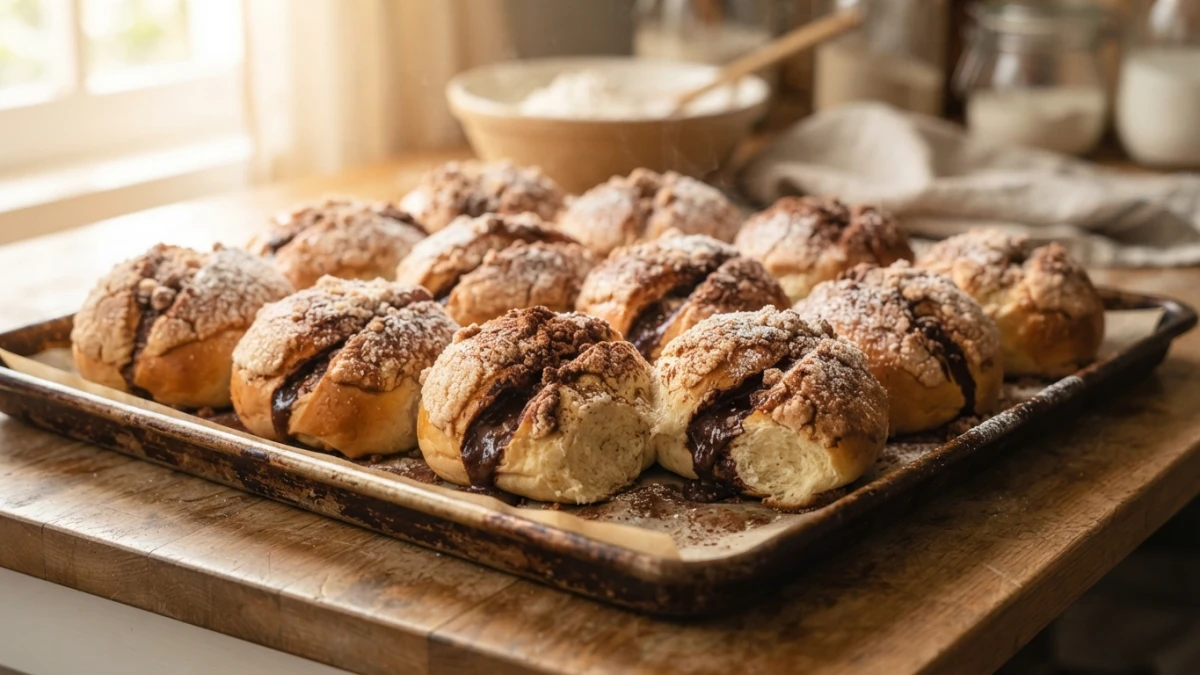
Choco german is a Filipino bakery bun: soft, barely sweet yeast dough, a cocoa paste filling and a sugary crust that cracks when you bite it. It bakes in 15 to 18 minutes and is sold by the piece. It is not German, despite the name.
On the bakery tray it shows up in two different shapes, and that explains half of the confusion around it. It also explains why one shop calls it pan de choco and the next calls it choco german, with no change in the recipe.
This article covers what it is, where the name came from, how it differs from the chocolate bread you already know, where it fits on the Filipino table, how many calories it has and how to store it. The steps and amounts are in the homemade choco german bread recipe.
What choco german is: the bakery bun that is never baked in Germany
The base is an enriched dough: flour, milk, egg, butter and yeast, filled with a paste of cocoa powder, sugar and butter, and finished with a sugary crust. There is no ganache and no melted chocolate bar. The result is a tender bread, barely sweet in the crumb and with a cocoa centre that tastes softly bitter.
Two shapes share the tray. The first is a long, flattened roll with slashes on top, where the filling shows as it bakes; many bakeries simply call it pan de choco. The second is the round bun with a sugary topping, the most common version at bakery chains. Each one weighs between 70 and 100 grams and is sold loose, never bagged: this is bread meant to be eaten the same day.
Why it is called choco german when it is not German
The first thing that can be stated is the awkward part: there is no documented German origin for this bread. It is a Filipino bakery invention, and the word german works as a trade name, not as a description of where it comes from. Filipino baking is full of names that travelled and stayed, such as Spanish bread, which is not Spanish.
The theories that circulate should be read as oral legend, not history. One story says german entered as a label for the rich bread, heavy on butter and egg, at a time when German baking was associated with quality. Another repeats the tale of a baker trained in Germany, and a third points to a brand name that became generic. None of the three has a source that confirms it.
It is also worth clearing up the confusion that comes up most often: this bread has nothing to do with American German chocolate cake, which carries the surname of the chocolatier Samuel German. The name travels in English as choco german bread, even though the bread is only sold in the Philippines and in Filipino bakeries abroad.
Pan de choco, choco german and chocolate bread: three names for almost the same thing
In the Philippines, pan de choco, choco german, choco bread and chocolate bread all refer to the same familiar bun. The name changes with the bakery and the region more than with the recipe, and in Spanish-speaking bakeries it often appears translated as chocolate aleman.
What really sets this bread apart from Western chocolate bread is the filling: there is no ganache and no melted chocolate, but a thick paste of cocoa powder, sugar and butter, sometimes with a little flour or milk. That is why it tastes more of cocoa than of sweet chocolate. The topping is the other signature: sugar with butter or margarine that crystallises and crackles, or a sandy streusel-style crust rubbed in cold.
Where it fits: Filipino bakeries and merienda
To understand the bread you have to look at its ecosystem. The Filipino bakery has an everyday bread, pan de sal, and a sweet shelf where Spanish bread, pan de coco, ensaymada, monay and choco german sit together. Of all of them, choco german belongs to merienda rather than to breakfast.
Merienda is not a footnote: it is the mid-afternoon meal, and sweet bread is bought freshly baked, by the piece, to eat with coffee, hot chocolate or a soft drink. That moment explains why the bun is small and why it is not a cake. With the Filipino diaspora it travelled to the United States, the Emirates and the rest of Asia, and today it turns up in Filipino bakeries around the world.
What it tastes like and how it is eaten
The appeal of choco german is not sweetness, it is texture. The crumb is tender and pulls apart in strands, the dough barely sweetens, the cocoa filling has a soft bitterness and the crust brings the crunch. It is a soft bread with a thick filling, never a sponge cake.
It is eaten warm, just out of the oven; if it has gone cold, 3 to 5 minutes in a toaster or oven brings the crust back. A microwave ruins it, because the crumb turns rubbery. Spotting a good one on the counter takes three looks: a crust that cracks and shines, slashes that reveal cocoa filling rather than a hollow, and an even toasted base.
How many calories are in a choco german
The house reference is the site's own recipe: it makes 12 buns and lists 300 kcal per piece. This is a recipe estimate, not a laboratory figure, and in a bakery the real range is wide because both the weight of the bun and the amount of topping change.
With the method laid out, our own count comes in a little higher. Adding up the amounts in the recipe (500 g of flour, 100 g of sugar, 60 g of butter, egg, 250 ml of whole milk, plus the cocoa, icing sugar and butter filling and the flour, sugar and cold butter crust) gives roughly 4,100 to 4,500 kcal per batch, or about 340 to 380 kcal per bun, above the 300 listed. This is an estimate based on reference values, not an analysis. Without changing anything, it is enough to ask for the smallest piece, eat only half the topping and cut the sugar in the homemade version.
How to store, reheat and freeze it
The specific numbers: 2 to 3 days in an airtight container at room temperature, which is when it keeps best; up to 5 days chilled, at the cost of losing softness, which toasting brings back; and up to 2 months frozen, well wrapped in cling film and inside a bag. Thaw it at room temperature for 1 to 2 hours, or put it straight in the oven if it is going to be toasted.
Reheating is where the bread gets ruined: oven or toaster for 3 to 5 minutes over medium heat, never a microwave. One idea ties the rest together: choco german is a bakery bread, meant to be eaten the same day. That is why cold air hardens it sooner than you expect; the details are in the article on how to keep bread fresh longer.
Choco german at home: what decides the result
Technically it is a dough enriched with egg, milk and butter, fermented twice, filled with cocoa paste and topped before baking. The steps and amounts are in the homemade choco german bread recipe; this article explains, the recipe executes.
There are three points where home baking fails: milk that is too hot kills the yeast, so it should not go above 40 °C; the filling leaks through the seam if it is not sealed properly before shaping the bun; and the topping melts in the oven if the butter is not cold or if the dough is handled with warm hands. If you enjoyed Filipino cooking, the site also has balut, the fertilized duck egg, puto maya with sikwate and belekoy, plus Spanish bread and milk bread from the same sweet shelf. The Philippines tag rounds out the rest.