Belekoy: What the Filipino Sesame Sweet Is and How It Is Eaten
 By
Diego Cortés
By
Diego Cortés
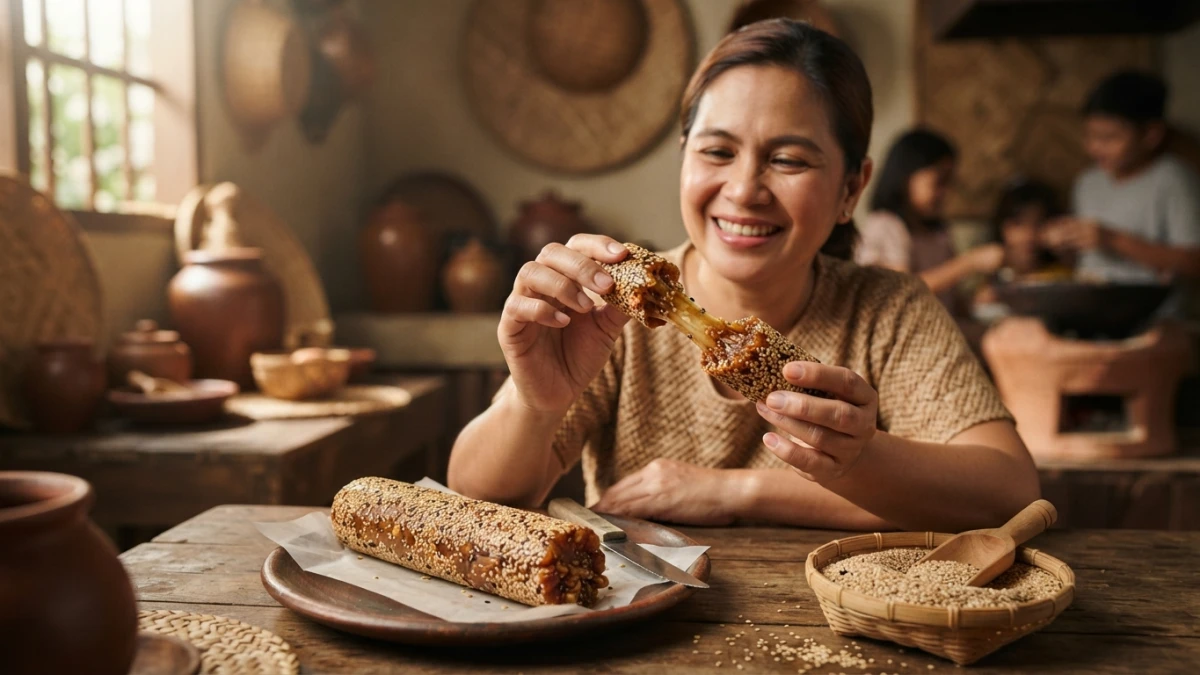
Belekoy is a Filipino sweet from the province of Bulacan: a chewy, sticky dough of glutinous rice flour cooked in a brown sugar syrup and coated, inside and out, with toasted sesame seeds.
What Belekoy Is (and Why It Is Called That)
It is worth saying up front what it is not. It is not a hard candy like a brittle, and not a crunchy nougat: it is soft, chewy and eaten in bites, somewhere between a soft caramel and a rice cake. As for the name, honesty comes first: belekoy is a Tagalog word for a soft, very chewy sweet that sources translate as "taffy" or "chewy candy", with no documented etymology.
In your hand you recognise it quickly: a bar or a disc ranging from golden brown to almost black depending on how long the flour is toasted, a surface studded with sesame, a piece that gives when pressed and keeps the mark of your fingers, and a taste of toasted brown sugar with the bittersweet edge of sesame. Here is the rest: where it comes from, what is in it (no quantities), how it is eaten, how to recognise a good one and its calories. The step-by-step method with quantities lives in the full belekoy recipe, step by step.
Where It Comes From: Bulacan, Rice and Sugar
Belekoy is placed in Bulacan, the province of Central Luzon just north of Metro Manila. That makes sense: it is rice and sugarcane country, so the same pantry supplies its two base ingredients, glutinous rice flour and brown or muscovado sugar. Local glossaries list it among the province's classics, alongside the biscocho of San Miguel or the chicharron of Santa Maria.
About its beginning, one thing has to be clear: no source fixes a date, an author or an exact town. What does get repeated is that this is a home sweet, passed down from generation to generation and born from making the most of two crops that were always there. It belongs to the kakanin, although it is sold as a candy rather than a table rice cake, and to the culture of pasalubong. The site already covers other kitchens from that table, such as balut and puto maya with sikwate.
What Belekoy Is Made Of: Glutinous Rice Flour, Sugar and Sesame
The ingredients come in four blocks, and each one does a different job: glutinous rice flour gives the elasticity and the chew (it is not ordinary rice flour; "glutinous" does not mean it contains gluten, it names the starch that produces the sticky texture); brown or muscovado sugar sweetens and gives the caramel colour; toasted sesame goes inside the dough and on the outside as a coating; and vanilla rounds off the flavour. Many modern versions cook the syrup with apple juice, which brings acidity and a fruity note. These are documented variations, not steps in a method.
What really defines the sweet are two gestures that never appear in a list of ingredients: toasting the rice flour and the sesame before cooking, because that toasting gives the colour and the nutty flavour and without it belekoy comes out pale and tasting of raw flour; and greasing your hands and the surface when shaping it, because the hot dough sticks and cannot be moulded. To go deeper, the site has the properties of sesame and a guide to making homemade rice flour.
How Belekoy Is Eaten: Merienda, Coffee and Roadside Pasalubong
Its natural moment is the merienda: mid-afternoon, one bar at a time, with coffee, tea or cold water, because the sweetness and the sesame call for something to drink. In the Philippines it is also the treat children take to school, and it leaves your fingers sticky. It is not a spoon dessert or something you cut up to share: it is a hand-held candy.
Its other signature is the road: for decades it was sold at bus terminals and provincial stops, where vendors climbed onto the bus to offer small packets for a few pesos; Filipino media now describe it as a classic fading in the face of imported sweets. The third setting is pasalubong: you buy it on the way back from Bulacan as a travel gift, which is why it is sold in bars wrapped in cellophane and why abroad it shows up labelled as belekoy candy.
How to Recognise a Good Belekoy (and the Mistakes That Ruin It)
The signals are in the piece: even golden-brown to dark colour, generous sesame that is properly stuck on, a bite that resists but yields, a tender centre with no lumps and a taste of toasted sesame and sugar; if it snaps apart it was overcooked, and if it crumbles and smears it was underdone. The three most common mistakes are untoasted flour (a taste of raw dough), a syrup that never reaches the right point (the dough does not set) and burnt or rancid sesame (bitterness). That point explains why a stale belekoy tastes bad: sesame is rich in oil and heat and humidity turn it rancid, so "hard and bitter" is not a texture, it is deterioration.
Belekoy and Other Filipino Sweets: How They Differ
| Sweet | Base | Texture | Format |
|---|---|---|---|
| Belekoy | Glutinous rice cooked in a brown sugar syrup | Chewy, between caramel and rice cake | Sesame inside and out; wrapped bars or discs |
| Pastillas de leche | Milk and sugar reduced down | Soft and creamy | Cylinders wrapped in paper |
| Yema | Egg yolk with condensed milk | Creamy and rich | Sugar or caramel |
| Polvoron | Toasted milk powder with sugar and butter | Dry, melts in the mouth | Pressed mould, no coating |
| Espasol | Toasted, ground glutinous rice | Soft and floury | Toasted grated coconut |
| Sesame brittle or turron | Caramelised sugar with sesame | Hard and crunchy | Brittle slab |
The real difference is technical: belekoy is the only one in the family made by cooking the flour inside the syrup, which produces a plastic dough you cut and roll rather than something you set. As for the sesame sweets map: belekoy is chewy, brittle and turron are hard and crunchy, and Chinese glutinous sesame balls are chewy but without the brown sugar syrup. The hub for the cluster is the Philippines tag, with recipes such as pancit batil patong and champorado, and the sweet itself lives in the jams and sweets category.
How Many Calories Belekoy Has
The composition tables cited put it at roughly 350 to 400 kcal per 100 g, depending on the proportion of sugar and the method: it is a concentrated sweet, with very little added water beyond what evaporates, so the energy per gram is high for a "small candy".
| Measure | Calories |
|---|---|
| Published reference | 350-400 kcal per 100 g |
| One batch from the site's recipe | about 1,150 kcal (our calculation) |
| If it yields 20 pieces of 20 to 23 g | 55-60 kcal per piece |
| If it yields 12 bars of about 38 g | 95 kcal per bar |
Two clarifications, because the calculation is our own: the dough loses water as it cooks, so the energy per 100 g of finished sweet sits above the simple division; and of that energy, a third comes from the brown sugar and a quarter from the sesame. The advice is not a ban but a portion: it is a candy, not a dessert, and best enjoyed one piece with coffee or tea. It is not an option for anyone watching their sugars, and dark muscovado sugar does not make it lighter: it changes the flavour, not the count.
How to Store Belekoy and Where to Find It Today
In an airtight container in a cool, dry place it keeps well for a few days; the site's recipe card suggests the refrigerator for up to 3 days in a closed container. The dangers are humidity, because brown sugar is hygroscopic and the piece turns soft and sticky, and heat, which melts the dough and turns the sesame rancid; wrapping each bar in cellophane, as it is sold, stops the pieces sticking together. It tolerates being frozen wrapped and airtight, because it is sugar and rice with no dairy or egg, and it thaws at room temperature; microwaving it is not advisable, because the sugar heats before the dough and the piece loses its shape.
Where to find it? In Bulacan markets and delicacy shops, at bus terminals across Central Luzon, in pasalubong shops and in Filipino grocery stores abroad, where it is usually sold as belekoy candy. If you like rice sweets, the same table on the site has bibingka, halo-halo and taho, and the model for the genre is the article on what balut is.
Belekoy, in the end, is a sweet from another time: slow in the pot, cheap and generous with sesame. Next time you see a bar wrapped in cellophane in a Filipino shop, you will know what it is and why it is worth trying next to a cup of coffee.