Kubdari: What Georgia's Meat-Filled Bread Is and How It Is Eaten
 By
Diego Cortés
By
Diego Cortés
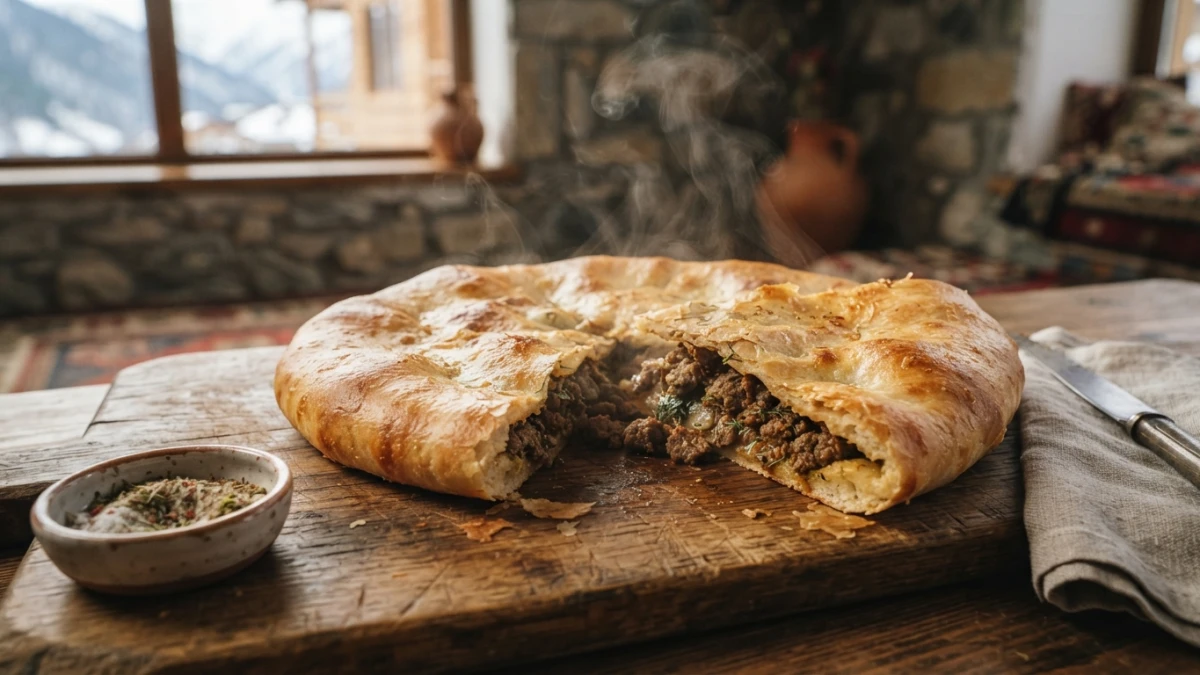
Kubdari is the round loaf of leavened wheat dough that Svaneti seals around spiced meat: it is baked until the crust browns, brought whole to the table and cut into wedges. There is no cheese and no egg in it: there is meat.
What follows is what the dish page does not answer: where it comes from, what it is called, what goes into it without quantities, why Svan salt defines it, how it is eaten, how it differs from khachapuri and how many calories it has. The step-by-step with quantities lives in the kubdari recipe, step by step.
What kubdari is (and why it is also called kubed)
It is worth starting with what it is not: it is not a khachapuri with meat and it is not a thin-dough empanada, and it holds no cheese, egg, rice or potato. The underlying difference fits in one sentence: in khachapuri the dough is the vehicle for a cheese filling; in kubdari it is a sealed container that cooks the meat in its own juices. In the hand it is recognised by the weight and the shape: a thick, slightly domed disc with the seam on top, the size of a large plate.
About the name, the sources deserve honesty: in Svan it is called kubed and some Georgian guides record kuptaari, while kubdari is the form used in Georgia. The sources do not agree on the meaning, so no meaning is claimed here.
Where it comes from: Svaneti, the towers and winter bread
Svaneti lies in northwestern Georgia, under the Greater Caucasus, between 1,400 and 2,200 metres, with Mestia as its capital and Ushguli as the high village: for centuries there was a single road in and snow cut the villages off for days at a time. That is where the dish comes from, mountain cooking dense in calories, made from what a household stores -flour, meat from the slaughter, onion, garlic and dried spices- and built to keep.
Kubdari has been inscribed on Georgia's Intangible Cultural Heritage list since March 2015, and sources present it as the national dish of the Svans. Oral tradition about its origin is told as a story, not as documented history.
What goes into it: wheat dough, knife-cut meat and Svan salt
Three blocks and none of them is negotiable. The dough is wheat flour, water, salt and yeast, firm enough to hold a juicy filling without splitting. The filling is raw meat -beef, pork, a mix, lamb or kid depending on the house- with onion, garlic and spices. And then Svan salt, which works as seasoning and almost as the argument of the dish.
The rule that defines the texture and that almost nobody follows: the meat is cut by knife, not minced. Minced meat packs together and ends up as paste; meat cut by hand into pieces the size of a fingernail keeps its bite and releases juice inside the bread. For the dough, the complete guide to types of flour and how to activate fresh yeast help; for the filling, chopping onions without crying.
Svan salt and the oven: what makes it taste like Svaneti
Svan salt (svanuri marili) is not salt with spices: it is a blend in which salt is only one component, with garlic, blue fenugreek (utskho suneli, the bitter note of Georgian cooking), ground coriander, dried dill, dried red pepper and marigold petals. The proportions change from family to family, and its original logic was preservation: without refrigeration and with long winters, spices and garlic slowed spoilage better than salt alone.
The other factor is the oven: the traditional clay tone, or a hot flat surface and then the oven, until the crust browns and the filling cooks in its own juices. Outside Svaneti the dish can be made and it turns out very good, but it is not identical: the family salt, the local pork and the wood-fired oven are missing. For home baking, oven settings and temperatures and the meat cooking temperature chart are useful.
How kubdari is eaten: in wedges, hot or cold
It arrives whole, is cut into wedges like a tart and eaten with the hands or a fork, with no sauce or side. Hot is when the juices run and the first wedge takes the soaked crumb just under the crust; cold it is still good, and it travels well in a backpack. One kubdari the size of a plate serves two hungry people or three at the end of a walk. The natural moment is the supra, the Georgian feast, with red wine or chacha.
In the valley, a whole kubdari costs between 15 and 25 lari in Mestia, a little more in Ushguli, and between 8 and 14 lari in bakeries in other cities. It is worth ordering ahead: it is baked to order and takes around 40 minutes from the moment the dough is filled.
Kubdari, khachapuri and the other Georgian stuffed breads
| Dish | Filling | Shape | How it is eaten |
|---|---|---|---|
| Kubdari | Knife-cut meat with onion, garlic and Svan salt | Round and sealed, the size of a plate | In wedges, hot or cold |
| Khachapuri imeruli | Imeruli or sulguni cheese | Round, cheese inside | Very hot: the cheese sets as it cools |
| Khachapuri adjaruli | Cheese, egg and butter | Open boat | The egg is stirred into the boat |
| Lobiani | Red beans with spices | Round, sealed | Hot, in wedges; a fasting dish |
| Khinkali | Meat and broth (or cheese, or potato) | Pleated dumpling | Bitten while holding the topknot; it is not eaten |
| Mchadi | None (corn) | Thick disc | For dipping into soups and stews |
| Chvishtari | Cheese worked into the dough | Corn circle | Griddled; the everyday bread |
| Tashmijabi | Potato with cheese | Thick puree | With a spoon; winter food |
Kubdari is sometimes called "Svanetian khachapuri" because of its shape, and Svaneti has its own real khachapuri, made with imeruli cheese and millet. Anyone searching for khachapuri expects cheese, and that answer lives in Georgian cheese bread. The rest of the Georgian cluster is badrijani nigvzi, chakhokhbili, kharcho, mchadi, lobio and satsivi.
How many calories kubdari has
The published figure speaks of 215 to 288 kcal per 100 g, with 27 to 34.7 g of carbohydrates per 100 g depending on the ratio of dough to meat. It is an energy-dense dish: wheat dough, meat and oil, with very little free water.
Put into portions (my own estimate based on reference values), a home batch -4 cups of flour, 1 of water, half a cup of milk, 2 tablespoons of oil in the dough, 450 g of meat, 2 onions, 2 garlic cloves and 2 tablespoons of oil in the filling- adds up to around 3,480 kcal and 1,230 g of raw mixture. If it yields 10 breads, each one comes to roughly 350 kcal at 120 g raw: 320 to 330 kcal per 100 g once baked. One portion is a full meal, not a snack, and the home version is lighter than the traditional one.
| Measure | Calories | Notes |
|---|---|---|
| Published reference | 215-288 kcal per 100 g | With 27-34.7 g of carbohydrates per 100 g |
| Full batch of the home version | ~3,480 kcal | My own estimate with those ingredients |
| One of the 10 breads of the batch (~120 g raw) | ~350 kcal | ~320-330 kcal per 100 g once baked |
| Whole kubdari, Svan style (600-700 g baked) | ~1,290-2,030 kcal | For 2 or 3 people |
| Per wedge (one large kubdari in 6 to 8 wedges) | ~180-340 kcal | The useful measure at the table |
How to recognise a good kubdari (and the mistakes that ruin it)
The signals are concrete: a browned crust with a blister or two, a moist crumb under the crust - that is the juice from the meat -, a filling you can feel in pieces, an aroma of blue fenugreek and garlic, and seasoning that arrives without reaching for the salt shaker. If it tastes like bread stuffed with plain minced meat, it was missing the Svan salt.
Four mistakes come up again and again: minced meat instead of knife-cut; dough too thin or badly sealed, which splits and loses the juice; an under-seasoned filling or stale spices; and reheating it in a hot oven, which dries it out, when the better move is to reheat it covered over moderate heat, or eat it cold, which is how it is eaten in the valley.
It keeps for a day or two wrapped and freezes without a problem because the filling holds no dairy. It helps to have on hand how to keep bread fresh longer and the methods to thaw food safely. And one honest note: because it is home cooking, no two kubdaris taste the same, since the salt blend, the fat in the meat and the oven all change; the test is not "same as the usual one" but the signals above.