Mongolian Beef: What It Is, Where It Comes From and How It's Made
 By
Diego Cortés
By
Diego Cortés
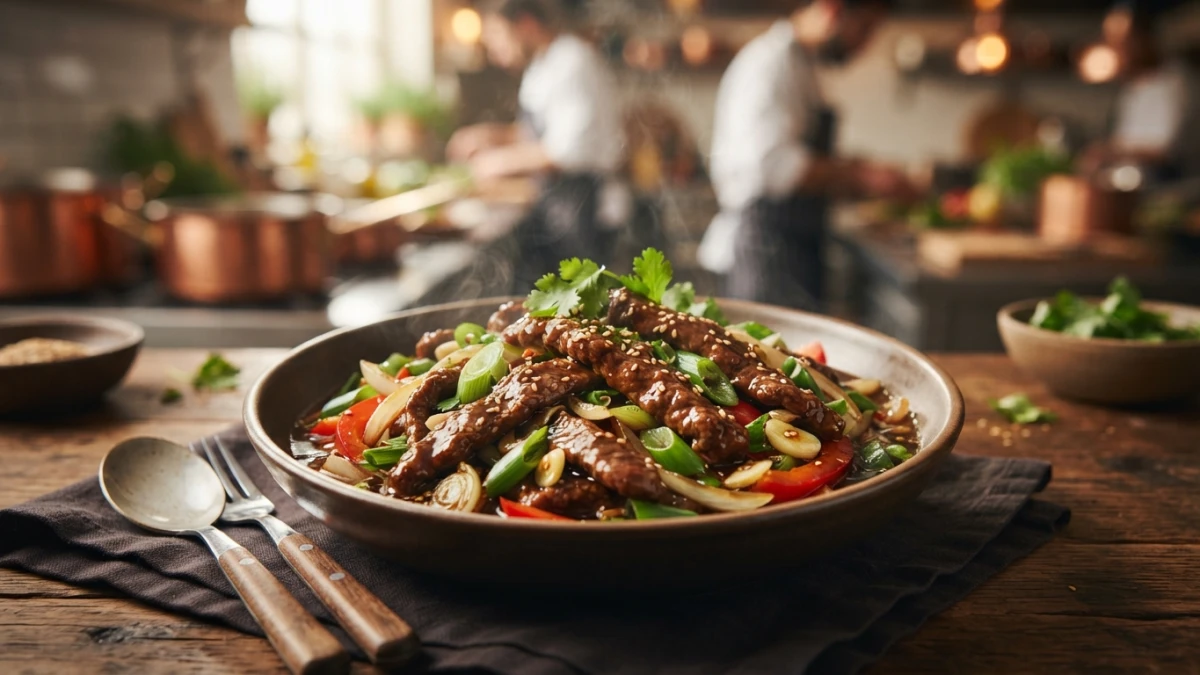
Mongolian beef is a dish of beef strips stir-fried over high heat with scallions and a glossy soy-and-sugar sauce. It is not spicy and it is served over rice. The name is misleading: it does not come from Mongolia, but from the griddle format of Chinese restaurants.
Here is what the recipe card does not tell you: why it is called Mongolian without being Mongolian, where it comes from, what goes into the sauce, why the beef stays tender, how it differs from Mongolian chicken and teriyaki, how many calories a portion has and how to make it lighter. The step-by-step with amounts lives in the Mongolian beef recipe, step by step.
What Mongolian beef is (and why it is not Mongolian)
It is a stir-fry of beef strips with scallions in a sweet-savoury sauce built on soy sauce, sugar and cornstarch, with no heat and a thick gloss. It has no cheese, cream, tomato or deep frying: if a dish brings any of those, it is a different recipe. Nor does it come from Mongolia or belong to traditional Mongolian cooking; the word was borrowed from Mongolian barbecue and the dish was shaped in restaurant Chinese kitchens. It is worth stating as a fact, because searches for "where is it from" and "what is in it" now outnumber those for the recipe.
Where it comes from: Taiwan, 1951 and the grill that borrowed Mongolia's name
The documented origin is Mongolian barbecue: Wu Zhaonan, a Taiwanese comedian and restaurateur born in Beijing, settled in Taiwan after the Chinese civil war and in 1951 opened a place in Taipei where meat and vegetables were cooked on a very hot griddle in front of the diner. The format was named Mongolian by association with the Mongolian way of cooking meat, not because the recipe came from there.
The surname stuck to the technique and from there it passed to the dish: the Mongolian beef on menus is a later adaptation, formed in overseas Chinese kitchens, which between the 1970s and the 1990s travelled to Chinese restaurants in the United States and from there reached Chile and Latin America, with a sauce that is sweeter or less sweet depending on the kitchen. Sources agree on the date and the person behind the grill, but the invention of the dish itself has no documented author or year.
What goes into the sauce: soy, sugar, cornstarch and aromatics
The sauce is 80% of the dish and it reads in four flavour blocks:
- Salty: soy sauce brings colour, salt and the umami base that holds everything together.
- Sweet: brown sugar is the signature; it caramelises with the heat and creates the sweet-savoury contrast.
- Body: cornstarch, dissolved in the sauce or coating the beef, thickens it in a minute and gives the gloss.
- Aroma: ginger, garlic and scallions, plus dried chilli or paprika if the kitchen uses them.
There are no amounts and no steps here: this section explains what each ingredient does. If you want to go deeper, the site has a guide on whether soy sauce is healthy or harmful and another on the benefits of ginger.
Why the beef stays tender: cornstarch and high heat
Two things separate restaurant Mongolian beef from a tough stir-fry at home. The first is the cornstarch coating, sometimes with a little baking soda: it seals the surface, holds in the juices and, as it releases into the oil, thickens the sauce. The second is temperature: this is a stir-fry of very high heat and short time, with the beef added in batches so it browns instead of releasing water and steaming, and the sauce going in at the end, once the beef is seared, so it thickens without burning the sugar. Pile it up and the dish ends up boiled with a watery base.
No wok? Not a problem: the largest, heaviest frying pan you own, well heated, plus cooking in batches, does more than a home wok over a weak heat source. The site's guides on how to choose a frying pan and the meat cooking temperature chart cover both points.
Mongolian beef, Mongolian chicken and other Chinese menu classics
These are the differences people look for when comparing dishes on a menu:
| Dish | Sauce | Spicy | Cooking | Served with |
|---|---|---|---|---|
| Mongolian beef | Soy and sugar, glossy and thick | No | Beef strips seared over high heat with scallions | White or fried rice |
| Mongolian chicken | The same sauce, with chicken | No | Short stir-fry | Rice; vegetables |
| Sichuan beef | Soy with chilli paste and garlic | Yes, strongly | More oil and dried chilli | Rice |
| Teriyaki (Japanese) | Soy with mirin and sugar, glazed | No | Glazed, no cornstarch | Rice; noodles |
| Chop suey | Light soy, less sweet | No | Stir-fry with plenty of vegetables | Rice |
| Sweet and sour pork | Pineapple or vinegar with sugar | No | Deep-fried, sauce on the side | Rice |
The pairs that get mixed up most: teriyaki sauce contains soy, but it is sweeter, it is glazed and it does not replace the Mongolian sauce; chop suey is a different dish, not the vegetable version of the same one. In Chile, menus use beef, chicken or pork with the same sauce logic, and at home it also works with Mongolian chicken with rice, or the vegan version with textured soy or seitan. To expand the menu, the site's other article is the one on how to make Chinese dumplings.
How many calories Mongolian beef has
Restaurant compilations place an order without rice between 450 and 720 kcal, with references of 367 to 480 kcal for 300-360 g portions, and they warn that the total depends above all on the oil in the stir-fry and the sugar in the sauce: it is not a fully fried dish, but both weigh in. The published range reaches 800 kcal or more in generous versions.
| Measure | Calories | Comment |
|---|---|---|
| Restaurant order, no rice | 450-720 kcal | Published references |
| 300-360 g portion | 367-480 kcal | Another published reference |
| Recipe-card portion, no rice | around 400 kcal | Our own estimate from reference values |
| Portion with a cup of cooked white rice | around 605 kcal | Rice adds about 205 kcal |
| Sodium per portion with standard soy sauce | around 1,840 mg | Low-sodium soy brings it down to 900-1,000 mg |
Our own calculation, stated as an estimate: with the four-portion batch from the recipe card (half a kilo of beef, half a cup of soy sauce, half a cup of brown sugar, a quarter cup of cornstarch and two tablespoons of oil), the total lands around 1,600 kcal, about 400 kcal per portion without rice; with a cup of cooked white rice the portion comes to roughly 600 kcal. The number almost nobody checks is sodium: half a cup of soy sauce brings about 7,300 mg per batch, around 1,840 mg per portion, and low-sodium soy cuts that to nearly half. From there come the rules to lighten it: less sugar, less oil, low-sodium soy and more scallions and vegetables. The recipe card declares 147 kcal per portion, a figure that does not square with its own ingredients (the beef alone brings about 200 kcal), so it is best treated as conservative.
Mistakes that ruin it and how to serve it
You can see it on the plate: strips with golden edges and a juicy centre, a glossy sauce that coats the beef without pooling at the bottom, firm scallions and a flavour that starts salty and finishes sweet without cloying. The four most common mistakes: not coating the beef with cornstarch, cooking everything at once (the stir-fry turns into steaming), adding the sauce at the start (the sugar burns before the beef browns) and over-sweetening, the easiest one to fix. Leftovers keep for up to 3 days in the fridge and reheat better in a pan with a tablespoon of water than in the microwave, where the beef toughens.
The classic side is white or fried rice, and with noodles it becomes heavier. Rice absorbs the sauce, which is the sweetest part of the dish. For a lighter version, stir-fry vegetables separately and add them at the end, or serve with a cabbage or cucumber salad dressed with rice vinegar. And the context the recipe card does not give: this is a restaurant dish adapted to home cooking, so the goal is not an exact replica but a quick weeknight stir-fry. If you want to compare it with other classics, see the article on how many calories Chilean dishes have, and the beef recipes are grouped in the meat category.