Ajiaco: What It Is and How the Chilean, Cuban and Colombian Versions Differ
 By
Diego Cortés
By
Diego Cortés
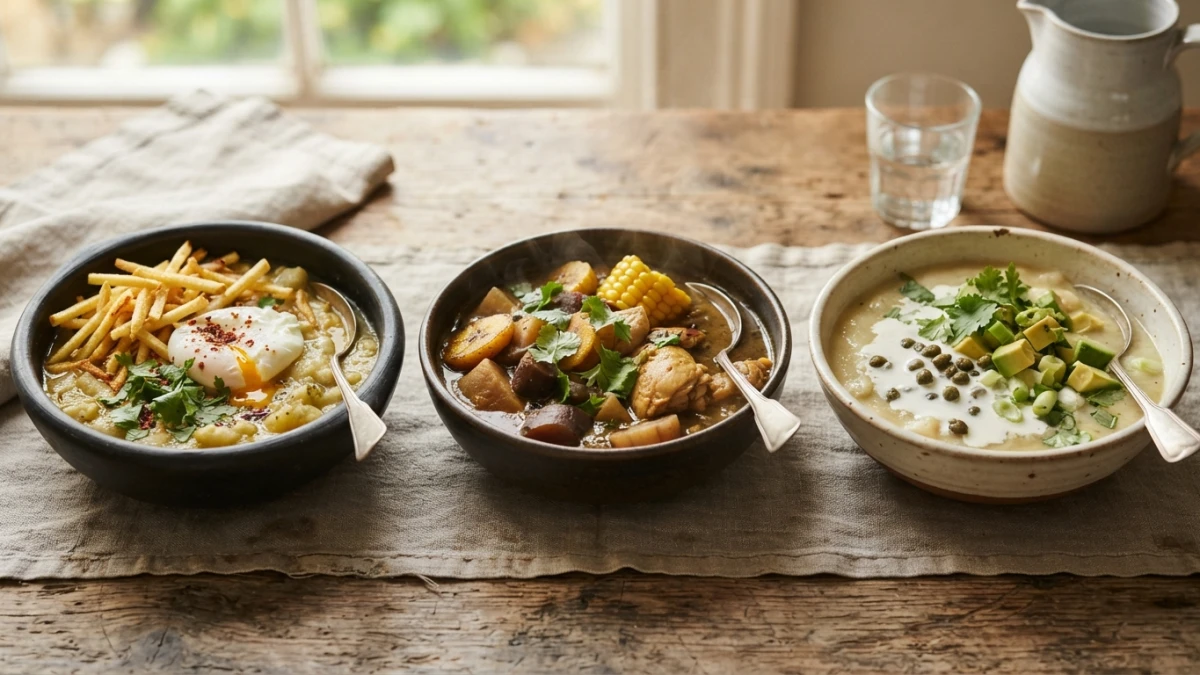
Ajiaco is not one dish: it is the name that in Chile, Cuba and Colombia refers to three different stews, sharing a surname but not a recipe. This guide covers where the term comes from, what each version contains, how it is served and how many calories it has.
The dictionary definition fits all three: a stew of broth with meat, fruits and tubers cut in pieces and spices that vary from country to country. Each kitchen ordered those same ingredients according to what it had in the pantry.
What ajiaco is: a Taino name for three stews that do not look alike
The word ajiaco is almost certainly a derivative of the Taino aji, the indigenous name for chili in the Greater Antilles. Any link to the Spanish ajo (garlic) is ruled out, because that bulb is not part of the original dish. The term was already used in pre-Hispanic times for stews with chili, which explains the homonymous versions in several American countries.
The three recipes with amounts and steps live on the site: the Chilean ajiaco step by step, the Cuban ajiaco recipe and the Colombian ajiaco with guascas.
Chilean ajiaco: the leftover roast soup nicknamed the corpse reviver
In Chile, ajiaco is the soup made from leftovers the day after a barbecue. Leftover meat, beef, chicken, pork or lamb, is cooked in a sofrito of onion, garlic, carrot, bell pepper and celery, with cumin, oregano and mild chili powder, potato cut into sticks and white wine, until the broth thickens.
It is nicknamed the corpse reviver because it is eaten the day after celebrations, when strength must be restored. The eggs are poached in the broth, cilantro goes in at the end and it is eaten with pan amasado bread.
It should not be confused with beef cazuela, which is made with raw meat, corn, squash and rice; ajiaco starts from roasted meat and ends with a whole egg on top. It is close to Chilean carbonada, also born from leftovers.
Cuban ajiaco: the stew of viandas and meats eaten since the 16th century
Cuban ajiaco, or criollo, is a thick stew, closer to a pot dish than a soup: pork, beef, tasajo or chicken with yuca, malanga, yam, boniato, squash, chayote, plantain and corn, seasoned with a sofrito of garlic, onion, chili and cumin.
Its exact origin is not documented, but it has been eaten in Cuba since the early 16th century and was part of the diet of field workers. The ethnographer Fernando Ortiz used it as a symbol of mixed Cuban identity: what is Cuban is cooked by blending contributions in a single pot.
It comes out thick, with some pieces whole and others broken down, and goes with white rice, avocado and lime or hot chili. There is no poached egg and no potato sticks here, and what thickens it is the yuca and the plantain. Cuban style rice completes the table.
Colombian ajiaco (or santafereño): Bogota's soup of three potatoes, guascas and capers
It has three signature marks: shredded chicken, corn on the cob and three potatoes, criolla or yellow, common, and pastusa or sabanera, scented with guascas, the local herb that gives it its flavor. It is served with cream, capers, avocado and rice on the side.
The criolla potato breaks down and thickens the broth without flour or cream, the common one adds body and the pastusa keeps the pieces whole. It is a natural thickener: with a single variety the result is watery soup or mashed potato.
The origin is told as a hypothesis: the most cited versions trace it back to the potato soups and corn dishes of the Muisca people, with a Caribbean-flavored name that arrived later. In Bogota it is a lunch dish, and it comes with arepas with hogao or Colombian tamales.
The three versions side by side
Side by side, the differences come from the pantry and from technique:
| Chilean | Cuban | Colombian | |
|---|---|---|---|
| Home name | ajiaco chileno, corpse reviver | ajiaco criollo | santafereño or bogotano |
| Where it is eaten | Chile, after the barbecue | Cuba, big pot | Bogota, at lunch |
| Meats | leftover beef, chicken, pork or lamb | pork, beef, tasajo or chicken | shredded chicken |
| Tubers | potato sticks, carrot, bell pepper, celery | yuca, malanga, yam, boniato, plantain, corn | criolla, common and pastusa potatoes, corn |
| Aromatics | cumin, oregano, chili powder, white wine | sofrito of garlic, onion, chili and cumin | guascas |
| What thickens it | the potato and the meat broth | the tubers | the criolla potato, no added starch |
| Final touch | poached eggs and cilantro | lime or hot chili | cream, capers and avocado |
| Served with | pan amasado bread | white rice and avocado | rice, chili, bread or arepas |
| Texture | thick broth with a whole egg on top | thick stew with whole pieces | creamy, pale soup |
The logic is the same in all three: boil what you have, meat with tubers and chili. Chile used the grill and the potato; Cuba brought together the viandas of the countryside with salted meats and the Taino and African heritage; Colombia added chicken, the Andean potato and a local herb.
There is a fourth version: Peruvian ajiaco, not a soup but a stew, with aji amarillo, potato and Peruvian aderezo, and it should not be compared with the homonymous soups. For potato dishes, charquican is the closest Chilean cousin.
How many calories ajiaco has
In Chile a figure of about 300 kcal per serving circulates for the Chilean ajiaco, the same number on the site's page. For the Colombian one, the most cited published table gives about 300 kcal per 400 g plate, that is 75 kcal per 100 g, with 20 g of protein, 36 g of carbohydrates and 8 g of fat. Soup is half broth.
The estimate based on reference values is different: the Chilean one from the page, with 800 g of roasted meat, 1 kg of potato and 6 eggs for 6 servings, adds up to around 3,500 to 3,700 kcal, or 550 to 620 per serving, well above the 300 published. The Cuban one, with pork and viandas for 8 portions, lands between 600 and 800 kcal per portion, because its tubers are more energy dense. Everything depends on how much meat and tuber goes into the pot. The Chilean food calories chart works as a reference.
To make them lighter: in the Chilean one, skim the broth, lower the potato and increase carrot and celery; in the Cuban one, choose lean pork and give more weight to squash and chayote; in the Colombian one, serve the cream on the side and use only criolla potato as the thickener.
How each one is served, what goes with it and how it keeps
The Chilean one is eaten as a single course with pan amasado and chili powder; the Cuban one, with white rice, avocado and lime; the Colombian one, with rice, cream, capers, avocado and chili, and with the side dishes served separately so each guest adds them at the table.
All three improve overnight and the Chilean one is even described as better reheated. They keep refrigerated for up to 3 days, they are reheated in a pot rather than a microwave to recover the potato texture, and they freeze well, although potato and plantain change when thawed. That is where the methods for safe thawing help.
Cooking times are the most looked-up data: yuca, malanga and yam need more minutes than potato, and a pressure cooker shortens them a lot. The three recipe pages live in the soups category of the site.
Common mistakes and confusions with ajiaco
Ajiaco is not one thing: three soups and one Peruvian stew share the name. It does not include garlic by etymology, because the word comes from chili. And the Chilean one is not a cazuela: cazuela uses raw meat and vegetables, ajiaco uses already roasted meat and poached eggs.
The Cuban one is not light or quick: the viandas need time to soften. The Colombian one uses no added thickener. The Chilean one is not made with raw meat, although it can be improvised with seasoned meat roasted in the oven if there was no barbecue. To tell them apart: broth with potato sticks and a whole egg on top, Chilean; thick pot with yuca, malanga and plantain, Cuban; creamy, pale soup with shredded chicken, cream and capers, Colombian.