Badrijani Nigvzit: Georgian Eggplant Rolls with Walnuts
 By
Diego Cortés
By
Diego Cortés
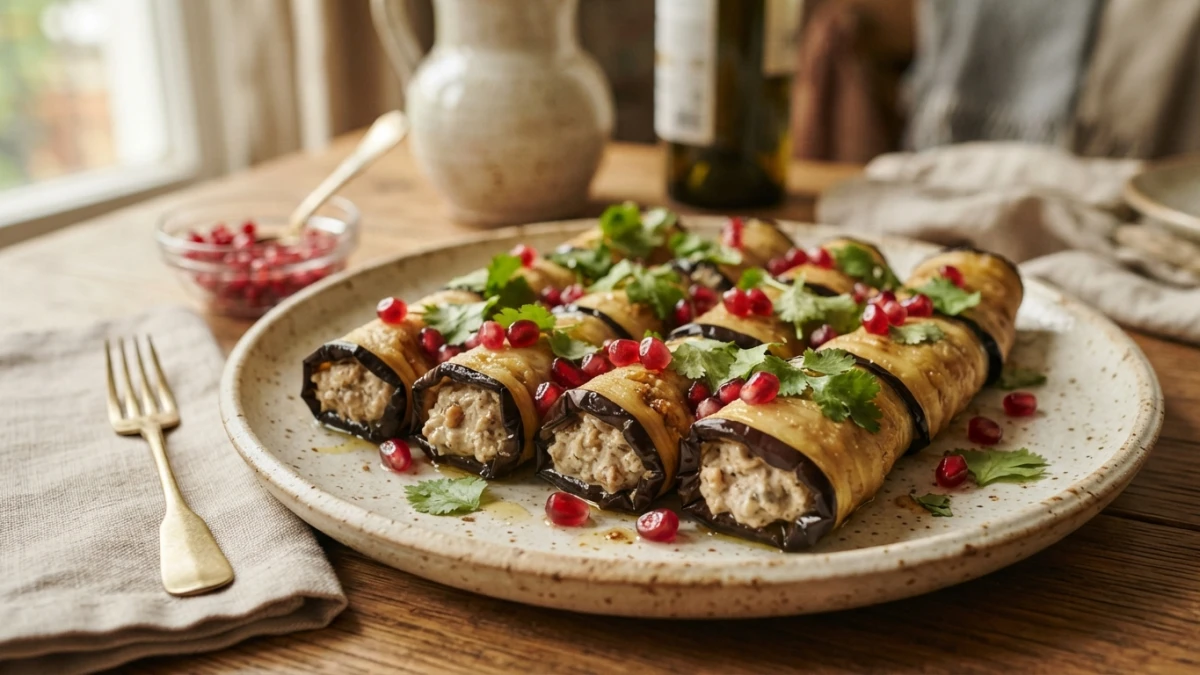
The badrijani nigvzit is Georgia's best-known appetizer: thin slices of fried eggplant rolled around a paste of walnuts, garlic and cilantro, topped with pomegranate seeds. It is eaten cold, never straight off the heat, and that detail sets up everything else.
Before getting into details, it helps to fix the central idea. This is not a dish of eggplant bathed in walnut sauce: it is eggplant wrapping the walnut paste. Here the walnut does not season, it is the filling, which is why each bite is dense and creamy rather than light. The dish is naturally vegan and gluten free, and that partly explains why it has travelled so well outside Georgia.
What badrijani nigvzit is (and what the name means)
The name is the first obstacle, so it is worth taking apart. Badrijani is the Georgian word for eggplant, and nigvzit means with walnut, from nigvzi, walnut. The full name therefore translates as eggplant with walnuts. The inverted form nigvziani badrijani is also used and means the same thing, and at a Georgian table you simply order badrijani.
That literal translation makes clear where the weight of the dish sits. The eggplant is the wrapper and the walnut paste is the content; if the paste is too scarce or too runny, the roll falls apart. On the palate you recognize three things at once: the silky, slightly sweet eggplant, the rich and spiced paste, and the tart, crunchy pomegranate on top.
Where it comes from: the Georgian table and walnut culture
The real context of badrijani is the table, not the restaurant kitchen. It belongs to the cold starters that open the supra, the Georgian feast that can last for hours and is served in waves: cold dishes first, hot dishes afterwards. In that first round, badrijani sits alongside pkhali, lobio, fresh herbs, pickles, fresh cheese and bread.
The walnut is the other thread. Ground walnut paste reappears in pkhali, in satsivi and in badrijani, and it is what gives body, fat and flavour to much of the country's cooking. Georgia is one of the most important walnut-producing areas of the Caucasus, and the kitchen shows it.
On origins it is best to be careful. Various sources attribute its rise to farming and wine regions in the east of the country, such as Kakheti, but that is an attribution rather than a documented fact. What is certain is that today it is a classic across the country, and also on Georgian tables abroad.
What goes into it: the eggplant and the walnut paste
The technical part is the eggplant. It is cut into lengthwise slices about 2 to 3 millimetres thick, salted so it releases water, and then griddled or fried. The target is a flexible, golden slice, never falling apart, and it must cool before rolling because while hot it tears.
The walnut paste is worked until it becomes spreadable. It contains ground walnuts, garlic, fresh cilantro, blue fenugreek, marigold or Imeretian saffron, salt and an acid, which may be vinegar or pomegranate juice; sometimes the spice blend khmeli suneli is added. It is loosened with a little water or stock. Garlic and acid are what wake up the flavour, and without them the paste tastes flat.
Pomegranate seeds and cilantro leaves go on top. What is not in it also matters: no cheese, no tomato and no breadcrumbs. Anyone expecting Italian-style rolls is in for something else. If the theme interests you beyond this dish, the eggplant recipes category gathers the site's options.
Badrijani, pkhali and satsivi: how they differ
All three belong to the same walnut family, which is why they get mixed up. Badrijani is eggplant plus rolled walnut paste. Pkhali applies the same logic to chopped vegetables, such as spinach, beetroot, eggplant or green beans, shaped into patties. Satsivi, by contrast, is a spiced, warm walnut sauce that coats chicken, turkey or fish; the house version is in the Georgian satsivi recipe, and there is a vegetarian variation with mushrooms.
It is also worth clearing up the most common confusion in English: badrijani is not a brand or a single dish, it is simply the word for eggplant, so it can appear in the name of other Georgian preparations. The dish discussed here is always the nigvzit one, the one with walnuts.
To recognize them on a menu there is a practical rule: if it is cold and shaped like a roll, it is badrijani; if it is a soft, pate-textured portion, it is pkhali; if it is a stew with a pale walnut sauce, it is satsivi. Two more names will show up at the same table: lobio, the bean stew, and khachapuri, the cheese bread.
How badrijani nigvzit is made (process and variations)
The traditional process follows a fixed order: slice and salt the eggplants, brown them on both sides, drain them on paper, grind the walnuts with garlic, cilantro and spices into a paste, correct it with salt and acidity, spread each slice, roll it up and chill for a while so the rolls hold their shape. They are served with pomegranate and cilantro on top.
There are two routes and it is worth knowing both. The fried version is the most traditional, but eggplant soaks up a fair amount of oil; griddling or baking is lighter without losing character. Among the variations you find pastes that are more or less spicy, pastes with pomegranate juice, and a grilled version known as badrijani shemtsvari.
If you want the quantities and the step-by-step method, they are in the house recipe: eggplant with walnut filling, step by step. The home shortcuts that work are using pre-ground walnuts and a food processor for the paste, roasting the eggplant instead of frying it, and assembling the rolls a day ahead, because they gain flavour when cold.
How they are served and what to pair them with
They are served cold or at room temperature, two or three rolls per person, on a flat platter with pomegranate seeds scattered over the top. They are a starter, an appetizer or part of a spread, not a main course; that said, because walnuts are so filling they can work as a light meal with a salad.
The pairings that make sense are Georgian-style shoti bread, a cheese khachapuri and fresh cheese with herbs. To drink, a dry white wine or a light red, which is how it is served in Georgia. The dish can be made ahead and keeps well in the fridge for a day or two.
The full-table version is the most Georgian: badrijani as a starter alongside a meat-filled kubdari and a satsivi, cold dishes first and hot ones after. If you want the background on that bread, the article on what kubdari is and how it is eaten covers it.
Calories and whether it is a healthy dish
It is better to give the figure by method rather than as a single number. Third-party references place the dish at around 160 kcal per 100 grams, so a portion of two or three rolls, about 80 to 120 grams, comes to roughly 130 to 190 kcal. The number depends above all on the oil the eggplant absorbs and on how much walnut goes into the paste.
The nutritional profile is reasonable without being a miracle. Walnuts bring good fat, including plant omega-3s, plus protein and fibre; eggplant adds fibre and water. The dish is vegan and gluten free, but it is calorie-dense because of the walnuts and the oil, so it is not something to eat without counting. The house recipe does not list calories today, so these values are an estimate based on reference tables.
If you want to lighten it there are three levers: roast the eggplant instead of frying it, stretch the walnut paste with water and less oil, and control how much paste goes into each roll.
Common mistakes and questions about badrijani
The three most repeated misunderstandings are these: it is not served hot, it contains no cheese or tomato, and it is not the same as pkhali or satsivi. Nor is it a dish of walnuts with eggplant, but eggplant wrapping walnut paste. And badrijani on its own simply means eggplant.
The cooking questions have answers too. If the eggplant tastes bitter, salting it and draining it before cooking solves it. If the rolls fall apart, the slice was too thick or the paste is too runny. If they come out oily, griddle them and drain them properly on paper. And if the walnut paste tastes flat, correct it with salt, more garlic and a touch of acid.
In short: badrijani nigvzit is eggplant with walnut paste, served cold and crowned with pomegranate. That is enough to understand the dish, and the exact quantities are in the house recipe.