Fufu: What It Is, What It's Made Of and How It's Eaten
 By
Diego Cortés
By
Diego Cortés
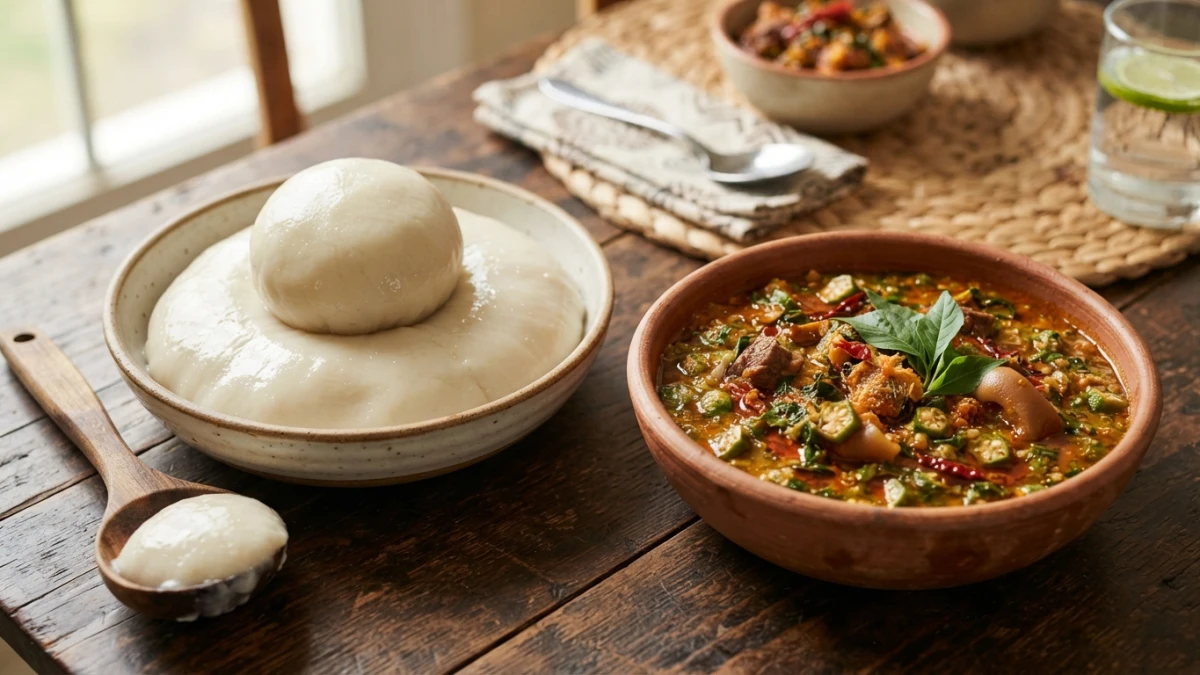
Fufu is a soft, springy and slightly sticky dough made from cooked, pounded starches, and in West Africa it is always served next to a soup or a stew. It is not a bread or a cream: it is a neutral dough eaten by hand.
What fufu is and why it is called a "swallow"
To understand it, start with the English name for the whole group: swallow. That is what all the African doughs are called, from fufu itself to ugali, sadza and banku, because they are taken in small balls, dipped in the soup and swallowed without chewing. It is not an exaggeration or a trend: their chewy texture makes chewing uncomfortable, and that is where the technical name for the family comes from.
Fufu only makes sense as a pair: dough plus soup. Its flavour is neutral on purpose, close to plain starch with a slightly sweet edge when it contains plantain. That neutrality is exactly what makes it the perfect vehicle for okra soup, egusi or a peanut stew. It is also where its living-dough texture comes from, the one that stretches when you pinch it and springs back.
Where it comes from: West Africa and a name that changes by country
Fufu is a staple food of West Africa and is attributed to the cooking of the region, above all to Nigeria, Ghana, Benin, Togo, Ivory Coast and Cameroon, with a traditional presence in Central Africa as well. It is everyday food and celebration food at the same time: it is made in large amounts, shared, and it even appears in twentieth-century African literature as part of the everyday landscape.
The first confusion is the name, because the same kind of dough is spelled differently from country to country: fufu, fufuo in Ghana, foufou in French-speaking countries and also foo-foo. In several places it also gets a name of its own when the starch changes, such as eba or garri, pounded yam or banku. Here we are talking about fufu in general, not a brand or a single preparation.
What it is made of: the starches that change the flavour and the texture
The traditional base is the most asked-about part: cassava (yuca or manioc) boiled and pounded together with unripe plantain, and sometimes cocoyam (taro) or yam. Cassava provides the elasticity; green plantain provides the body and a slightly sweet background. That is where the white, glossy, chewy dough comes from. Plantain has a long history in tropical cooking, and the site already covers the benefits of bananas beyond the flavour.
The variants line up by starch: cassava and plantain fufu (the most traditional), yam fufu (denser), cocoyam fufu (softer), corn or cornmeal fufu (close to ugali), adapted versions with semolina or rice, and instant-flour fufu, made with elubo (yam flour) or garri (fermented cassava flour), which is today's shortcut.
Cassava also shows up in other dishes you may already know from other cuisines: fried yuca, yucca arepas and yuca bread are relatives of the same root.
The quick version, the one people look for at home, is made by hydrating the flour with boiling water and kneading it in the pot until the dough turns elastic: three ingredients (flour, water and salt) and a few minutes. The traditional version is another story: it requires boiling cassava and plantain and pounding them in a mortar until the dough comes away from your hands.
Fufu, ugali, sadza, banku and pounded yam: how they differ
The rule that organises the whole swallow family is about technique: fufu is boiled and then pounded until elastic, while ugali (East Africa), sadza (Zimbabwe), nshima (Zambia) and pap (South Africa) are stirred in boiling water until they thicken, with no pounding at all, and they end up firmer and more crumbly, not elastic.
The names readers see mixed together are not equivalent either: banku (Ghana) is a fermented dough of corn and cassava with its own acidity; pounded yam (Nigeria) is made only with cooked, pounded yam; eba or garri is made with fermented, toasted cassava flour, and kenkey is fermented corn as well. They are cousins, not synonyms.
At the table the difference shows up fast: fufu is the most elastic and the most neutral, ugali and sadza are firmer and can be cut, and banku is sour. They all do the same job, which is to pick up the soup, and the choice depends on the region and the stew, not on a ranking.
How fufu is made (traditional process and quick version)
The traditional process goes in order: peel and boil the cassava and the green plantain until soft, drain them, take them to the mortar (the pilon) and pound them while turning, adding hot water little by little, until you get a smooth, glossy, elastic dough that comes away from your hands. The goal is not a hard dough, but one that stretches without breaking.
The home shortcut uses instant flour and boiling water, kneading in the pot with a wooden spoon and cooking a few more minutes, until the dough lifts with the spoon in a long tail. The exact amounts and steps for that quick version are in the fufu with yam flour recipe, which we only link here so as not to repeat it.
How it is eaten and what to serve with it
The table mechanics are what almost nobody knows: fufu is served hot in a bowl, a portion is taken with the right hand, shaped into a ball with the fingers, dented slightly, dipped in the soup and swallowed without chewing. The right hand is the traditional custom; in restaurants it is also served with a spoon.
The sides that make sense are the ones with plenty of liquid, because the dough needs broth to go down: okra soup, egusi (pumpkin seeds), peanut stew or soup, palm soup, fish or vegetable soups and meat stews with plenty of stock. The house okra soup is a good place to start.
To build a West African table, the real order is simple: the bowl of dough in the middle and the soup on the side, and each guest serves themselves. A Nigerian jollof rice or its Ghanaian version complete the plate, and there are no cutlery on a traditional table.
How many calories fufu has and whether it is a healthy dish
The figure is best given by method rather than as a single number: reference values put cooked fufu at around 150-180 kcal per 100 g, so a usual portion of 200 to 250 g comes to about 300-400 kcal. The number rises if it is calculated on dry dough, and it depends on the starch, on the water absorbed and on whether it contains plantain.
The nutritional profile is clear: it is an almost pure carbohydrate food (starch), with very low protein and fat, and gluten-free when made only with cassava, yam, cocoyam or corn. Its problem is not fufu itself, but that it is eaten in large portions with oily stews on the side.
There are three levers to fit it into a better diet: control the portion of dough, choose vegetable or fish soups instead of very fatty stews, and pair it with protein and vegetables, because its glycaemic index is high. These are estimates based on reference values: the house recipe does not declare calories today.
Common mistakes and questions about fufu
The most searched misunderstandings: it is not chewed, it is swallowed; it is not a bread, it is a dough with no oven and no yeast; it has no gluten when made from cassava, yam or cocoyam, though it does if wheat flour is used; it is not the same as ugali or polenta, because the starch and the technique change. And it is suitable for coeliac diets in its cassava or yam version, as long as the flour is checked.
In the kitchen, the usual slips have explanations too: lumps appear when the flour is added to warm water or stirred slowly (always boiling water and vigorous stirring), it turns hard or rubbery when it lacks cooking or water, it sticks to the pot over high heat without stirring, and it hardens when cold, so it is reheated over steam or in the microwave with a few drops of water.
In the end, fufu is a pounded starch dough eaten by hand with soup, not a pastry recipe. If you want to try it, the site's fufu with yam flour recipe has the quick version with amounts and times.