Babi Guling: What Balinese Roast Suckling Pig Is and How It's Made
 By
Diego Cortés
By
Diego Cortés
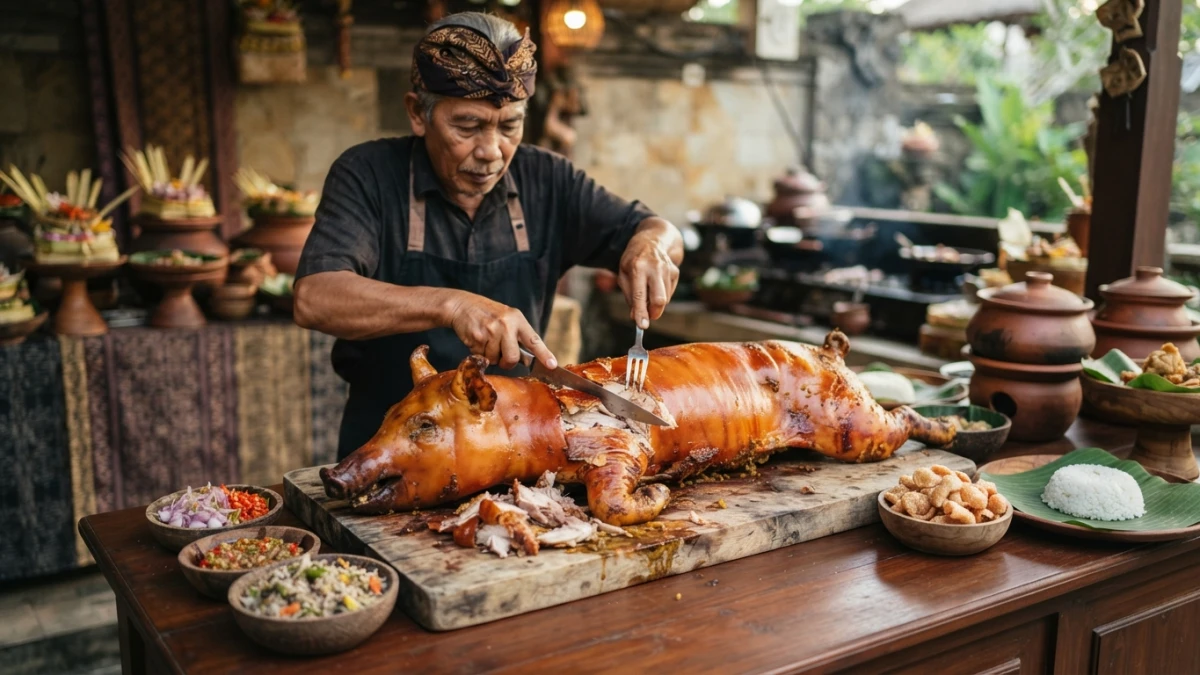
The babi guling is Bali's roast suckling pig: a whole young pig skewered on a spit, rubbed and stuffed with a spice paste, and turned over hot coals until the skin crackles. In Bali it is also called guling celeng and, over rice, nasi babi guling.
What follows is the context and the method behind a ceremonial dish, not a weeknight recipe: the quantities belong to the recipe page.
What babi guling is: Bali's roast pig
It starts with a young pig of about 15 to 20 kilos, skewered on a long bamboo or wooden spit. The paste is rubbed on the outside and pushed inside, and the pig is turned over the embers for hours until the skin turns into a reddish crust that cracks when you cut it. Underneath, the meat stays juicy and heavily perfumed.
The name translates itself: babi means "pig" and guling means "to roll" or "to turn", so babi guling is literally "the pig that turns". The dish is named after its method, not after a cut of meat.
It helps to say what it is not, because that is the most common mix-up: it is not an oven roast, it is not a stew and it is not an adult pig on a grill. There is a whole pig spinning over a fire, and that is where its two contrasts come from: brittle skin outside, very juicy meat inside.
Where it comes from: a temple offering before a restaurant dish
Babi guling began as an offering and a ceremonial meal within Balinese Hinduism: it was prepared for the temple and eaten by the community. Only much later did it move into warungs and restaurants, and it still appears today at weddings, village celebrations and temple ceremonies.
It exists in Bali and not in the rest of Indonesia for a simple reason. Bali is the country's only Hindu-majority province, while the rest of the archipelago is mostly Muslim, so pork holds a central place on the island's table. Babi guling is not halal and has no halal version; anyone who does not eat pork picks another Balinese dish. Because it is roasted before dawn, warungs often sell out well before mid-afternoon.
Base genep: the spice paste that defines it
Base genep means "complete base paste", the Balinese mix used as the starting point for almost everything cooked on the island. In Indonesian, pastes like this are called bumbu; in Bali the term is base genep. In babi guling it is not just another seasoning: it is the heart of the dish.
The typical ingredients, without quantities, are shallots and garlic, red chillies and bird's eye chillies, turmeric, ginger, galangal (the ginger relative that gives the fresh background), kencur, lemongrass, kaffir lime leaves, candlenut (kemiri, which adds body), fermented shrimp paste (terasi), coriander, pepper, salt and palm sugar. The exact mix changes from family to family.
The paste is rubbed outside and in, the cavity is filled, and many versions also tuck in salam leaves, banana leaves and a stuffing of cassava leaves that is later served chopped. The flavour profile is yellow-green and aromatic, with turmeric, galangal and lime up front: there is chilli in it, but it is not trying to be a hot dish.
How a babi guling is roasted: spit, embers and three to four hours
The pig is threaded onto a long spit, tied so it does not shift, a fire of wood and coconut husk is lit, and the animal is turned by hand over the embers (not over the flames) for roughly three to four hours, brushed with its own fat and with the juices of the spices.
It works because the constant turning spreads the heat evenly and pushes the fat back into the meat instead of letting it drip away, and because flame-free embers brown the skin without burning it. The result is easy to recognise: a dark red crust that shatters when cut and meat that almost falls off the bone.
The scale is what turns it into a dish for a crowd: dozens of kilos turning at once, with a team of people working the fire. That is why it is not everyday food, and not food for one person.
What goes into a plate of nasi babi guling
The base is steamed rice with slices of leg, loin and belly, plus pieces of that crackling skin everyone fights over, and each warung builds its own arrangement on the plate.
The classic sides are lawar (shredded vegetables with coconut and spices), urutan (Balinese pork sausage), sate babi or sate lilit (minced meat wrapped around a lemongrass stalk), sambal matah (a raw relish of shallot, lemongrass and chilli), sambal mbe and pork skin crackers. Many warungs add a short broth made from the less noble parts, and the special version adds liver, ribs and extra skin.
The dish, then, is a set, not a single cut of meat. Indonesian cooking also reaches well past pork: the site already has nasi goreng, the Indonesian fried rice, and beef rendang.
How many calories are in babi guling, and why it is not a light dish
As an estimate rather than a precise measurement, roast suckling pig with its skin lands around 280-390 kcal per 100 grams, depending on the cut and the fat, and a full plate of nasi babi guling, with rice, lawar and sausage, sits around 900-1,100 kcal. It changes from one warung to the next because the portions change.
Much of the appeal is the skin and the belly, the fattiest parts; in exchange, the meat brings roughly 24 to 27 grams of protein per 100 grams. This is celebration food, dense and meant to be shared. If you want to lighten it without betraying it, ask for more lawar and vegetables than rice, pick more lean meat and less skin, split it between two and drink water.
Babi guling, lechon and cochinillo: how they differ
All three are young pigs roasted whole and served at celebrations, but each tradition solves the fire and the flavour its own way. It is worth naming them together, because in Spanish-language searches the three get mixed up all the time.
Babi guling is roasted on a horizontal spit over wood and coconut-husk embers, stuffed with base genep. Segovian suckling pig baked in the oven uses a wood-fired oven and little more than salt, fat and maybe a herb, so the flavour of the meat leads. Filipino pork lechon is roasted over charcoal with an herbed stuffing and served with liver sauce. And one clarification that avoids confusion: lechon kawali is something else entirely, deep-fried crispy pork belly, with no spit and no whole pig.
Frequently asked questions about babi guling
The basics: what is babi guling? A whole pig from Bali stuffed with spices and roasted while turning over embers. What does guling mean? To turn or to roll: the dish is named after its method. Where is it from? Indonesia, and specifically the island of Bali.
The practical ones: is it very spicy? It has chilli, but you can ask for less or for it on the side. Is it halal? No, it is pork, and there is no halal version. How long does it take? Roughly three to four hours of turning, plus making the paste and building the fire. Is it eaten the same day? It is a fresh-roast dish, and warungs sell out early.
Can you make it at home? Yes: with a whole pig if you have somewhere to roast it or, more realistically, with a large cut of pork, leg, loin or belly, oven-roasted with the same paste, packed tight and sealed so the steam cannot escape. The amounts and the step-by-step are in the Balinese roast pork recipe, with quantities and times.