Fairy Bread: What It Is and Where the Name Comes From
 By
Diego Cortés
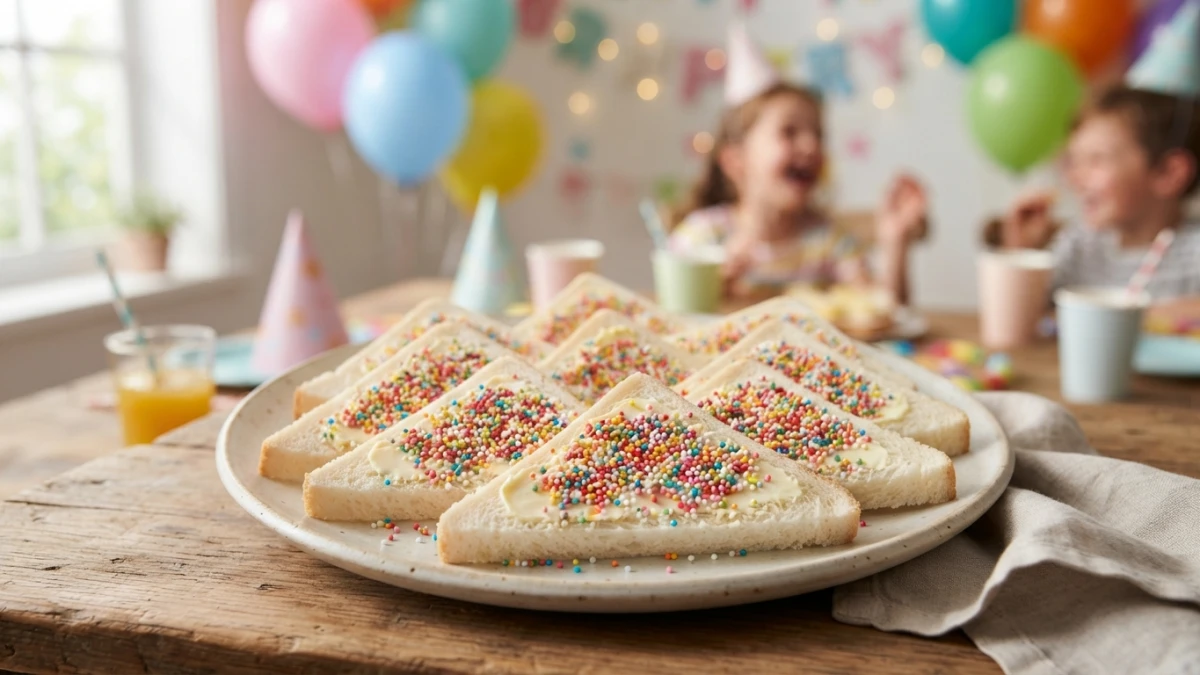
Fairy bread is a slice of white sandwich bread spread with butter and covered in round coloured sprinkles: three ingredients, no oven and no toaster.
In Australia and New Zealand it is served like that, cut into triangles, at children's parties, and eaten with your hands. Anyone searching for it in Spanish wants to know what it is, why it is called that and which sprinkles to buy, not the method; the quantities live in the fairy bread recipe. This article covers the rest.
What fairy bread actually is
It is not a sweet bread, it is not a cake, and there is no yeast involved. It is party food: fresh sliced white bread, a thin layer of soft butter and sprinkles on top. A batch of twelve slices takes about ten minutes including the cutting, and nothing goes near a hot oven. One tray is enough for a children's birthday table and still leaves a slice or two for the adults.
The appeal is contrast: bread brings softness, butter brings fat and salt, sprinkles bring crunch and colour. Outside those two countries the item is barely known, which is where most of the confusion starts. It is never served warm, and it is not a dish you cook for a meal but party-table food.
Where the name and the custom come from
The earliest known reference to the name appears in The Mercury, the Hobart newspaper, in April 1929. The report describes a party for children in a tuberculosis sanatorium and a table that began with bread and butter and hundreds and thousands. Buttering bread with sprinkles was older; what shows up that day is the name.
Where the phrase itself comes from is unproven. The most repeated hypothesis links it to Robert Louis Stevenson's poem "Fairy Bread", published in 1885 in A Child's Garden of Verses, where bread with butter and sugar is the treat offered to children. It is reasonable, but it is treated as a hypothesis: the phrase was used for other foods earlier and no document closes the gap.
Two dates explain the end-of-year search curve: Google's doodle on 13 November 2021, timed to Stevenson's birthday, and Australia's Fairy Bread Day on 24 November.
The sprinkles: hundreds and thousands and their substitutes
The sprinkle defines the item. In Australia they are called hundreds and thousands; in the trade they are nonpareils: hard sugar balls one or two millimetres across, matte, with no glazed shine. Spanish-speaking cooks buy them as coloured sprinkles for cupcakes, from the baking aisle of a supermarket.
The mechanism is the entire technique: the ball rolls over the film of soft butter, sinks in slightly and stays there. Chocolate strands are heavier, they roll off and fall, and many bleed colour into the fat; icing sugar simply dissolves. That is why every version insists on the round sprinkle: it is the only thing that sticks. If only strands are available they work, with the warning that a share of them will end up on the tray.
How it is served at a party: assembly, cuts and timing
The butter layer is both the glue and the limit. It has to be thin and even, right to the edge: too little and the sprinkles will not hold, too much and the bread goes soggy and leaves fat on everyone's fingers. It is worked at room temperature, never melted, because melted butter soaks the crumb.
The traditional cut is triangles, two diagonals per slice; squares or cookie-cutter shapes are also common. Cut on a board with a serrated knife, after the sprinkles go on, and serve immediately. Timing is where most batches fail: one flat tray, a single layer, nothing stacked and nothing covered, assembled at most an hour ahead. With children around it is a good job to share out in a line, as outlined in the guide to cooking with kids.
The mistakes that ruin it
The first is melted or overheated butter: it soaks the bread, makes it rubbery and sinks the sprinkles. The second is the bread itself: a very soft loaf breaks while you spread, and bread a few days old tastes stale under the sugar. The third is making it too early: assembling hours ahead or storing it in the fridge damages all three layers, because the sprinkles soften, the bread releases moisture and the butter stains. Freezing does not help either.
The fourth is oversprinkling: too few and the bread looks like a mistake, too many and they fall off in handfuls. The target is a layer that covers without mounds, with a tray underneath. And a quieter fifth mistake: serving it stacked.
Variations: from chocolate spread to the tray version
Changing the spread is the most common variation. Hazelnut chocolate spread, peanut butter and cream cheese whipped with a little sugar all hold the sprinkles better than butter and change the flavour completely; the cream cheese version is the closest to Latin American party finger sandwiches. With these spreads it stops being the original, so present it as a variation.
Changing the bread also works: brioche tastes richer but falls apart while you spread, and wholemeal adds fibre and cuts the sweetness if the crumb is firm, like the one in the sliced bread entry. The two party mutations are the fairy bread cake, one large sheet covered in sprinkles and cut like a birthday cake, and the fairy bread lamington, the same bite passed through chocolate and coconut. For a full birthday table, the rest of the sweet ideas are in the site's dessert recipes.
Fairy bread, pan de hadas and hagelslag: telling them apart
In several Latin American countries, "pan de hadas" or "sandwichitos" means small crustless party sandwiches filled with cream cheese, ham or jam, and they contain no sprinkles at all. Australian fairy bread is something else, and it is worth saying plainly so the reader looking for the other thing is not misled. The party logic is the same, the contents are not: that is where it meets party sweets from other cuisines, such as chilenitos.
The nearest European relative is Dutch hagelslag: buttered bread with chocolate or fruit sprinkles, eaten at breakfast rather than at a party. Same gesture, different moment of the day. The baking cousin is funfetti, the cake with sprinkles mixed into the batter: there they are baked and melt. And the Australian damper, a flatbread baked on coals, has nothing to do with this either.
Calories, a lighter version and common questions
The numbers are an estimate, not an analysis. One 30-gram slice of white sandwich bread is around 80 kcal, five grams of butter add about 36 kcal and three grams of sprinkles about 12 kcal: roughly 125 to 130 kcal per slice, with four or five grams of added sugar, almost all of it from the sprinkles. These are table values, not label values.
Three easy adjustments make it lighter: scrape the butter back to about three grams, switch to wholemeal bread and use half the sprinkles. The fourth is portion size: cut each slice into quarters. Even so, it is an occasional party treat, not a breakfast. And because nonpareils are hard balls, they should not be given to children under three without supervision.
Frequently asked questions
Do you toast the bread? No: the traditional version uses soft bread, and toasting changes the texture.
Can you make it with margarine? Yes, that is the usual school version and it works the same way.
Does it keep overnight? Not worth it: the sprinkles soften and the bread releases moisture within a few hours.
Is it Australian or New Zealand? Both countries claim it, and the oldest written references appear on both sides of the Tasman.
The summary is short: fairy bread rests on three decisions, soft butter, round sprinkles and serving it soon. Everything else is presentation.