Bitter Melon (Karela): What It Is and How to Tame Bitterness
 By
Diego Cortés
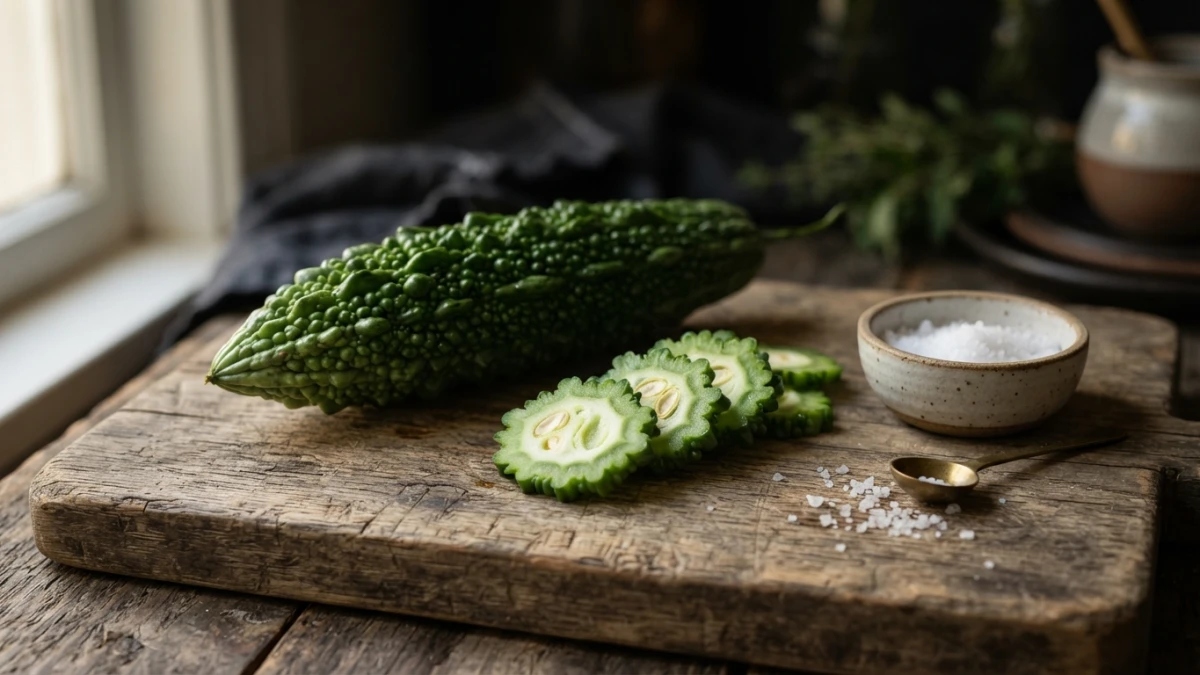
It is called a melon, cooked as a vegetable and bitterer than anything else in the kitchen: karela, or bitter melon, is the green, warty fruit of a tropical vine, eaten before it ripens and carrying its bitterness in the white pulp around the seeds.
The skin, by contrast, is thin and edible, so the first rule is simple: the peel stays and the seeds with their pulp go. Nor is it a dessert fruit or a sweet cousin of melon: it is a cucurbit, and in cooking it is treated as a vegetable. One medium fruit serves two to four people.
This article answers what people ask the first time they see it in an Asian grocery: what it is, where it comes from, how it tastes and how to tone down the bitterness. Quantities and timings are in the bitter melon stir-fry recipe, with quantities and timings, filed under seafood.
What karela (bitter melon) actually is
Karela is the fruit of Momordica charantia, a vine with thin stems and yellow flowers grown in warm climates. It is harvested green: elongated, ridged, with warts that form triangular spikes in some varieties. Inside are flat seeds wrapped in pale, spongy pulp, which is the bitterest part of all.
Three layers matter in the kitchen: a thin edible skin, firm watery flesh and a core that has to go. A medium fruit weighs 150 to 300 grams and yields less than it looks, because seeds, pulp and tips take about a third. It is often confused with caigua and chayote, mild cucurbits.
Where it comes from and what it is called in each country
The species is believed native to tropical Africa and southern Asia and to have been domesticated in Southeast Asia, where it has been cooked for centuries. Today it grows across Asia, Africa and the Caribbean, and reached the Americas through colonial trade.
The list of Asian names explains half the trouble at the store. In India, Pakistan and Bangladesh it is karela; in the Philippines, ampalaya; in China, ku gua; in Okinawa, goya; in Malaysia, peria; in Thailand, mara; in Vietnam, muop dang. In a grocery outside Asia, three or four of those names share the same crate and none says "bitter melon".
In Spanish the spread is wider still and almost nobody connects them: melon amargo, melon amargo chino, caigua amarga, cundeamor chino, balsamina, pimpinillo. In the Philippines it is amargoso or ampalaya, in Central America calaica, on the Gulf coast of Mexico chote. There the vegetable is part of daily cooking, and more of that tradition sits under the Philippines tag.
How it tastes and why it is so bitter
The first surprise is texture: crunchy and watery, close to cucumber or chayote, and firm as long as it is not overcooked. The base flavour is vegetal and green, with a pod-like note. The bitterness arrives later and stays in the throat longer than anyone would like.
The mechanism is chemical: the bitterness comes from cucurbitacins, the same compounds that make a bad melon or a drought-stressed cucumber bitter. In karela they concentrate in the skin and above all in the white pulp. It is not spicy: there is no heat, only persistence.
For scale, it is bitterer than endive, watercress or grapefruit, and far beyond any leafy green. That is why in Asia it is never served alone: it always comes with egg, coconut, dairy, fat or something acidic to round it out.
The varieties you will find: Indian, Chinese and mini
The Indian variety, also sold as Pakistani, is short and narrow, pointed at both ends, dark green and marked with triangular warts. It is the bitterer of the two big families and the one used for stuffing, slicing into chips or pickling.
The Chinese one is long, 20 to 30 centimetres, with blunt ends, paler green and a smoother surface. It is the one usually found in supermarkets outside Asia and the friendliest for a first try.
Then come the mini ones, 6 to 10 centimetres, stuffed whole and popular in Bangladesh, India, Pakistan and Nepal, and the white varieties with pale skin and a milder flavour. A rule at the stall: at equal size, the darker, thicker-skinned fruit tends to be bitterer. A tendency, not a law.
How to take (some of) the bitterness out
The starting point has no shortcuts: cut lengthwise, scoop out the seeds, scrape the white pulp away with a spoon and slice into thin half-moons. If the pulp stays, no later technique rescues it.
From there, three things work. Salting the slices for ten to fifteen minutes, squeezing them by hand and rinsing: the salt draws out liquid and some bitterness with it. Blanching for two or three minutes in boiling water and draining. Or soaking in cold water, which removes some without cooking. Combining salt and blanching is what Filipino and Indian kitchens do, and what works best at home.
The part almost nobody explains is balance: the goal is not to eliminate the bitterness but to bring it down to a level you enjoy. Egg, coconut milk, yoghurt, a pinch of sugar or an acid such as lemon, tamarind or vinegar round it out without erasing the flavour. Strip it all away and the dish loses its reason to exist.
How to choose it, wash it and store it
When buying: firm to the touch, bright and even green, no yellow patches or soft spots, firm tips. The very large, yellowing ones are past their prime. One warning worth repeating: the ripe fruit, orange and split open, is not eaten, and neither are mature seeds. Only the green fruit is used.
Washing is the usual routine, running water and drying before storing; details are in the guide to washing fruit and vegetables. In the fridge it keeps three to five days wrapped in paper in the vegetable drawer, and the fridge shelf-life chart gives the range per vegetable.
Sliced, it oxidises and loses texture, so cut it just before cooking. Blanched and well drained it keeps for months in the freezer; times are in the blanching and freezing guide.
How it is eaten around the world (no recipe)
The Philippines is the easiest way in. The home dish is ginisang ampalaya, a stir-fry with garlic, onion, tomato and egg, and the vegetable is also part of Ilocos pinakbet with eggplant, okra and beans. For the egg at its best, perfect scrambled eggs covers it, and to fill out the table there is filipino adobo.
In India and Pakistan it is cooked as a sabzi with potato, stuffed with spices and fried, pickled, sliced into chips; in the south it comes with grated coconut and yoghurt. For a first step into that cuisine, chana masala is a good start. In China it is stir-fried with pork and fermented black beans, and in Okinawa it is the base of goya chanpuru.
At home, the short version: open it, hollow it, salt it, squeeze it, then stir-fry hard and fast. The shrimp go in at the end so they do not overcook.
Calories, bitter melon tea and frequently asked questions
Per 100 grams of raw green fruit, the usual estimate is 17 to 20 calories, about 3.7 grams of carbohydrate (roughly 2 of fibre), 1 gram of protein, 84 milligrams of vitamin C, 72 micrograms of folate and potassium. Cooking changes little unless you fry it: a stir-fry with oil for two servings lands around 70 to 90 calories per serving. Estimates, not a lab analysis.
Bitter melon tea is a tradition in Asia and the Caribbean and is credited with effects on blood sugar. The evidence is preliminary and replaces no treatment. It is also not recommended during pregnancy and may interact with diabetes medication, so it is worth discussing with a health professional.
Questions that always come up. Can it be eaten raw? Yes, sliced very thin and dressed, but far bitterer. Does it need peeling? No, the skin is edible; what you remove is the white pulp. Is the Chinese one less bitter? Yes, it is the milder of the two. Fruit or vegetable? Botanically a fruit, in the kitchen a vegetable. How much bitterness can you remove? A lot, not all, and that is the point.