Quenelle de Brochet: What It Is and How to Serve It
 By
Diego Cortés
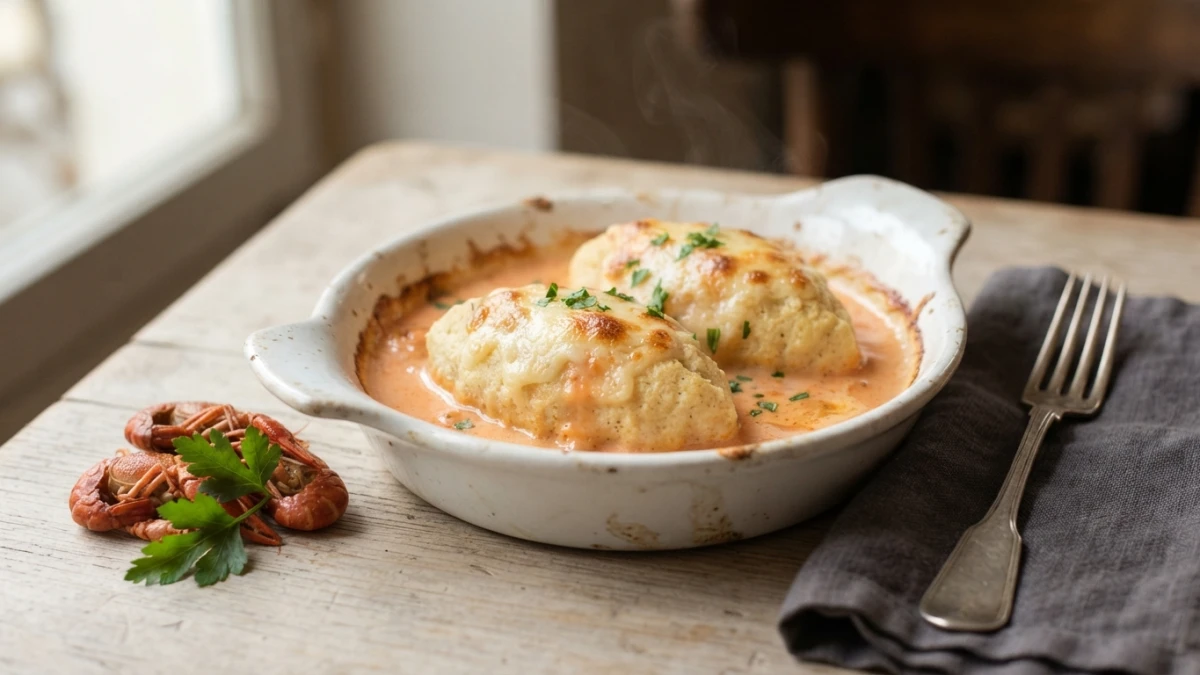
A quenelle de brochet is a portion of pike paste bound with panade and poached in water. It is never breaded and never fried: it comes to the table covered in sauce.
The name misleads twice. It sounds like a brand or a sauce, and it is neither: it names the preparation. And "brochet" is not a surname, it is French for pike, a river fish with more bones than usable flesh. Even so, Lyon turned it into a signature dish. It is pronounced "kuh-nel".
What a quenelle de brochet actually is
It is a portion of fish paste shaped like an elongated bullet with pointed ends, cooked in liquid rather than in a pan. The base is ground fish, a cooked dough called panade, and egg. The result sits closer to a mousse than to fish.
What sets it apart from things you already know: from a croquette, because there is no breadcrumb coating and no hot oil. From a meatball, which is ground meat with bread and gets browned. And from gnocchi, which is potato or flour dough: here the fish leads and the dough only holds it.
Where it comes from: from the German Knödel to the Lyon bouchon
The word comes from German Knödel, "dough ball", with Alsatian relatives such as Knöpfli, diminutives of Knopf, button. The idea travels before the recipe does: balls of dough boiled in water exist across half of Europe. Roman cooking is credited with a boiled paste of fish and egg, and in 1746 a recipe book by Menon already suggested filling dough balls with pike puree. The modern quenelle appears when panade enters the picture.
The most cited Lyon origin dates to around 1830: pike was plentiful in the Saône and hard to transport, so a Lyon pastry chef turned it into paste and mixed it with a cooked dough. But the origin is a documented dispute: Nantua and Port-de-Quirieu also claim the recipe, and in 1907 a Lyon charcutier claimed it again. In the bouchons, the Lyonnais taverns with set tables, the quenelle shares the menu with Lyonnaise mashed potatoes.
Why pike: the fish of the Dombes ponds
European pike is a freshwater predator, long-bodied, with white, fine flesh, usually between half a meter and a meter long. It has been farmed since the Middle Ages in the more than twelve hundred ponds of the Dombes, north of Lyon.
The problem the recipe solved is practical: pike is full of small Y-shaped bones that are hard to remove when filleting. Grinding the flesh in a mortar and passing it through a sieve removed them and produced the fine paste the quenelle needs. The technique was born from a kitchen nuisance, not from a chef's whim. That is why many people who say they dislike fish eat quenelles without complaint. One condition stands: the fish must be fresh and properly deboned.
Panade: the dough that decides the texture
Panade is a cooked dough of flour or semolina with milk or water and butter, worked over heat until it dries and pulls away from the pan. It belongs to the same family as choux pastry and gives the quenelle body and lift while binding the fish. The type of flour changes the result, so this guide to types of flour and their uses helps you choose.
Two rules explain almost every failure. First: the panade is cooled and rested, because mixing it warm curdles the egg and splits the fat; careful versions rest it for up to a day. Second: in the 1920s a Lyon charcutier reworked it with butter instead of beef fat and with a more cooked panade, almost pastry cream, and called it "quenelle de régime" because it was lighter. That is the base of the Lyon quenelle today.
How it is shaped and poached: two spoons and trembling water
The paste is chilled until workable and shaped with two spoons, one flat and one curved, passing it from one to the other until you get the pointed bullet. That shape is the signature of the handmade Lyonnaise quenelle. The full method, with quantities and timings, is in the pike quenelle recipe.
Poaching is the opposite of frying: the quenelles go into salted water or stock, never at a hard boil, until they float and swell; they double in size. A violent boil breaks them and dries them out. They are drained and finished in sauce, or cooled for the gratin. The detail you learn the hard way: the paste must be well chilled before shaping and your hands wet.
Sauce Nantua and the other ways to serve it
The classic pairing is quenelles with sauce Nantua, a pink sauce made with crayfish butter, a descendant of sauce américaine, named after Nantua in the Ain, by the lake where those crayfish were caught. Today the crayfish is often replaced with crustacean butter. In Nantua quenelles the local rule requires at least 22 percent pike flesh; that figure applies to that specialty, not to all of them.
There are other routes. In tomato sauce, as they are served in many bouchons and as Lyon families bought them on Sundays, walking to the pastry shop with a pan. Coated in white sauce, whose bechamel base is explained in this white sauce recipe. Gratinated with cheese. As a vol-au-vent filling. Or sauteed and served cold in a salad, as an appetizer.
The gratin is the restaurant version and the easiest at home: quenelles in a dish, sauce, a little cheese and a hot oven until golden, the same move as a gratin dauphinois. And if the craving is French oven cooking, a quiche lorraine or a ratatouille sets the same table.
How to buy them, store them and read the label
In France they are sold fresh in markets and traiteur shops, and also precooked, in tins, vacuum packs and frozen, in any supermarket. Outside France they turn up in gourmet shops and imported frozen aisles, almost always as "quenelles de brochet sauce Nantua". On this site the recipe sits in the seafood category.
The number to watch is the fish percentage. Many industrial versions are mostly panade with very little pike; at the same price, the one declaring more flesh and fewer additives is the one closest to the dish. Fresh ones keep two or three days in the fridge, frozen ones for months at -18 C. Reheat them in a bain-marie, in the sauce, or straight into the oven from frozen with a little extra liquid. Do not boil them again: they are already cooked.
Calories, pike substitutes and frequent questions
As an estimate, a cooked fish quenelle is around 240 kcal per 100 grams, with about 9 grams of protein, 21 of carbohydrate and 13 of fat. Sauce Nantua and the cheese on top raise the bill: four gratinated quenelles can reach 500 or 600 kcal, again as an estimate.
If there is no pike, any firm white fish works: hake, fresh desalted cod or corvina, well dried and free of skin and bones. There are also chicken and veal quenelles, and a "nature" version with no meat at all, born from Second World War rationing. On the sweet side, French pastry uses the same two-spoon gesture for oval portions, as you can see with French macarons.
The questions that come up most: is it the same as a croquette? No, it is neither breaded nor fried. Can it be made without fish? Yes, the nature quenelle is dough only. Why are there chocolate quenelles? Because the name spread to any preparation shaped with two spoons: today a quenelle is also the oval scoop of ice cream or mousse. Do they freeze well? The cooked ones do.
The tip for a first attempt: chill the paste for at least an hour, keep a bowl of warm water nearby for the spoons and poach in water that trembles rather than boils. If the quenelle falls apart, the water was too hot or the paste too warm.