Tacacho con Cecina: What It Is and How It Is Served
 By
Diego Cortés
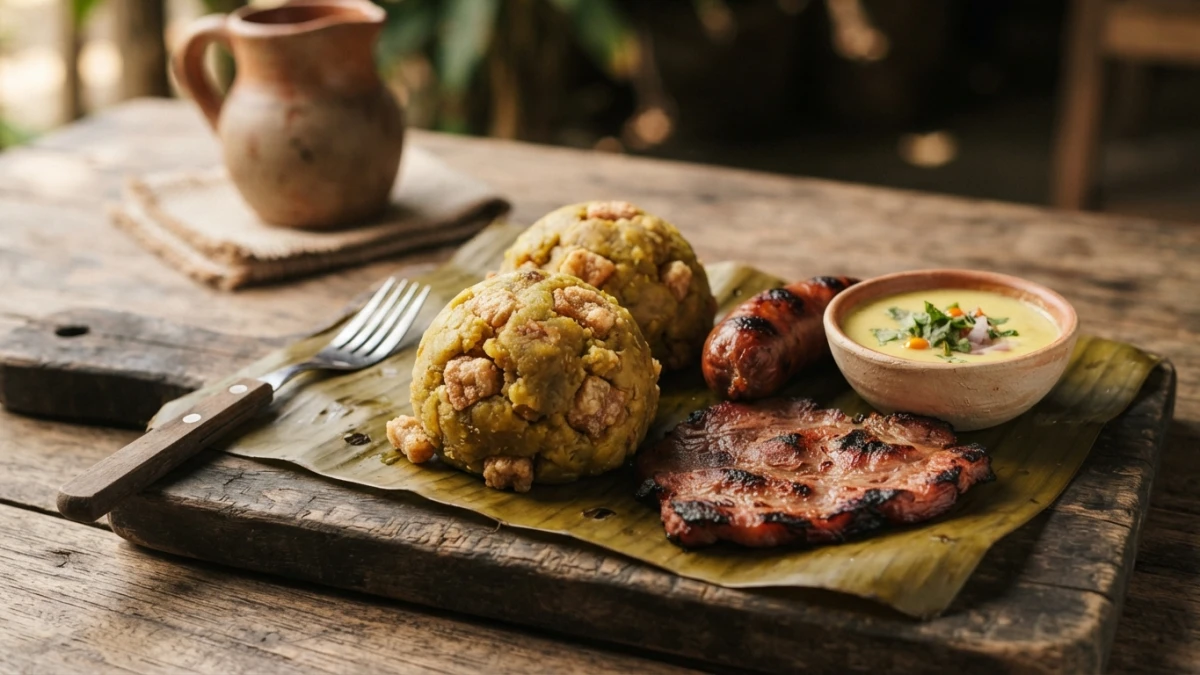
Few dishes puzzle a first-time diner like tacacho con cecina: two balls of plantain that are not dessert, a smoked meat that is not ham, and a name that comes from Quechua and translates as "the beaten one". No flour, no egg, no breading: what holds the mash together is pork fat.
What tacacho con cecina is
In its classic form the plate arrives with two balls of tacacho, one piece of cecina and, very often, a chorizo; proportions are adjusted to order. Tacacho is green plantain roasted and mashed with pork fat and chopped chicharron. Cecina is pork salted and smoked over wood. Nothing else. The appeal lies in the contrast between the starchy plantain, the fat and the smoke of the meat.
Two confusions are worth clearing up. The plantain is green, never ripe: green is not sweet, it is starchy, and that is why it survives the mashing. And Peruvian cecina is not Spanish beef cecina, nor a cured sausage sliced thin, but pork seasoned with local spices, salted and smoked. If you want quantities and timings, they are in the tacacho con cecina recipe with quantities and timings; this piece covers what the dish is and where it comes from.
Where it comes from and why it is called that
Tacacho belongs to the Peruvian Amazon: it is cooked in Loreto, San Martin, Ucayali, Madre de Dios and Huanuco, and from there it spread across the country; it also appears in the Colombian department of Caqueta. Its history mixes two worlds, since plantain and mashing predate the Spanish arrival while pork, salting and smoking came with the colonial period. The older version used chicharron from sajino, the wild Amazonian peccary.
The name has an explanation repeated in almost every source: it would come from the Quechua "taka chu", translated as "the beaten one", a reference to the mallet used to crush the plantain. It is best taken as the most widespread hypothesis rather than a settled etymology. What is certain is the gesture: the dish is defined by the pounding, not by a seasoning or a sauce.
San Juan: the day tacacho becomes a celebration
June 24 is the patron saint feast of the Peruvian Amazon, and the date when tacacho con cecina multiplies across tables, markets and streets. The signature dish of the celebration is juane, and tacacho is its classic companion: they show up together at the same stalls. Outside that date it is eaten all year round, but it loses its character as a collective event.
The time of day depends on the region. In San Martin and Madre de Dios it is usually breakfast, with brewed coffee or a fruit drink; elsewhere it is lunch or dinner. Anyone who wants to try it in context will find it in the markets and small eateries of Iquitos, Pucallpa and Tarapoto, and at roadside stalls where the plantain is roasted over charcoal on the spot.
The plantain: why green and why bellaco
The variety matters. Bellaco, also called macho or harton, is a large, elongated plantain; green it is used for tacacho and for frying, ripe for sweet chips. With dessert banana the dish does not work: it will not bind and it tastes like something else. That is why tacacho cannot be improvised with whatever fruit is at hand.
Traditional cooking is over charcoal: the plantain is roasted whole until the skin chars and the flesh yields. In areas such as Huanuco it is boiled instead, which gives a slightly wetter result. Then it is peeled while hot, mashed with a mallet or by hand, and the melted fat and chopped chicharron are worked in. Without that fat the mash turns dry and crumbles in your hand; with it the ball forms, and sometimes it is browned for a moment in a pan. For the ingredient itself, the article on the health benefits of bananas and plantains is a useful start, and for the roasting technique, these grilled plantains.
Cecina and the chorizo of the Amazon
Peruvian cecina is pork seasoned with local spices, salted and smoked over wood. It stays juicier than other dried pork preparations and carries a smoke that is nothing like cured ham. On this site the term is translated as jerky, a convenient but imprecise approximation: jerky is a dry strip, while this is a piece of pork with fat. It is cooked on a grill or in a pan until browned outside and still juicy inside; overcook it and it turns hard and salty.
Regional chorizo is the other table companion: in the Amazon it is made thicker, with its own spices and smoke, and served in rounds or next to the steak. Another recipe helps explain the cured pork flavour: chili pepper stuffed with cecina and cilantro sauce. The whole family of meat preparations sits in the meat category.
The sauces and what comes alongside
The sauce that goes with the plate is made from cocona, a sour Amazonian fruit related to the tree tomato, chopped with onion, aji charapita and cilantro and dressed with lime. It cuts the fat and makes the whole plate feel fresh; without it, tacacho sits heavy. The same fruit makes a cocona soft drink that usually appears on the same table.
Around it come salsa criolla, a fresh salad, fried plantain or thin plantain chips and, at some stalls, a bijao leaf under the food, which adds aroma. To drink, the natural choice is brewed coffee or a fruit drink; chicha works too. An ice-cold soda hides exactly the smoke you want to taste.
Tacacho, mofongo, bolon and patacon: the mashed plantain family
Tacacho belongs to a family that crosses the Caribbean and the Andes: green plantain, fat and mashing. The fat changes, the side changes and the name changes. Mofongo is made with fried plantain and plenty of garlic; Ecuadorian bolon is kneaded with cheese or chicharron and eaten for breakfast on the coast; patacon is a fried, flattened slice, not a mash. These patacones show that difference in format clearly. Tacacho, by contrast, is roasted, made with pork fat and chicharron, and served with cecina.
One neighbour is not a relative: African fufu is made with yam, cassava or plantain and belongs to another tradition; the coincidence is in the name and the gesture, not in the recipe. Anyone curious can read the article on what fufu is and what it is made of. A shared trunk does not mean claiming that one kitchen copied another, only that the same technique appears in many places with different results.
Calories, how it is eaten and frequent questions
The count, as an estimate rather than a laboratory figure: a classic plate with two balls, a piece of cecina and chorizo runs around 700 to 900 calories, because it stacks plantain, pork fat, chicharron and smoked pork. Without chorizo it drops to about 600 or 700. Green plantain provides roughly 120 calories per 100 grams; the rest comes from fat. It is a calorie-dense, salty dish, the kind you eat now and then.
It is eaten without ceremony: the platter goes in the middle and everyone opens a ball with a fork, mixes it with a piece of cecina and adds sauce. Two sensible precautions: cecina and Amazonian chorizo are cured, so keep the rest of the plate light on salt, and the plantain must be thoroughly cooked before mashing.
Frequent questions
Can it be made with ripe plantain? Then it is not tacacho; it would be something else, and sweet. Can it be served without cecina? Yes, with chorizo, chicharron or grilled chicken. Can it be frozen? Plain tacacho freezes well; cecina loses texture. Is it the same as a patacon? No: patacon is a fried, flattened slice, while tacacho is a roasted mash with fat.