Jocón: What Guatemala's Green Chicken Stew Is
 By
Diego Cortés
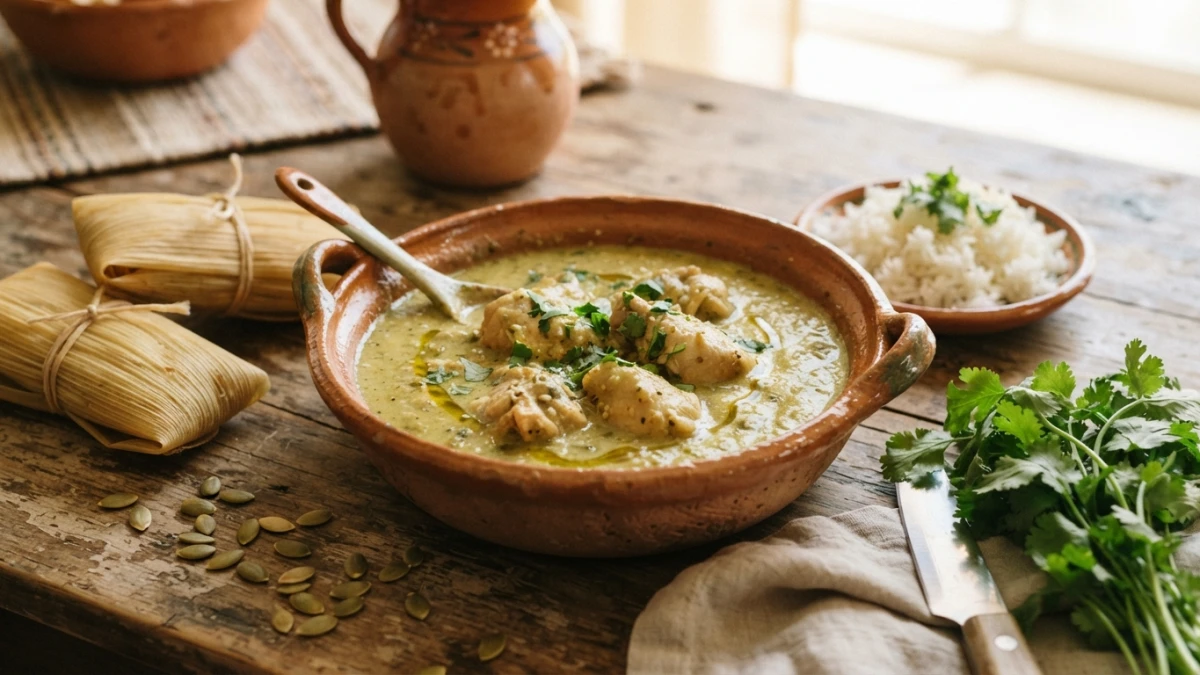
The jocon, Guatemala's green chicken stew, is chicken simmered in a thick green recado that, despite its colour, contains no tomato at all: its body and toasted-nut flavour come from ground pumpkin seeds and sesame.
First-time eaters usually look for the tomato and never find it. That is the first clue that this is a different kind of cooking, one from a country that grinds its sauces on stone and turned this dish into a national treasure.
What Jocon Is
Jocon is a chicken stew, often made with a free-range hen, cooked in a dense green sauce. The recado is built from miltomate, fresh green tomato, spring onion with its stalk, coriander with its stems, mild green chilli and, in some homes, mint. What separates it from any other green sauce is the seed: pumpkin seeds toasted on a comal and sesame, ground fine, bringing fat, thickness and a toasted taste that defines the dish.
The anatomy is simple: chicken pieces covered in the recado, served in a deep bowl or a clay dish, with white rice on the side and tortillas or corn tamalitos to go with it. It is eaten with a spoon: the sauce has to hold the meat, not slide off it.
Nor is it pepian, which is red and uses dried chillies; nor kak'ik, a turkey soup from Alta Verapaz; nor Mexican green salsa, which is not thickened with toasted seed.
Where It Comes From: Huehuetenango and the Name "Jok Om"
Several sources place its origin in Huehuetenango, in the highlands of western Guatemala, and describe it as a dish with Maya roots. Today it is cooked all over the country, still with the feel of country cooking.
The name has an explanation that gets repeated a lot and is best taken as attribution rather than settled fact. It is derived from the K'iche' "jok om", translated as green recado. Some read it as "five greens", for the number of green ingredients that go into the pot. Both readings circulate and neither is definitively documented.
What can be verified is the official recognition: in November 2007, Guatemala's Ministry of Culture and Sports declared it Intangible Cultural Heritage of the Nation, alongside other recado dishes of Guatemalan cooking.
Why It Is Green (and Why There Is No Tomato)
The green comes in three layers. The first is the vegetables: miltomate, the husked green tomato known elsewhere as tomatillo, fresh green tomato, spring onion with its stalk, coriander with stems and mild green chilli. Everything is charred or briefly cooked before grinding, so it loses its raw edge and gains sweetness.
The second layer is the seed. Pepitoria means pumpkin seeds toasted on a comal until they release their aroma, and the sesame is toasted separately because it burns faster. Ground fine and added to the blend, they give the recado its pale colour, its fat and that nutty taste nobody expects in a chicken stew. Without them the dish tastes like any green sauce; with them it tastes like jocon. The chicken in pepitoria recipe shows that use of toasted seed as the base of a recado.
The last layer is care at the end: the sauce should not boil hard or cook long, because the green dulls and turns olive. It is finished over low heat and served soon.
The Thickener: Corn Masa, Soaked Tortilla or Sweet Bread
Tradition calls for nixtamalised corn masa. In practice, many kitchens use a corn tortilla soaked in broth and blended, which does the same job. And some thicken with sweet bread crumbs toasted on a comal, a home-cooking trick that rounds out the flavour and darkens the colour slightly.
The thickener is blended with the chicken broth and strained if a finer sauce is wanted. The texture you are after is a stew that holds on the spoon, not a cream. If it gets too thick, loosen it with hot broth; if it is watery, add a little more masa dissolved in cold water, never dumped in dry because it clumps.
Salt goes in at the end. Pumpkin seeds and sesame already bring flavour, and broth from a free-range hen tends to be salty, so tasting before adding is the only way to avoid overshooting. The jocon recipe with quantities and timings follows that same order of work.
What Goes In, and How It Changes by Region and Occasion
The meat is the first point of variation. Chicken dominates today, often a free-range hen for its deeper broth. It used to be made with pork ribs, and some homes mix both. For big celebrations it is cooked by the potful, because the sauce improves as it rests.
The vegetables change too. Chayote and potato are the usual companions; in some areas green beans or carrot go in. They are served inside the stew or on the side, depending on the house.
There is also a meatless version, with vegetables and the same green sauce, eaten during Lent. And there is the difference between a farm chicken and a supermarket one: the former has firmer meat and a stronger broth, and that shows in the final result more than any adjustment of spices.
How Jocon Is Served
The plating matters. A deep clay bowl or earthenware dish, two pieces of chicken per person and plenty of sauce spooned over, without holding back. On the side, a generous spoonful of white rice and warm tortillas to push it along. The rice stays separate, not inside the bowl, so it does not turn to mush.
The classic accompaniments are corn tamalitos wrapped in corn husks, white rice and, if wanted, a chilli sauce on the side for anyone after more heat.
To drink, fresh fruit water or coffee; dessert, something light, because the dish is already substantial. This is midday food and a long after-lunch conversation, not a quick dinner.
The dish belongs to the same family as the Guatemalan hilachas we covered earlier, and it is served with the same corn accompaniments as Guatemalan tamales. All of the country's recado cooking comes together under the site's meat category.
Jocon, Pepian, Kak'ik and Hilachas: Four Different Dishes
All four are Guatemalan recados, meaning ground sauces cooked with meat. The seed changes, the chilli changes and the colour changes, and with that the whole dish changes.
Pepian is red and more complex: pumpkin seeds, sesame and toasted dried chillies, with chicken, pork or both. Jocon is green and more herbal, with fresh mild chilli. The difference is not heat but profile: one is toasted and deep, the other fresh and green.
Kak'ik is a turkey soup from the Q'eqchi' tradition of Alta Verapaz, with annatto and chillies, thinner and with a different aroma. Hilachas are shredded beef in a tomato sauce that leans sweet. None of them tastes like jocon, even if they share gestures in the pot.
Calories, Storage and Common Questions
The count, always as an estimate rather than a lab analysis: a plate with two pieces of chicken, sauce and rice lands around 500 to 650 kcal. The sauce adds pumpkin seeds and sesame, both oil-rich seeds, plus the masa. Without rice it drops by roughly 200 kcal. It is rich because of the seeds, but it has chicken and vegetables: the balance is in the portion.
On storage: it keeps three or four days in the fridge and freezes well, ideally with the sauce and meat separate from the rice. When reheating, use low heat and a splash of broth so the green does not dull. The chicken must be fully cooked before serving, with no pink near the bone.
Common questions
Is it spicy? Only mildly. The chilli is fresh and seeded, so it brings flavour rather than heat.
Can it be made without pumpkin seeds? You can, but it becomes a different sauce: you lose the toasted-nut flavour that defines the dish.
Can it be made with turkey? Yes, and it ends up closer to kak'ik than to the original jocon.
Can it be made ahead? Yes, and it improves: the next day the sauce settles and tastes better.
Does it contain tomato? No red tomato. It uses miltomate, which is green and husked, and that is the key to its colour.