Patbingsu: What Korean Shaved Ice Is and How to Eat It
 By
Diego Cortés
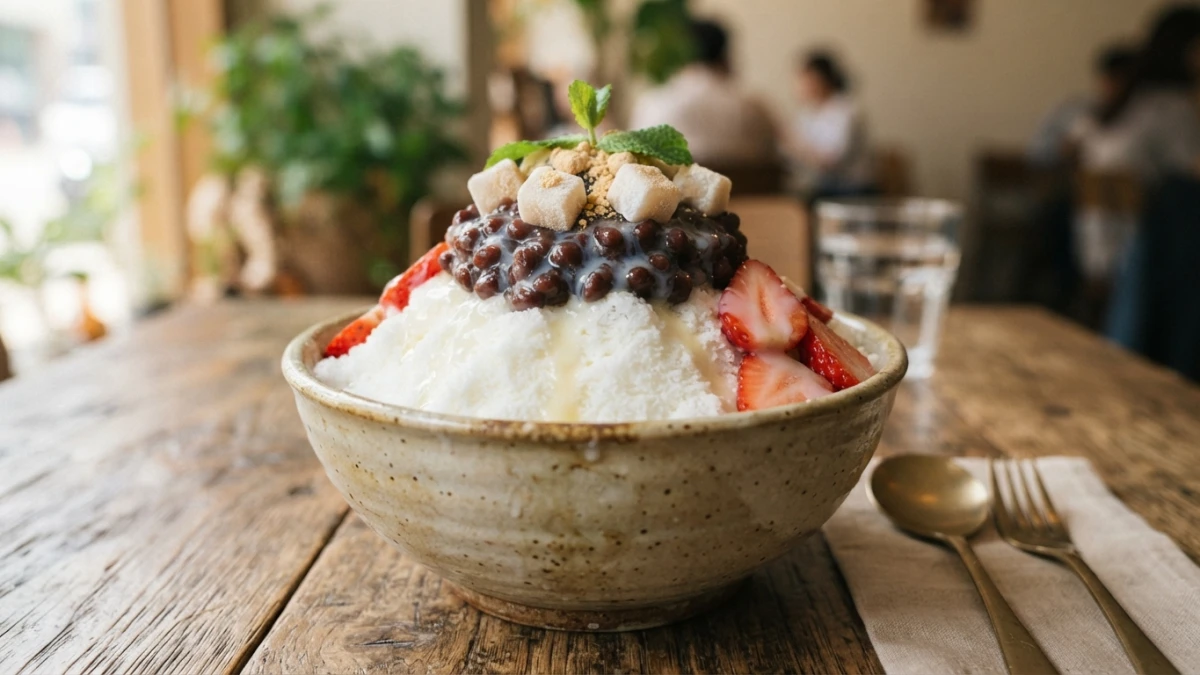
Patbingsu is not ice cream: it is milk ice shaved until it looks like snow, covered with sweet red bean paste, pieces of rice cake and condensed milk. In Korea it is ordered for two and eaten quickly, before it melts.
Anyone expecting a slushie finds something far creamier and sweeter, with textures that do not resemble any Western dessert.
What patbingsu is
Patbingsu is a Korean shaved ice dessert served in a large bowl, topped with sweet red bean paste. It differs from ice cream in how it is made: ice cream has air churned into it while it freezes; here a liquid is frozen and then shaved into very thin sheets, so the result is airy and dissolves in the mouth in seconds.
There is a distinction almost nobody explains. Bingsu is the category: shaved ice with a sweet topping. Patbingsu is the classic version, the one with red beans. If the bowl has no pat, it may be an excellent bingsu, but it is not a patbingsu.
At the table it is easy to recognise by its shape: a deep steel or ceramic bowl, a mountain of white ice, a spoonful of dark paste, pieces of rice cake, fruit and a thread of condensed milk. As soon as it starts to melt, the snow texture is gone.
Why it is called that: pat + bingsu
The name is literal. Pat is the red bean, the same sweet legume known as azuki in Japan; bingsu is written with the characters for "ice water". Together: ice with red beans, which is exactly what sits in the bowl.
Outside Korea it appears as patbingsu, patbingsoo or simply bingsu. In Korea the difference is one of use: bingsu covers the dessert in general and patbingsu is the classic. English has settled on shaved ice dessert, which describes the concept rather than naming the dish.
Where it comes from: from Joseon ice houses to Seoul cafes
The early origin is documented in the Joseon period (1392-1897), when ice was kept in underground chambers and used on special occasions; sources cite the seokbinggo in Gyeongju, a stone storehouse that kept winter ice until summer.
The modern dessert was born as shaved ice with sweet beans sold by street vendors: cheap, seasonal and eaten standing up. After the Korean War, condensed milk, syrups and chocolate arrived with American influence, and with them cereal and ice cream.
The latest change is recent: many cafes now freeze sweetened milk instead of water, so the ice is creamy from the inside. A chain founded in Busan in 2010 created its injeolmi bingsu in 2013, and the success of the dish turned it into a nationwide network.
What goes into a patbingsu (and what each topping is)
The base is two things: shaved ice, from water or sweetened milk, and sweet red bean paste, which in Korea is bought ready-made and is the ingredient that defines the dish. The ice should feel like snow: if you can feel the grain, it is a slushie.
The classic toppings are four: small pieces of tteok, glutinous rice cake, chewy and not sweet on its own; sliced fruit depending on the season; condensed milk, added at the table; and, depending on the shop, vanilla ice cream, jelly or cereal flakes, which are modern additions.
The one worth trying is injeolmi: a rice cake steamed and pounded, then coated in roasted soybean powder. It brings a nutty flavour the red beans do not have, and many chains treat it as their signature.
To understand its texture, try tteokbokki first, which uses the same rice cake in a savoury version.
The varieties you will come across
The traditional ones appear on almost every menu: patbingsu (red bean), nokcha (green tea), ttalgi (strawberry), choko (chocolate), coffee and yoghurt. These are the ones inherited from the post-war years and the ones fast food chains sell from May to September.
Modern cafe versions take another route: injeolmi, mango, melon, black sesame, hojicha with tapioca pearls, cheese and even persimmon. Many are temporary and disappear when the fruit runs out.
Format counts too: cafe bingsu is served in an enormous bowl for two, with small plates for sharing. It is not an individual dessert; at home the portion is best adjusted.
How it is eaten and served
Order matters. You take ice, beans and topping in the same spoonful; eaten only from the top down, the bottom of the bowl is plain ice. Condensed milk is added little by little and stirred from the bottom up.
The moment is summer: June to September in Korea, mid-afternoon, after a meal or as an excuse to sit in a cafe.
At home no machine is needed: freeze sweetened milk in cubes and blitz them in a powerful blender for a close texture, then assemble. The patbingsu recipe, with amounts and times is on the site's recipe page.
If the plan is a full Korean table, the dessert comes after heavier dishes: kimchi to start, Korean barbecue or Korean tacos as a main, and bingsu at the end to cool the spice down. The site's Korea tag gathers the fifteen recipes of that cuisine.
Patbingsu, kakigori and halo-halo are not the same
All three are shaved ice with sweet things, and that is where the similarity ends. Japanese kakigori is made with water ice and fruit syrup, and its virtue is an almost dry snow; bingsu has a dairy base and toppings that get mixed in, so it is creamier and sweeter.
Filipino halo-halo mixes evaporated milk, coarsely crushed ice, beans, fruit in syrup and flan, and the whole thing is stirred before eating. Patbingsu is more restrained: the beans sit on top rather than stirred in, and the ice is far finer.
Malaysian ais kacang and Taiwanese tshuah-ping solved the same problem with their own pantry. Different ice, different topping, different dessert.
Calories, storage and frequently asked questions
Calories depend on the toppings, so ranges make more sense than a single figure. An individual homemade bowl lands around 250-300 kcal; a cafe bowl for two sits between 550 and 750 kcal in total, about 275-375 per person, because milk ice, sweetened beans and condensed milk all add sugar and fat. Without condensed milk or ice cream it drops by about 100 kcal. These are estimates.
Storage is simple: it does not keep. Shaved ice melts in minutes and, refrozen, turns into a hard, watery block. The only things that can be made ahead are the sweet beans, three or four days in the fridge, and the tteok, which keeps one or two days and softens in the microwave.
It is a sweet, cold dessert, and the cafe portion is designed for sharing. There is nothing to promise beyond the pleasure of eating it properly cold on a hot day.
Frequently asked questions
Does it contain alcohol? No; the classic version has none, and coffee variations with liqueur are the exception.
Is it the same as a slushie? No: a slushie is crushed ice with liquid and no dairy base.
Can it be made without red beans? Yes, but then it is another bingsu.
Why is it shared? Because the bowl is huge and the dessert becomes cloying if eaten alone.
To close out frozen dessert season, a homemade Coca-Cola ice cream is the other end of the same impulse.