Gazelle Horns: What They Are and Where They Come From
 By
Diego Cortés
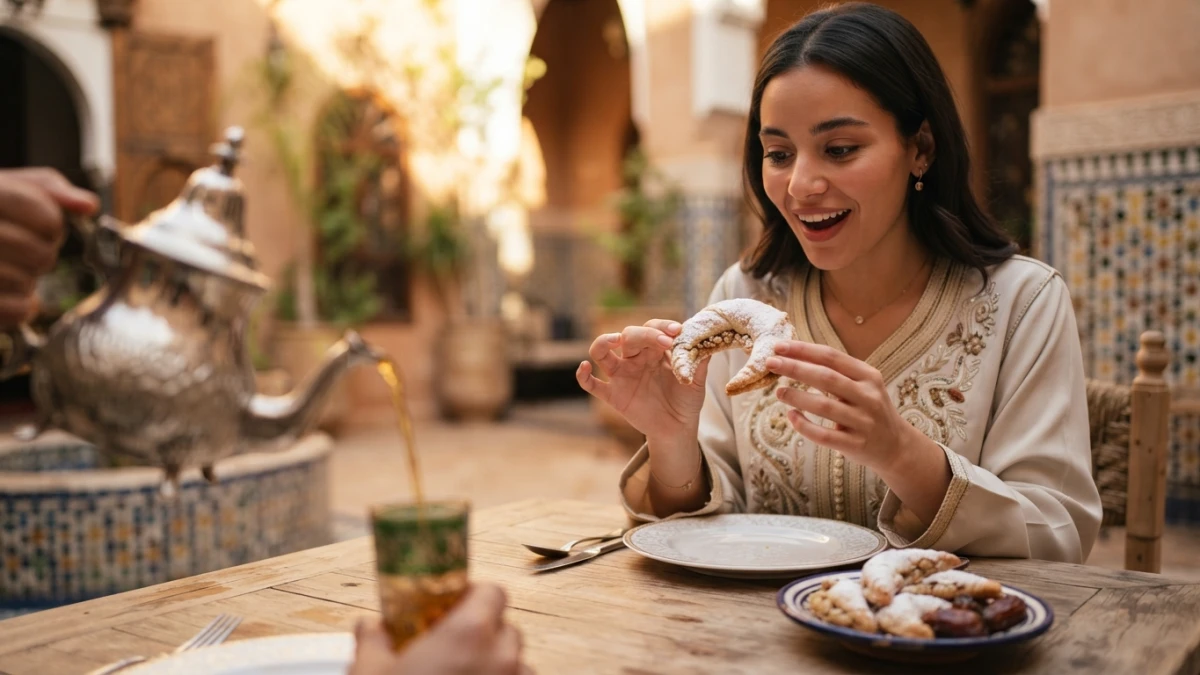
Gazelle horns surprise anyone who tries them for the first time: they are not puff pastry, they are not fried and they are not soaked in syrup. They are a North African sweet made from a sheet of dough so thin it almost shows the table underneath, filled with almond paste scented with cinnamon and orange blossom water, and baked just long enough to stay pale. The Arabic name, kaab el ghazal, does not mention horns either: it mentions ankles.
What gazelle horns are
They are a pastry from the Maghreb shaped like a crescent, with a very thin shell and a dense filling of ground almonds flavoured with cinnamon and orange blossom water. They bake briefly and are dusted with icing sugar while still warm. The result is ivory, not golden, and the orange blossom aroma arrives before the first bite.
There is no puff pastry and no shortcrust, no hot oil and no syrup glaze: the appeal lies in the contrast between a nearly translucent shell and a dense filling. You recognise them by size, six to eight centimetres, by the pale colour and by the thin layer of icing sugar. If they look toasted on top, someone turned the oven up.
Where the name comes from
The original name is kaab el ghazal. Kaab means ankle or heel and ghazal is the gazelle, so the literal translation would be "gazelle ankle". The French cornes de gazelle swapped the ankle for horns, and that is the name that stuck in menus and translated cookbooks. The gazelle is not random: it is the animal Arabic poetry uses as an image of elegance, and the name describes the fine curve of the pastry.
Outside Morocco the name changes with the shop: kaab el ghazal or kaab el ghzal in Arab bakeries, cornes de gazelle in French ones and tcharek in Algeria.
Where they come from: a sweet documented in the 13th century
The earliest written trace usually cited is the cookbook of Ibn Razīn al-Tujībī (1227-1293), an Andalusian scholar born in Murcia who wrote in Tunis a work of some 475 recipes covering the cooking of al-Andalus and the Maghreb. It documents an early version: rolled, with a dough of olive oil, flour, hot water and salt, filled with almonds and sugar.
From roll to crescent there are centuries of cooking: the shape curved, the dough was rolled thinner and olive oil gave way to butter, until it became the pastry sold today in Fez, Meknes, Tetouan, Algiers or Tunis. On the exact origin the sources disagree, since Morocco, Algeria and Tunisia all claim it. It is safer to speak of a Maghreb sweet, without a single homeland.
What goes in: thin dough and almond paste
The dough is a sheet, not a bread. It takes flour, melted butter (or smen, the fermented Moroccan butter), one egg yolk, a pinch of salt and orange blossom water instead of water. It is kneaded for a long time, rested and rolled so thin that it almost turns transparent: that rolling decides the outcome, because a thick sheet cracks.
The filling takes ground almonds and icing sugar in a rough ratio of two to one, with cinnamon and orange blossom water. Some recipes add a pinch of gum arabic, and that is where the old-fashioned bakery perfume comes from. A classic batch uses about 500 grams of almonds and 250 of sugar for the filling, and 300 grams of flour for the dough: almost three quarters of the pastry is almond, which is where texture and calories come from. That is why it tastes closer to a scented marzipan than to a biscuit, as you notice when comparing it with Spanish almond marzipan.
How they are shaped and why they must stay pale
The filling is rolled into short cylinders and the ends are tapered. Each cylinder goes on the rolled dough, is covered, sealed, cut with a pastry wheel and curved into a crescent. Then it is pricked with a needle so the dough does not puff up.
The oven decides the pastry: twelve to fifteen minutes at about 170 °C, with one clear goal, that they do not brown. They must stay pale, barely blond underneath; if they toast, the dough loses its delicacy and the filling dries out. Once out, they are dusted with icing sugar so it sticks, and some versions are brushed with egg white or rolled in sesame. Exact quantities and times are in the gazelle horns recipe.
How many calories do gazelle horns have
The practical figure is 100 to 140 kilocalories per piece of 25 to 30 grams, depending on size and on the almond to sugar ratio. Two published recipes with full quantities give 107 and 137, and a calculation from the ingredients of a batch of forty lands in the same range. It is a reasonable estimate, not a laboratory figure.
They are heavier than they look, because almonds bring fat and the icing sugar in filling and finish adds the rest. They are small, dense and easy to eat two at a time. No alarmism: this is a pastry, and there are no health claims to make. One necessary warning: anyone with a tree nut allergy cannot eat them.
How they are served: mint tea, Ramadan and party tables
The natural companion is mint tea. In Morocco it is served very sweet, in a glass, and its bitterness cuts through the almond. Without tea, an espresso or a glass of cold milk works better than any soft drink. There is more detail in the black mint infusion.
They are a sweet of Ramadan and Eid al-Fitr, and of wedding tables too. On a Moroccan party tray they sit next to ghoriba, fekkas and chebakia, and the gazelle horn is the finest piece. Demand peaks in the month before Ramadan, which in 2027 begins in early February according to the estimated date, subject to the sighting of the moon. For a full meal, a vegetable tagine to start and a chicken tagine with apricots as the main course set up the palate, with lamb tagine if the occasion is big; for a simple snack, Moroccan crepes do the same job.
Variations, storage and common mistakes
The family is wide. Algerian tcharek is the version coated in icing sugar; Moroccan m'hanncha is the same almond paste rolled into a spiral; Tunisian kaak warka changes shape, a ring, and aroma, with rose or geranium water. The French version often carries chopped pistachio. In the Spanish-speaking world, almond polvorones are the closest relative.
They keep for two weeks in an airtight tin, in layers separated by paper, and for up to three months frozen. The fridge is not their place: cold makes them damp and the dough softens. The three mistakes that ruin them all have a fix: dry or thick dough, which cracks in the oven and is fixed with rest and a thinner sheet; a hot oven, which browns and hardens them, fixed by treating 170 °C as the ceiling; and a filling that is too soft, which bursts through the base and is fixed with less liquid and more almond.
Are they the same as marzipan?
No. They share the almond and sugar base, but marzipan is baked as a compact paste while the gazelle horn wraps that paste in a very thin dough. The aroma differs too: orange blossom and cinnamon in the Maghreb, lemon zest in the Spanish version.
Can they be made without orange blossom water?
Yes, but they lose their signature. An acceptable substitute is fine orange zest with a few drops of almond extract.
Why horns, if the Arabic name says ankles?
Because of the French translation. Cornes de gazelle replaced the ankle with horns, and that version spread across Europe and the Americas.
Do they contain gluten?
Yes, the dough is made with wheat flour. Anyone with coeliac disease needs a gluten-free flour version, which changes the texture because the dough loses elasticity.
Do they travel well?
Yes, in a rigid box in a single layer. They are firm and the icing sugar protects the surface, although rough handling leaves marks.