Crema Volteada: What It Is and How It Differs from Flan
 By
Diego Cortés
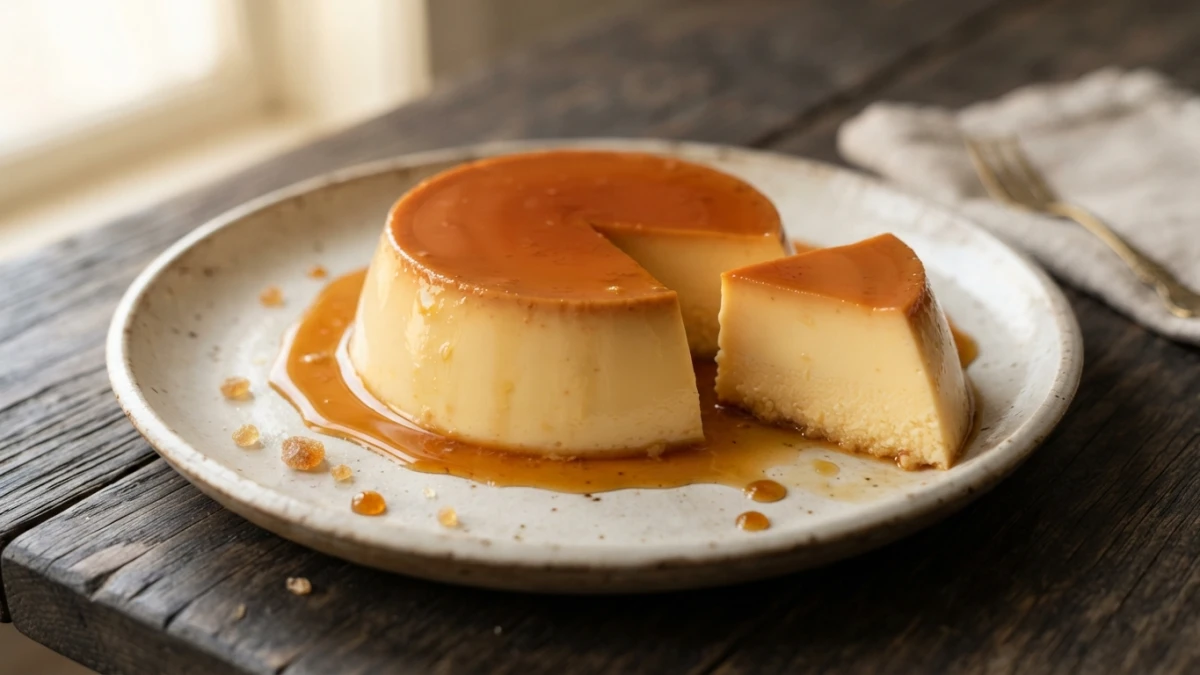
Crema volteada takes its name from the final gesture: you have to turn the mould out to serve it, exactly what the French crème renversée says. And its caramel, that amber sauce that looks added separately, forms on its own at the bottom of the tin.
It is not a complicated dessert: milk, eggs, sugar and vanilla in a water bath over caramel. Here is what the dessert is, where the name comes from and why it is not a packet flan.
What crema volteada is
Crema volteada is a milk and egg custard set in a water bath over caramel and served by turning the mould out, so the caramel ends up on top and turns into sauce. Four ingredients and one technique: nothing more.
At the table you recognise it at once: an even ivory colour, a smooth top that is never browned, and an amber pool that appears as soon as the mould is lifted. It is cut into slices and served cold. It has no flour and no gelatine: if the surface is toasted, either it is a different dessert or the oven was too hot.
Why it is called crema volteada
The name describes the last step: turning the mould out onto a plate. French says the same with crème renversée, "overturned cream".
The detail almost nobody mentions: the modern dessert, with soft caramel on top and a water bath, is first documented in La cuisinière provençale by Jean Baptiste Reboul, published in 1897. And the name travelled with the gesture.
A translation warning: English does not say "flipped cream" because it means nothing; it says crème caramel or caramel custard, and in the Spanish-speaking world, simply flan. The site's recipe cards translate it literally.
Where it comes from: from European cooked cream to American tins
The family is old: milk and egg custards are documented in Greek and Roman cooking, with the tyropatina, and in the Middle Ages sugar and caramel join in. The flan of today comes from that line, not from a single country.
The American jump did not change the technique, it changed the ingredient: European baking brought the mould, the water bath and the caramel, and in the twentieth century evaporated and condensed tinned milk gave a denser, sweeter, more stable custard, with no need for fresh milk.
A note on method: there is no invention date and no owner country; sources place the modern dessert in the late nineteenth century and the tinned-milk version through the twentieth century.
How it differs from flan, from packet flan and from leche asada
Against flan: it is the same dessert under another name. The difference is the recipe: in Peru it is made with condensed and evaporated milk, denser and sweeter; in Spain, with whole milk, eggs, sugar and vanilla. The proportions change, not the family: this homemade vanilla flan with caramel is the very custard.
Against packet flan: here the difference is real. The instant powder does not set with egg but with hydrocolloids such as agar or carrageenan, or with starch. It tastes similar and it is not the same: it lacks the silky texture and the liquid caramel.
Against leche asada: same base, different bake. Leche asada is baked uncovered at a higher temperature, so it develops a browned top and a coarser texture; crema volteada is baked covered, in a water bath, and served turned out.
The map of names: quesillo in Venezuela, pudim de leite in Brazil, leche flan in the Philippines with condensed milk and yolks only, and in Chile the two-layer variant is homemade chocoflan. In Peru it is also called leche volteada.
What goes in, and in what proportions
The whole-milk version, the most common one in Chile and Spain, takes 1 litre of milk, 6 eggs, 150 grams of sugar for the custard and another 150 for the caramel, plus vanilla. It serves 8 from a 22-centimetre tin.
The Peruvian version swaps sugar for tins: 1½ tins of evaporated milk, 1½ of condensed milk, 6 eggs and vanilla, with the caramel made separately from a cup of sugar. It comes out denser, sweeter and heavier per portion. The quinoa crema volteada recipe uses that base, and the chocolate crema volteada recipe, with quantities and timings, belongs to the same family.
The role of each one: eggs set the custard and give it structure, milk brings body, sugar sweetens and feeds the caramel, and vanilla, lemon zest, orange or cinnamon add aroma.
How it sets: caramel, water bath and cold
The caramel goes first: sugar and a few tablespoons of water over medium heat, without stirring, swirling the tin only, until it turns amber. Take it off before it smokes, because it keeps darkening; coat the base and part of the sides and let it harden. If you would rather have it ready-made, this liquid caramel for desserts works the same way.
The mixture wants a light hand: beat the eggs with the sugar only until combined, because foam leaves visible bubbles. Then the warm milk in a thin stream, the aroma, and one step almost everyone skips: straining through a fine sieve to remove chalazae.
The bake is a water bath, the tin covered with foil, standing in a roasting tin of hot water that comes halfway up, at 150-160 degrees for about an hour, with the water never boiling. Test with a knife: it comes out clean and the centre wobbles just slightly. Then a minimum of four hours in the cold, which is what lets you unmould it without cracking. Because the dessert depends on fresh eggs, it is worth checking how to tell if an egg is fresh.
How many calories it has
With the arithmetic in plain sight, in the whole-milk version the 300 grams of sugar contribute about 1,200 calories, the litre of milk about 620 and the 6 eggs about 420: roughly 2,240 per mould, or 280 calories per portion of 8. It matches published tables for a 180-gram serving.
The Peruvian one weighs more: with two tins the mould goes past 3,800 calories, so a slice from 8 to 10 portions lands between 380 and 480 calories. It helps explain why "just a little slice" does not mean the same thing in the two recipes.
No alarmism: it is a dessert of eggs, milk and sugar, and it is eaten now and then. Nothing about "low calorie" or "light": if you want to lighten it, serve a smaller portion, do not rename the dessert. And anyone who cannot have eggs or dairy cannot eat it.
Storage, mistakes and variations
Covered and kept cold it lasts 3 to 4 days. It does not freeze: on thawing it turns watery and grainy. It should not sit out of the fridge for more than two hours. It can be made the day before.
The four mistakes that ruin it: a hot oven or boiling water, which open holes; over-beating, which leaves bubbles; caramel taken too far to dark coffee, which turns bitter; and unmoulding without enough cold, which cracks it. If the caramel has stuck to the base, stand the tin in hot water for a few minutes before turning it out.
Variations: orange, coffee, chocolate or coconut in the mixture; lucuma, cherimoya or soursop in the Peruvian one. And the oven-free route, in a covered pot with a cloth, 45 to 50 minutes over low heat, is the same idea as microwave egg custard with caramel.
Are crema volteada and flan the same thing?
In practice, yes: the same dessert under two names. The difference lies in the recipe and the country.
Can it be made with condensed milk?
Yes, it is the most common version in Peru. Part of the sugar and of the milk are replaced by the tin.
Why does the caramel turn liquid?
Because the cooked sugar absorbs moisture from the custard in the cold: by the time you unmould it, it is sauce.
Can it be frozen?
Better not: the emulsion breaks and the texture turns watery.
How long does it keep in the fridge?
3 to 4 days, covered. The caramel keeps releasing liquid, so the sauce increases.
What is it called in other countries?
Quesillo in Venezuela, pudim de leite in Brazil, leche flan in the Philippines and flan de huevo in Spain.