Satsivi: What Georgian Walnut Sauce Is and How to Serve It
 By
Diego Cortés
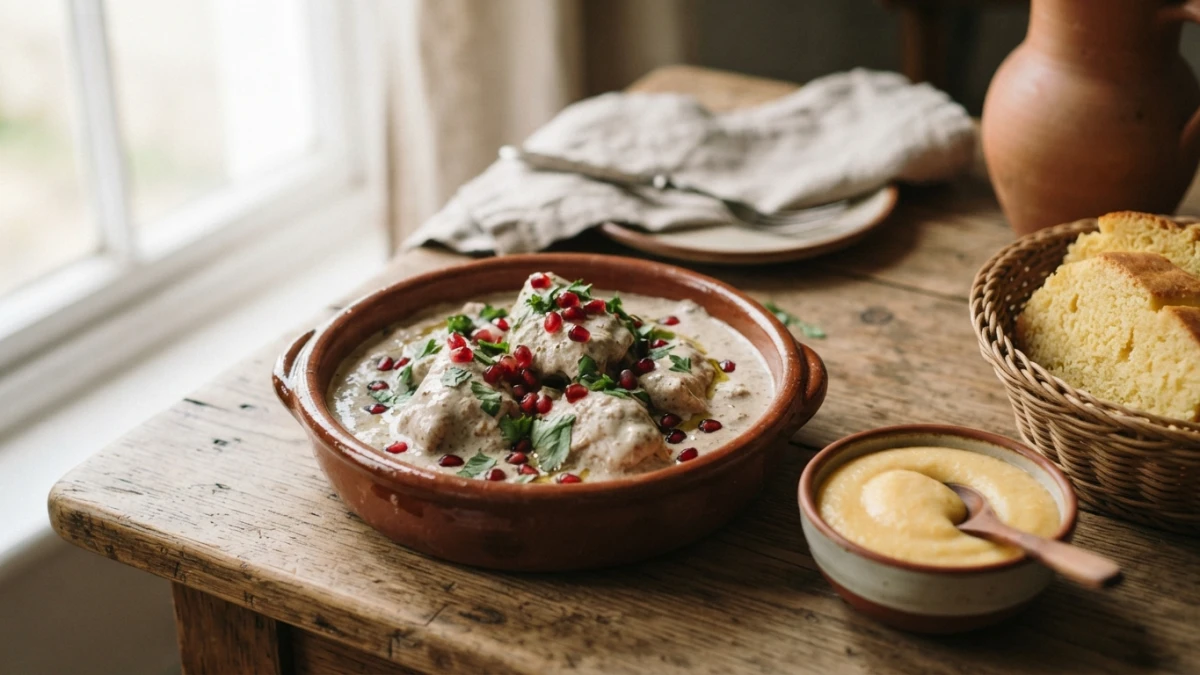
Satsivi takes its name from the Georgian tsivi, "cold", and that is the misunderstanding that ruins the dish outside Georgia: it is not a stew that arrives steaming, it is cooked poultry in a thick walnut sauce served cold or at room temperature.
What Satsivi Is and What the Name Means
The short definition: satsivi is cooked poultry, chicken almost always and turkey on holidays, covered in a thick sauce of ground walnuts, onion and spices. There is no cream or dairy, because the walnut supplies the fat and the body. The final texture is that of a dense cream, not a thickened broth.
The etymology sums up the dish. In Georgian, tsivi means "cold" and the prefix sa- forms the noun for something that has that quality, so satsivi is "the cold one". On the Georgian table it is the identity of the plate: this is the dish recognised by arriving cool.
What it is not: it is not a curry, contains no dairy and does not resemble a chicken stew with brown sauce.
Where It Comes From: Megrelia, Walnuts and the New Year Table
Georgian sources place satsivi in Megrelia (Samegrelo), the coastal strip in the west with Zugdidi as its capital and one of the country's culinary centres. From there it spread through the rest of Georgia and into Russian cooking, where it is known as chicken in walnut sauce.
To understand it you have to understand the walnut: in Georgia it is not a decorative nut but kitchen infrastructure, because it provides fat, body and protein without dairy, holds the table together on Orthodox fasting days and reappears in pkhali, badrijani and half a dozen sauces.
The calendar rules: it is a festive dish, above all a New Year one, and at that time it is made with turkey; the rest of the year, with chicken. It is prepared a day or two ahead and served on the supra, the long table.
What Goes Into the Sauce: Walnuts, Onion, Garlic and Spices
The base has three parts: ground shelled walnuts, which are the bulk of the sauce; poached and crushed onion; and poultry stock to bind it. For 1.5 kg of chicken, sources work with 500 to 700 g of walnuts and four or five medium onions. For the New Year turkey, some families use as much onion by weight as meat, and half that weight in walnuts.
The spices that make it recognisable: ground coriander, blue fenugreek (utskho suneli), dried marigold or Imeretian saffron, black pepper, a pinch of cinnamon and two or three cloves. The garlic is crushed with salt and goes in at the end, because cooked it loses its bite.
The acid comes last: a couple of tablespoons of white wine vinegar or pomegranate juice, with an acidity you notice without it taking over. And one professional rule that gets forgotten: cold food asks for more salt than hot food.
Satsivi Is Not Bazhe (and Not Pkhali or Badrijani Either)
The most repeated confusion is with bazhe: a raw walnut sauce, loose and aromatic, served with chicken, fish, vegetables or ghomi. Satsivi is a sauce cooked with the poultry stock, thicker and rounder, and it carries the weight of a celebration.
The other neighbours share the logic: walnut, garlic and acid. Pkhali is a walnut paste with chopped vegetables; badrijani, aubergine rolled around that paste; lobio in its satsivi version, the bean stew with the sauce. What changes is what sits under the walnut.
Quick rule: if it comes in cold little rolls, badrijani; if it is a soft paste, pkhali; if it is poultry under a thick walnut sauce, satsivi; if it is the same sauce raw, bazhe.
How It Is Made, in Order
First the bird and the stock: the chicken is simmered with salt, bay leaf and coriander stems until cooked through, without going too far. It is lifted out, the stock is skimmed and reserved, because that stock is half the flavour.
Then the walnuts: ground twice until almost a powder, mixed cold with the spices and garlic and pressed by hand so they release oil, which is kept for the surface. The least known trick: a few tablespoons of fresh coriander juice strained through a cloth are worked into the paste.
The binding has one rule: the paste goes into the hot stock ladle by ladle, without coming back to a boil, until it is like thick cream; then the poached onion and, at the end, the vinegar. Boiling the sauce breaks it and turns it grainy. The version with quantities and numbered steps is in the satsivi chicken recipe.
How It Is Served: Temperature, Accompaniments and the Next Day
Temperature: cold from the fridge or brought out for an hour or two, never hot. Letting it warm is not a whim: at full cold the fat thickens and the aroma hides. In Georgia it is often served in the k'etsi, the glazed ceramic dish, with the reserved walnut oil and a few pomegranate seeds on top.
With what: ghomi, the cornmeal polenta, or mchadi corn bread, and wheat bread to mop the sauce. The table mixes temperatures on purpose: alongside the cold satsivi sit kharcho, the beef soup, chakhokhbili, the hot chicken stew and freshly baked khachapuri, with Georgian eggs with herbs as another starter.
The next day: it improves after a few hours or a night in the fridge, and some sources ask for a minimum of six hours of chilling. It keeps covered for three or four days and is not worth freezing, because the walnut separates and the sauce turns grainy. Safety note: it is cooked poultry with nuts, so keep it out of the fridge as little as possible; and anyone who cannot eat walnuts cannot eat this.
How Many Calories It Has
The arithmetic, in the open, for 1.5 kg of chicken: 700 g of walnuts provide about 4,580 kcal, chicken with skin about 3,225, 500 g of onion about 200, the oil for poaching the onion about 220 and the stock about 30. That lands around 8,250 kcal for a dish of 3.1 kg, about 266 kcal per 100 g, always as a table estimate.
Per portion: 200 g is about 530 kcal and 250 g, about 665; in eight servings of almost 400 g, about 1,030 per serving. Almost all the caloric weight comes from the walnut, 55% of the total. Without alarmism: it is fatty because walnuts are fatty, and that makes it neither good nor bad; it is eaten at a shared table, with vegetables and bread.
Variations and Frequent Questions
The variations that exist: turkey at New Year, chicken all year, fish, aubergine, cauliflower, mushrooms and lobio satsivi with green beans or beans. The sauce is the same; what goes inside changes. The most served vegetarian version has its own page, Georgian mushroom stew, and lobio shows the same sauce over pulses. Kubdari and badrijani nigvzit complete the map.
The four mistakes that ruin it: boiling the sauce, serving it hot, using old or rancid walnuts, which turn it bitter beyond repair, and falling short on onion or acid. If it thickens as it cools, correct it with cold stock, never with water.
Frequently Asked Questions
Is satsivi eaten cold or hot?
Cold or brought out of the fridge. The name comes from "cold" and serving it steaming takes away its meaning.
Can it be made with supermarket chicken?
Yes. Simmer it with bay leaf and coriander so the stock has depth.
What is utskho suneli and what replaces it?
It is blue fenugreek, with a deep aroma. An acceptable substitute is a pinch of common fenugreek, which is milder.
And Imeretian saffron?
It is dried marigold, not real saffron: it gives colour and a soft floral aroma.
Can it be frozen?
Not advisable: the walnut emulsion breaks on thawing and the sauce turns grainy.
How long does it keep in the fridge?
Three or four days covered, the general rule for cooked poultry.
How is it different from bazhe?
Bazhe is a raw, loose sauce; satsivi is a sauce cooked with stock and thicker.
Why did mine turn out bitter?
Almost always because of rancid walnuts, or boiling the sauce after binding it.