Biltong: What It Is and How It Differs from Jerky
 By
Diego Cortés
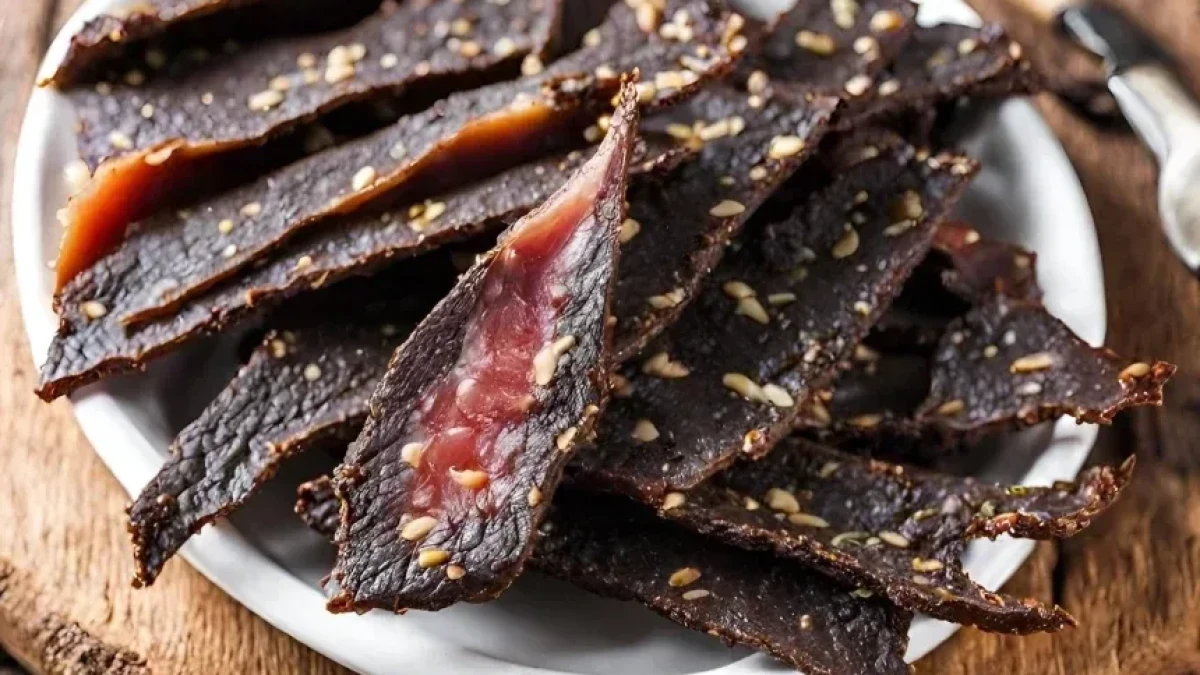
Biltong is not jerky: it is beef cured in vinegar and spices and dried in the air, with no heat. The strip is hung up and left to dry; it is never cooked or baked. That single difference explains its flavour, its texture and also its price.
What biltong is (and what it is not)
It is cured, air-dried meat, typical of southern Africa. Beef is the usual choice, but it is also made with game (kudu, springbok, wildebeest), ostrich, chicken and even fish. It is cut into thick strips or stokkies ("little sticks") and its texture runs from flexible to hard depending on the drying. It is not a sausage and it is not smoked.
The first thing to switch off: it is not jerky. Jerky is heated to at least 71 °C; biltong dries in cool air. That is why it comes out meatier and less fibrous.
The name explains half of it. Biltong comes from Afrikaans bil ("rump") and tong ("strip" or "tongue"): literally, "rump strip". Seen that way it stops being an odd word and becomes a description.
Where it comes from: southern Africa, the diaspora and a legend that does not hold up
It is from southern Africa and was born from a practical need, preserving meat without refrigeration. Sources attribute it to Afrikaner settlers, the trekboers, and point to the Khoikhoi habit of air-drying meat as an antecedent. It is told by attribution, without a settled date.
The legend that always gets repeated: that the pioneers tucked the strips under the horse's saddle and dried them in the animal's salty sweat. It is a popular tale, and an unlikely one: systematic horse use in the region came after colonisation.
What is documented: in the Second Boer War the commandos depended on biltong in the field, and in the First World War some South African soldiers received it from home. Today it is sold in South Africa, Namibia and Zimbabwe and in South African communities in the United Kingdom, Australia, Canada and the United States.
The four ingredients that define it (and why the vinegar is not decoration)
The base, in order: meat, vinegar, salt and coriander, plus black pepper. The traditional mix goes in equal parts: coarse salt, toasted coriander, coarsely ground black pepper and brown sugar, which some cooks cut or leave out.
What each one does. The vinegar acidifies the surface and takes it below pH 4.6, the threshold at which the botulism bacterium cannot grow according to the WHO: that is why cold curing is safe. The salt draws water out and slows bacteria. The coriander, the pepper and the clove bring aroma and antimicrobial properties too. The sugar balances.
The modern additions that have crept in: balsamic or malt vinegar, paprika, garlic powder, Worcestershire sauce, bicarbonate and sometimes saltpetre, which only makes sense in wet biltong that will not be frozen. Bicarbonate is not a biltong ingredient. And if the marinade carries Worcestershire sauce or beer, it may carry gluten.
How it is made: cold curing and air drying, with the weight loss in plain sight
Strips along the grain about 2.5 cm thick, or flat pieces cut across. Lean cuts are preferred (sirloin, loin, flank, shoulder) and the fat is trimmed, since fat goes rancid before the meat dries. All of this lives in the site's meat recipes section.
The sequence: run the meat through vinegar for one hour to a whole night, drain, rub with salt and spices, keep cold for 12 to 24 hours, drain and hang. Traditional drying happened in the highveld winter and took about two weeks; today it takes 3 to 7 days depending on thickness and on whether you want it wet, medium or dry. The step-by-step is in the homemade biltong recipe.
The arithmetic behind the price and the calories: 200 g of fresh meat yields about 100 g, almost all of it water. At home a rack box, a fan and a low-wattage bulb are enough; or a dehydrator on low, knowing that if the heat goes up it is no longer biltong, it is jerky.
Biltong vs jerky: the differences that matter
Air against heat. Biltong dries in the air; jerky is heated to 71 °C or more. Jerky takes hours and biltong takes days.
Thickness and texture. Biltong is cut into strips of around 25 mm because cool air allows slow drying; jerky is cut very thin. When you bite, biltong is more tender and meatier; jerky is more fibrous.
Vinegar, sugar and smoke. Biltong curing is vinegar, salt and spices; jerky is salted and marinated without vinegar and often smoked. Traditional biltong carries no added sugar or nitrates; industrial jerky almost always does.
Biltong vs cecina and vs charqui (and, while we are here, droëwors)
Against Spanish cecina, the difference is one of scale: cecina is a whole cured piece with at least seven months of work (trimming, salting, washing, resting, smoking and curing), eaten in paper-thin slices, with protected designations such as cecina de León or goat cecina de Vegacervera. Biltong is a thick strip with vinegar. On the site, cecina shows up in tacacho with cecina and in its tacacho recipe.
Against charqui, the kinship is Andean and the use changes. It comes from the Quechua charki, is made of thin strips dried in the sun, very salty, from camelids and today mostly beef. It is shredded and stewed: that is where charquicán comes from. Biltong is not stewed, it is eaten as a snack.
The missing relative is droëwors, a dried sausage of minced meat with coriander and pepper, air-cured. Same country, same spice, another shape. The family also includes Italian bresaola, Turkish pastırma and Nigerian kilishi: all dried meat, none of them biltong.
How it is eaten, how it is stored and how many calories it has
In strips or stokkies, as chips, shredded over bread or in a sandwich, in muffins and pot breads. In South Africa it is bought by weight and you pick the grade: wet, medium or dry. Shredded, it also lifts a stew, like a chicken charquicán.
It is stored in a paper or cloth bag so it can breathe: in closed plastic it sweats and mould appears. Wet biltong goes in the fridge and any grade keeps 3 to 6 months in the freezer, always fully cool before storing.
And the calories, with the arithmetic in view: a kilo of lean raw meat yields about 500 g. Using reference values for lean beef (around 1,300 kcal and 210 g of protein per kilo) plus salt, sugar and spices, you land at 250 to 290 kcal per 100 g, with 42 to 48 g of protein and 8 to 11 g of fat. A 30 g portion is about 80 kcal and 13 to 14 g of protein. For comparison, the USDA gives around 410 kcal and 33 g of protein per 100 g for beef jerky. It is an estimate that depends on cut, drying and salt; the same method is used in the chart of Chilean dish calories.
The honest warning: it is very salty, in the order of 1 g of salt per 30 g. It is not a superfood and it does not replace a meal: it is dried meat, high in protein and high in salt.
Common mistakes, myths and questions with answers
The three mistakes that ruin a homemade biltong: putting it in the oven and still calling it biltong, which is jerky; skipping the vinegar, which is what acidifies and gives the flavour; and drying it in a warm, humid place, where mould wins.
The myths: that you need a dehydrator (you do not, you need moving air and a cool spot), that biltong is "raw" (it is cured and dried, and that is why it is made with hygiene and in the cold) and that bicarbonate is essential (it is not, it is not even traditional).
Is biltong the same as jerky?
No. Jerky is heated to 71 °C or more; biltong dries in cool air. Texture, flavour and time all change.
Can it be made without a dehydrator?
Yes: a rack box, a fan and a low-wattage bulb, in a cool place with air moving.
How long does it keep and how is it stored?
In a paper or cloth bag, in a cool place. Wet biltong goes in the fridge; 3 to 6 months in the freezer.
How much protein does it have?
42 to 48 g per 100 g; a 30 g portion provides about 13 to 14 g. It is an estimate.