Pajaritos: Chilean Sweet Buns Topped with Meringue
 By
Diego Cortés
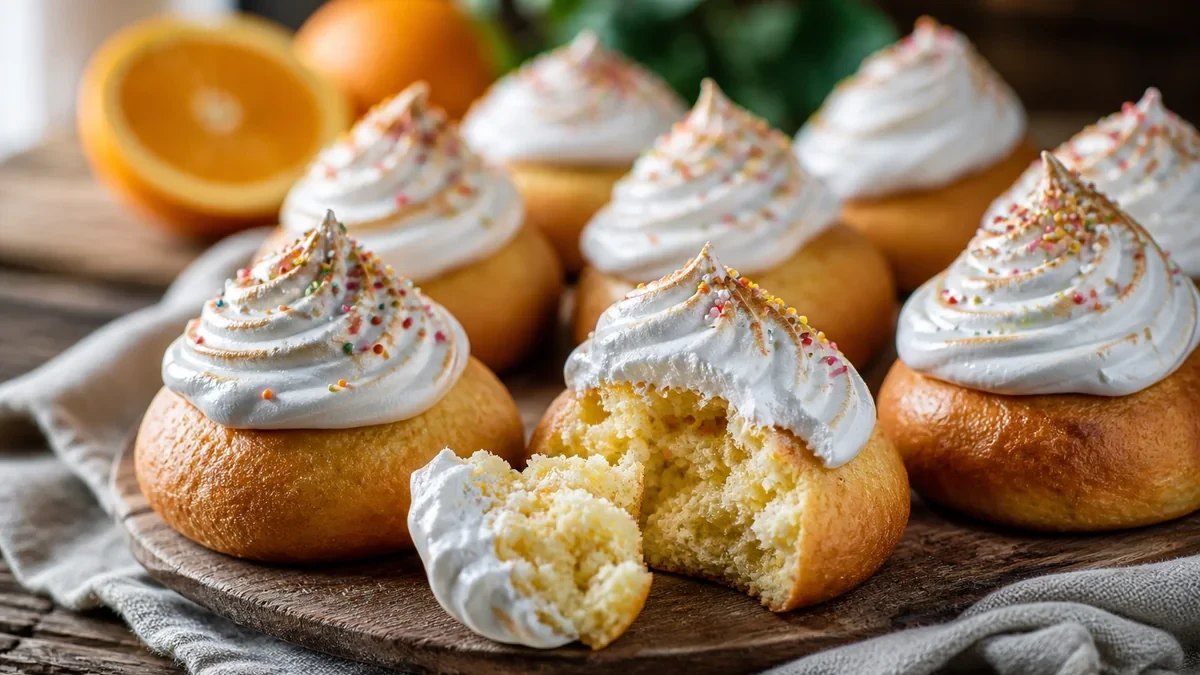
Pajaritos dulces are small yeast buns scented with orange zest, baked and then crowned with meringue and coloured sprinkles. They are not fried: they are bread. They were born in the convents of Biobío and sell by the thousand in September. Here is what the recipes leave out.
What pajaritos dulces are: a baked sweet bun, not fried dough
The short definition: a sweet yeast bun made with wheat flour, milk or water, sugar, eggs, fat and yeast, flavoured with citrus zest, baked, and topped with meringue. The dough is only half sweet: there is sugar in it, but sugar is not the point.
The first misunderstanding is worth clearing up early. Calzones rotos and sopaipillas are fried, and they carry neither yeast nor meringue. Pajaritos are baked, get two rises, and never touch hot oil.
On the table you see small buns, roughly the size of your palm, with a soft crumb that is barely sweet. The sweetness comes from the topping, which is why a well-made pajarito never cloys.
| Criterion | Pajaritos dulces | Calzones rotos | Sopaipillas |
|---|---|---|---|
| Cooking | Oven | Deep fried | Deep fried |
| Yeast | Yes, two rises | No | No |
| Meringue | Yes, essential | No | No |
| When they are eaten | All year, peaking in September | National holidays and rain | All year, peaking in winter |
From the convents of Biobío to the bakeries of September
The origin is imprecise, and it should be said that way. The earliest versions are recorded in the Catholic convents of what is now the Biobío region, in colonial Chile. From there they moved into La Araucanía and later into the rest of the country, alongside chilenitos and golfeados.
Today's map is specific: in September they sell in massive volumes in Concepción, Los Ángeles, Angol and Temuco, and Chilean recipe collections place them as a typical sweet of the eighth and ninth regions. Outside that area they appear in bakeries, without the full display case.
The real calendar is not only 18 September. There are accounts of families in Curacautín where pajaritos were never missing on the night of San Juan or during the Fiestas Patrias. Their fame is September, but they are eaten all year: cheap dough and a meringue of egg whites explain how they survived industrial baking.
Why are they called pajaritos?
What is documented: the buns can be shaped as plain rolls or moulded into the shape of little birds. The name is about the shape, not about an ingredient.
What is not documented, and I will not invent: no source fixes who named them or in which year. Any theory about a bird's beak is folklore, not history. And a warning: some pages online call a milk and egg dessert "pajaritos dulces". That is not this.
The dough: yeast, two rises and convent aromas
As a home reference, the pajaritos dulces recipe on the site calls for 500 g of plain flour, 125 ml of milk, 7 g of dry yeast (or 20 g of fresh), 100 g of sugar, 60 g of butter, 2 egg yolks, the zest of one orange, cloves and cinnamon to flavour the milk, and a pinch of salt. It makes 16 buns.
Two moments decide the result. The milk must be lukewarm, about 35 degrees: if it burns your finger it kills the yeast. And the yeast should foam for about 10 minutes before it goes in; if it does not foam, it is past its date. Then comes a first rise until doubled, and a second one after the buns are shaped.
The aromas are not a whim: citrus zest and spices are the signature of Chilean convent baking. Use only the coloured part of the zest, because the white pith is bitter.
Meringue for pajaritos: why it weeps and how to keep it standing
The base does not take shortcuts: egg whites with not a drop of yolk, a pinch of salt, and the sugar added gradually while beating. If you want a crunchier topping, dry it in a low oven after covering the buns.
There are two routes, and both are valid. French meringue takes raw sugar over beaten whites and is the one in recipe 1412. Italian meringue takes a hot syrup cooked to 118-121 degrees poured in a thin stream over the whites, and it is the one in the large-batch version. Italian handles heat and humidity better, which is why bakeries use it. Neither one is "the authentic" one.
The step almost everyone skips: the meringue goes on cold buns. Cover a hot bun and the steam makes the topping weep and slide. On rainy days, a few minutes in a gentle oven is the home fix, not more sugar.
Calories per bun, and how to store them
Recipe 1412 states 210 calories per bun for a batch of 16. That is the recipe's own calculation, not a laboratory analysis, and it is consistent with its ingredients: flour, sugar, butter, yolks and meringue. Treat it as an order of magnitude.
The proportion that matters is that this is bread, not cake. The weight is flour; the sweetness is meringue. A bun with Italian meringue carries slightly more sugar than one with French meringue, because the syrup concentrates the sugar in less water.
Two storage rules. Keep the buns like bread: closed bag, two or three days, revived in a low oven, as explained in the guide to keeping bread fresh for longer. And freeze them without meringue, because meringue shrinks and hardens when frozen, as the guide to what you can freeze once cooked points out. Add the topping after thawing.
The three recipes on the site: which one to use
If it is your first time, follow the complete recipe: dry yeast, two rises, French meringue, sprinkles, 16 buns and 210 kcal. It gives exact amounts and temperatures, which is what you need while the dough is not yet muscle memory.
To share, the syrup meringue version uses 1 kg of flour, lemon and orange zest, and makes 15 larger buns. And the grandmother's version, little birds like my grandmother's, uses milk, butter and tagatose, makes 18 buns and takes five steps: the fastest one, for anyone who already knows how to knead.
| Recipe | Buns | Meringue | Calories per bun |
|---|---|---|---|
| 1412 - Pajaritos dulces | 16 | French | 210 |
| 1377 - Pajaritos | 15 | Italian, with syrup | Not stated |
| 1411 - Like my grandmother's | 18 | Whipped egg whites | Not stated |
One editorial note: the site holds three recipes for the same sweet, and none of them is changed from this article. This text is the hub that orders and links them; the recipes keep the steps.
Frequently asked questions
What are pajaritos dulces?
Sweet yeast buns scented with orange or lemon zest, baked and topped with meringue and sprinkles. They are a traditional sweet from central-southern Chile.
Are they fried or baked?
Baked, always. The confusion comes from calzones rotos and sopaipillas, which are fried and carry neither meringue nor yeast.
Why are they called pajaritos?
Because of the shape: they can be moulded into little birds. No source documents who named them, and theories about beaks are folklore.
How many calories does a pajarito have?
About 210 per bun according to recipe 1412, which makes 16. It is the recipe's estimate, not a laboratory figure.
Can you freeze them?
Yes, but without the meringue. Meringue shrinks and hardens when frozen; bake, freeze the buns, and decorate after thawing.
Which meringue should you use?
French or Italian, both work. Italian, with syrup at 118-121 degrees, handles humidity better; French is quicker to put together.
Can you make them without meringue?
You can bake and eat them as sweet rolls, but then they are no longer pajaritos: the meringue and sprinkles are what identify them.
How are they different from sweet bread?
In the aroma and the topping. The dough is close to a sweet yeast bread, but the zest, the spices and the meringue are what make a pajarito.