Tkemali: What Georgian Sour Plum Sauce Is and How It Is Used
 By
Diego Cortés
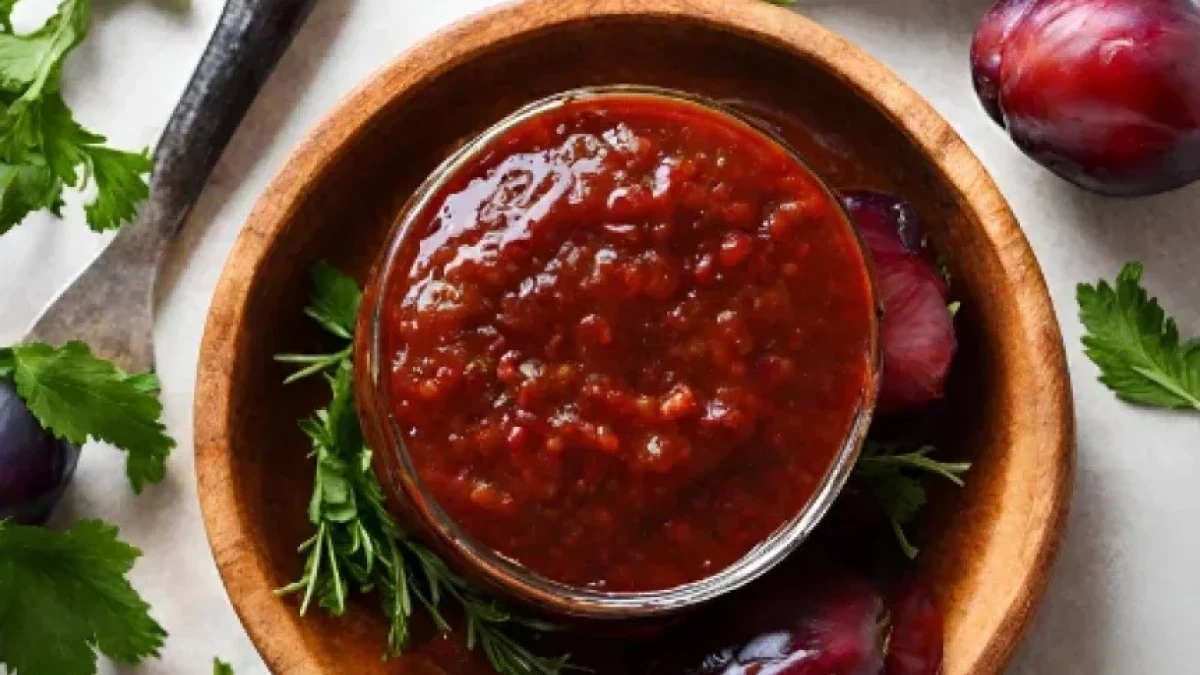
Tkemali is not ketchup or tomato sauce: it is a cold sour plum sauce from Georgian cooking, thick, olive green or wine red, heavy on garlic and fresh herbs. It sits next to grilled meat, fried potatoes and bread, and what makes it work is exactly what it leaves out: tomato.
What Tkemali Is (and What It Is Not)
The first time someone tastes tkemali they usually ask whether it has tomato. It does not. The base is fruit: sour plums cooked down and pushed through a sieve, with garlic, coriander, dill and chilli flakes. No vinegar and no sugar at home: the acidity comes from the fruit, and that is where its character comes from, a sauce that cuts fat instead of dressing it.
It is not the Chinese plum sauce sold for spring rolls either, which is sweet and built on star anise. You recognise it in a Georgian restaurant because it arrives without being ordered: a small bowl, unheated, with flecks of herb and a grainy texture. On this site it lives in the sauces category.
Where It Comes From: Georgia, the Caucasus and a Wild Plum
The name explains the dish: in Georgian, t'q'emali names the fruit, not the sauce. That is the cherry plum (Prunus cerasifera), a small, firm, very sour plum that grows wild in the valleys of the Caucasus. The alucha variety and red-leaf plums are used too.
In Georgia it holds the place ketchup holds in the United States: on the table daily, made in factories and made at home, and through shared history it is popular in Russia and across the former Soviet space. What is not safe to claim is a year of invention or a single region: sources present it as a Caucasian family sauce, with house-to-house versions and a strong presence towards Mingrelia. The meat-filled kubdari bread is the natural next step in that collection.
Green or Red: The Two Seasons of Tkemali
Tkemali is made twice a year: the same technique with whatever fruit each season brings.
Green tkemali uses the green, hard plum of late April and May. It is the most sour and astringent of the two, olive to bright green, and sources describe it as the purist's favourite. That same early fruit goes into chakapuli.
Red tkemali uses the ripe garnet plum of July and August. It never gets as sweet as a supermarket plum, but it is rounder and works better with chicken, pork and roast vegetables; it is also the one you see in jars most often. Only the cooking time changes, because ripe fruit breaks down sooner.
What Goes In: Garlic, Herbs and No Tomato
As a home reference, a kilo of sour plums yields about 650 ml. In go 8 or 10 garlic cloves, a bunch of coriander (25 g), half as much dill (20 g), a teaspoon of ground coriander seed, half a teaspoon of chilli flakes and salt. No tomato, no vinegar, no preservatives.
Herbs are where each household leaves the script. Ombale, or pennyroyal, is a wild Caucasian mint with an almost medicinal edge that dried mint stands in for. Tarragon, summer savory and khmeli suneli also show up. The coriander and dill base is not negotiable.
The most common mistake is using sweet plums: you get jam, not tkemali. Pick the firmest, sourest fruit and correct with lemon; the gooseberry version exists for that. The sweet take on the same fruit is another recipe: plum jam.
How It Is Made, in Order
First, whole plums go into a pot with cold water that just covers them and simmer gently for about 20 minutes, until a knife slides in without resistance. If the fruit bursts, it gives its flavour to the water. Lift them out with a slotted spoon and keep that liquid, which is used to loosen the sauce.
Second, they go through a fine sieve or food mill so skins and stones stay behind. Do not blend it: the sieve is what gives the grainy texture.
Third, chopped garlic and herbs go in once the puree is back on the heat, and everything cooks for 5 to 10 minutes. The garlic is not browned first; you want its raw punch, only just softened. The sauce improves overnight. Exact quantities are in the tkemali sauce recipe.
How It Is Eaten: The Georgian Table
The classic pairing is mtsvadi, grilled meat, with fried potatoes, roast chicken or warm bread. The acidity cuts the fat of meat and cheese, which is why it sits in the middle of the table. With hot khachapuri it works just as well.
It also goes over lobio, the bean stew; alongside khinkali; with scrambled eggs; and with shkmeruli, the garlic chicken in cream. Badrijani nigvzit takes it well, and with poultry in walnut sauce satsivi has its own logic.
As an ingredient it works as a marinade for vegetables and tofu and mixed with yoghurt. The same fruit, dried as tklapi, sours soups such as kharcho.
Tkemali, Satsebeli, Adjika (and Satsivi): Not the Same Thing
The three sauces of the Georgian trinity differ by base. Tkemali is sour plum: fruity and only mildly hot. Satsebeli is tomato with ground walnuts and herbs, sweeter and the most universal. Adjika is a raw paste of chilli and garlic, tomato-free in the Abkhaz and Mingrelian version, and it is the one that actually burns.
The fourth one people confuse is satsivi, and it is not a sauce: it is a cold poultry dish in walnut sauce. It shares the taste for walnuts, but resembles neither the texture nor the use. The detail is in the article on satsivi and Georgian walnut sauce.
The practical rule: if the bowl is green or wine red and smells of plum, it is tkemali; if it is orange-red and tastes of tomato, satsebeli; if it is a thick paste that burns, adjika.
Substitutes, Storage, Calories and FAQ
Outside the Caucasus you will not find the tkemali plum. The closest thing is the greenest, firmest plum at the market; greengage, gooseberry or prunes soaked with lemon also work. Georgian jars turn up in Russian and Eastern European shops, and online.
On storage, sources give ranges depending on acidity: in the fridge, an open jar keeps 2 to 3 weeks and a freshly made sauce 2 to 3 months. Bottled in a water bath with a layer of oil on top, it lasts over a year in a cool, dark pantry.
The calories, with the maths in plain sight: a kilo of sour plums is 460 kcal, 30 g of garlic 45, 25 g of coriander 6, 20 g of dill 9, 2 g of coriander seed 6, 2 g of chilli flakes 6, and salt adds nothing. That is roughly 531 kcal for 650 g of sauce: around 82 kcal per 100 g and 25 kcal per two spoonfuls. It is an estimate, depending on how much liquid is left and whether oil is added.
It is a condiment, not a dish: fruit with herbs and salt. It is salty, so go easy on it if you watch your sodium. By ingredients it is vegan and gluten-free; a bought jar may contain preservatives or oil.
Is tkemali the same as ketchup?
No. It plays a similar role, but it is sour fruit with herbs, without tomato or sugar.
Does it contain tomato?
No. Tomato shows up in satsebeli.
Is it spicy?
Only mildly. Serious heat is adjika's job.
Green or red?
Green is sharper, from early plums; red is rounder. The technique is the same.
Can I make it with regular plums?
Yes, if they are firm and sour. Sweet plums give you jam.
How long does it keep?
Two to three weeks open in the fridge; over a year if bottled in a water bath.
How is it different from satsebeli and adjika?
The base: plum, tomato with walnuts, and chilli with garlic.
How many calories does it have?
About 82 kcal per 100 g and 25 per two spoonfuls, following the calculation above.
Is it vegan and gluten-free?
Yes, by ingredients. Check the label if you buy a jar.