Cazuela, Carbonada and Charquicán: How They Differ
 By
Diego Cortés
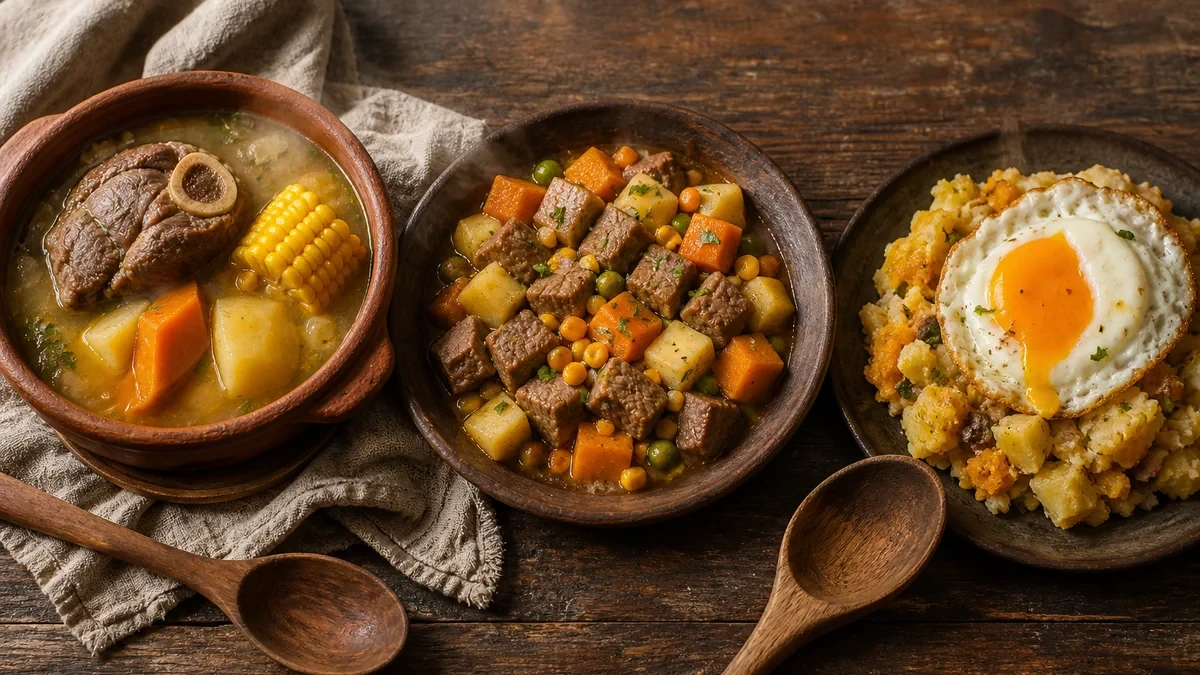
The Chilean cazuela, carbonada and charquicán share a pot, potatoes and squash, and still they are three different dishes. What separates them is not the recipe but the knife: cazuela is served in whole pieces with the bone in, inside a clear broth; carbonada arrives in even cubes with a short, thick broth; charquicán is served mashed, with the texture of a rustic paste and a fried egg on top.
What the Chilean cazuela is: a whole piece of meat in clear broth
The cazuela is a pot stew served in a deep plate with a piece of bone-in meat, beef, chicken or turkey, and vegetables cut large: potato, squash and corn, plus carrot, onion and celery. It takes its name from the clay pot it is cooked in. What defines it is what is not done: the meat is not cut, the diner breaks it apart on the plate, and the broth stays clear because starch goes in small amounts, as a handful of rice or chuchoca, dried corn ground into meal.
Regional maps explain the rest: in the north it is thickened with quinoa and in Chiloé the versions are lamb with luche seaweed and smoked pork. The beef cazuela is the model of the family, and from the same root come the poultry cazuela and the meatball cazuela.
What carbonada is: the stew of even cubes that thickens itself
Carbonada belongs to the same family, with another rule for the knife: everything is cut into small, even cubes. Beef, potato, squash and carrot are diced the same size, and loose corn, peas, green beans and a handful of rice go into the pot. The result is a thicker dish, with almost no free broth. The difference fits in one sentence: cazuela is served in pieces, carbonada in dice, and the cube releases starch so the broth gains body. The Chilean carbonada is the reference version, and in Chile it carries no dried peaches, the sweet dried fruit used in northwestern Argentina.
What charquicán is: the stew that gets mashed and crowned with an egg
Charquicán is made with potato and squash cooked in cubes and mashed before serving, with onion, garlic and ground beef, or charqui in the old version. Depending on the house it also takes corn, peas, green beans and chard, and it is served with a fried egg on top, the signature of the dish. Texture is its identity: it is neither soup nor chunky stew, but a rustic paste with lumps. If the potato and squash are not crushed against the pot before the heat goes off, the dish lands somewhere else and stays a carbonada. The Chilean charquican shows the right point, and there is also a chicken charquican.
Where each one comes from: olla podrida, the charqui route and Lota coal
Best to write this part as versions, not as record, because none of the three has a birth date. The cazuela has a disputed origin; one story links it to the Spanish olla podrida mentioned by Cervantes, and another holds that the Mapuche already cooked corri achawal, a poultry broth with potato, squash, corn or chuchoca and wild herbs, and that the Spanish name came from the pot itself.
Charquicán has the best documented etymology: it comes from the Quechua charki kanka, roasted charqui. The oldest records are from the sixteenth and seventeenth centuries and tie it to the muleteer route between Potosí and Arica, where charqui was the protein of travel. Carbonada is named either for the firewood that ended as charcoal at the end of cooking, or for the coal miners of Lota, where it is still a local dish.
The table that separates them: cut, starch, broth and service
| Trait | Cazuela | Carbonada | Charquicán |
|---|---|---|---|
| Cut | Bone-in piece, vegetables in chunks | Even cubes of meat and vegetables | Ground meat, crushed vegetables |
| Starch | A little rice or chuchoca | Rice and loose corn | The starch of crushed potato |
| Broth | Clear and loose | Thick and short | Almost none |
| Service | Deep plate with the meat inside | Deep plate, no whole piece | Flat plate with a fried egg |
The practical rule: if the meat has to be pulled apart with a fork, it is cazuela; if everything arrives in cubes and the spoon stands on its own, it is carbonada; if the plate can be spread on bread and comes with a fried egg, it is charquicán. All three share a base of onion and garlic, potato and squash as body, and the Chilean logic of one pot for the whole table. The family files live in the soups and stews category.
How many calories the Chilean cazuela has, and its two sisters
Calculated from ingredients and per 100 grams, cazuela sits around 145 calories while carbonada and charquicán stay near 105; fat in the meat and broth density make the gap. On a 350 gram plate: cazuela about 505 calories, carbonada near 366 and charquicán around 368, which reach 420 with the egg. The site files declare 700, 430 and 375: they are per-serving estimates and the difference lies in plate size.
In all three cases the calories come from the oil in the base and the fat of the meat, not from the vegetables. To lighten them without changing the dish: skim the broth, pick lean cuts, double the squash and measure the bread. The frame to compare them with the rest of Chilean food is the calorie chart of 18 Chilean classics.
When each one is eaten and how it is ordered in Chile
Cazuela is the everyday dish: home lunch, canteen, neighbourhood restaurant and street fair. It even has its own day, July 30. Carbonada is a winter dish from a big pot, made for long tables, and around the coal country it is a local badge. Charquicán is the most domestic of the three, and its fried egg is no garnish: it is the protein that completes the plate.
How to spot a good stew and the mistakes that ruin them
Signs of a good stew: the cazuela broth is clean because it was skimmed at the start, the carbonada has no cubes of different sizes, and the charquicán was crushed with the pot and not with a blender.
The most common mistakes: salting the cazuela at the start and toughening the meat; stirring charquicán like risotto and breaking the potato; boiling carbonada hard and dissolving the squash; serving all three straight off the heat with no rest, when fifteen minutes away from the fire settle them. Cazuela improves the next day if reheated gently, carbonada thickens further and is fixed with hot water, and charquicán should not be reheated twice.
Frequently asked questions about cazuela, carbonada and charquicán
What is the Chilean cazuela?
A pot stew with a bone-in piece of meat, potato, squash and corn, served in a deep plate with clear broth.
What is the difference between cazuela and carbonada?
The cut: whole pieces and clear broth in cazuela, even cubes and thick broth in carbonada.
What is carbonada?
A stew of meat and vegetables in cubes, with loose corn and rice, served without a whole piece.
Why is it called carbonada?
For the firewood that ended as charcoal, or for the coal miners of Lota.
Is carbonada Chilean or Argentine?
It circulates in Chile, Bolivia and northwestern Argentina; the Chilean version carries no dried peaches.
What is charquicán?
A stew of crushed potato and squash with ground beef or charqui and a fried egg on top.
Why is it called charquicán?
From the Quechua charki kanka, roasted charqui, even though ground beef rules today.
Does charquicán take an egg?
Yes, one fried egg per plate: it is the protein that completes the meatless version.
How many calories are in a plate of beef cazuela?
About 505 in a 350 gram plate; the site file declares 700 per serving.
How many calories does carbonada have?
Around 366 per 350 gram plate, about 105 per 100 grams.
Can charquicán be made without meat?
Yes, with potato, squash and a fried egg, and it takes cochayuyo, corn and chard.