Venezuelan Hallacas: What They Are, What Goes Inside and How They're Made
 By
Diego Cortés
By
Diego Cortés
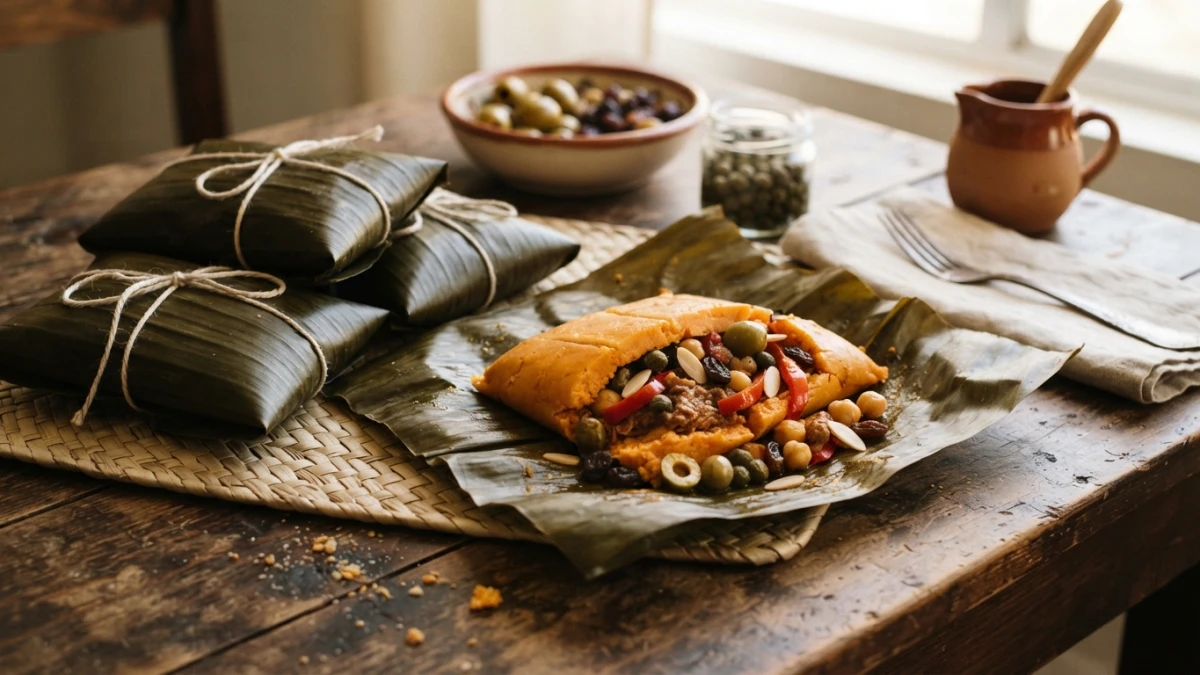
Venezuelan hallacas are the star of the country's Christmas table: corn masa tinted with annatto, a stew of several meats and pickled garnishes, all wrapped in plantain leaves. So what are hallacas, what goes inside them and how do they differ from a Mexican tamale? Here it is, part by part.
In Venezuela the dish is called hallaca; in Colombia, where it also exists, hayaca. The pickled garnishes and a touch of sweetness give it the salty, tart contrast that defines it.
What a hallaca is: Venezuela's Christmas tamale
Three things define it: corn masa seasoned with broth and annatto, a filling of meat stew and pickled garnishes, and a plantain leaf wrapper. None of that is accidental. Annatto (also sold as achiote) gives the masa its signature orange color, and the leaf works both as packaging and as aroma while the bundle cooks.
It helps to say up front what it is confused with, because that is where many searches come from. It is not a Mexican tamale, which has its own masa and its own filling. It is not a humita, made from sweet tender corn. And it is not the Colombian hayaca, which shares the name and the wrapped-parcel idea but changes from region to region.
The name has two spellings: hallaca in Venezuela, hayaca in Colombia. At home people say "a hallaca" and "the hallacas", and the family day spent making them, usually a full one, is called la hallacada.
Where the hallaca comes from: the name and the three kitchens behind it
The most repeated etymology links it to ayacá from the Tupi-Guarani language family, meaning a bundle or a wrapped parcel. It is a widely cited hypothesis, not settled fact: other explanations exist, so it is best treated as a theory.
What is clear is that it is a mixed dish born in the colonial period, with contributions from three continents: corn and the plantain leaf from the indigenous world, olives, capers, raisins and wine from Europe, and much of the cooking technique and seasoning from Africa. That blend is why there is no single hallaca.
Venezuela also formally submitted the hallaca, together with the arepa, as a candidate for UNESCO intangible cultural heritage. It is a candidacy, not an inscription already granted.
What goes inside Venezuelan hallacas: masa, stew and pickled garnishes
If your question is what the ingredients of hallacas are, the answer splits into three blocks: masa, stew and pickled garnishes, plus the wrapping.
The masa is made from precooked corn flour, the same one used for arepas, kneaded with broth and annatto for the orange color. The Caracas version adds a touch of sweetness with papelón, an unrefined cane sugar. Annatto is not decoration: without it the hallaca comes out pale.
The stew gives the dish its body: chopped beef, pork and chicken or hen sauteed with onion, garlic, bell pepper and ají dulce, with wine and, depending on the house, a little papelón. On top of the masa go the pickled garnishes that break up the fat with acid and sweetness (olives, capers and raisins), plus strips of bell pepper and onion and, in some kitchens, ripe plantain.
The wrapping is a plantain or cambur leaf, passed over hot water or flame so it does not split when folded, tied with pabilo, a cotton string. The exact quantities are in the recipe; here it is enough to identify the parts.
How a hallaca is assembled (the step-by-step lives in the recipe)
Making hallacas has four phases: preparing the masa, conditioning the leaves, cooking and cooling the stew, and assembling the bundle. In the last one, the masa is spread over the leaf, the stew goes in the center, the garnishes are distributed, the leaves are folded into the shape known as a pañoleta and the parcel is tied with string.
Then comes the cooking: hallacas are packed tightly into a pot of water and simmered for roughly an hour and a half to two hours, and there is an oven version too. Once cooked they are drained, cooled and stored in the fridge or freezer, either raw or already cooked. The detailed steps and proportions are in the hallacas recipe with measurements and times.
Caracas, plains, Andes and coast: how the versions differ
The Caracas version is the best known: a full stew with beef, pork and chicken or hen, more ingredients and a sweet note from papelón and wine. It is the hallaca of the capital's Christmas table.
The llanera version looks like it but is simpler, with fewer ingredients, and usually includes peas, carrots and a little heat; in some towns fried ripe plantain and chicken gizzards are added. The Andean and eastern versions change the stew and the spices by region, and along the coast versions with fish appear.
The useful conclusion: there is no single correct hallaca recipe. Every region and every family has its own, and the common thread is always corn masa with annatto, a meat stew and pickled garnishes inside a plantain leaf.
The Venezuelan Christmas table: what to serve with a hallaca
A hallaca is never eaten alone. The full Venezuelan Christmas plate pairs it with pan de jamón and chicken salad, plus roast pork if the house has it; to drink, something sweet and alcohol-free such as papelón with lemon.
The part that explains the tradition is the logistics: hallacas are not made two at a time, they are made by the dozen or the hundred in a family workday (the hallacada) where some people prepare the masa, others the stew and others tie the parcels, and at the end they are shared with family and neighbors.
Two practical questions come up often: how many hallacas you get per kilo of flour is not a fixed number, because it depends on the size of the masa and how much stew goes in; and the work goes more smoothly split over two days, one for the stew and the leaves, another for the assembly. Outside December, Venezuelan cooking continues with classics such as tequeños, cachapa, pabellón criollo and carne mechada, with sauces like guasacaca, green mango guasacaca or guasacaca for empanadas.
How many calories are in a hallaca (and how to lighten it)
A medium hallaca, around 250 grams, lands between 400 and 500 calories, near 450 in published estimates, with roughly 18 grams of protein, 38 grams of carbs and 26 grams of fat; per 100 grams it drops to about 180. What adds up is the masa (corn flour and oil) and the pork fat, not the plantain leaf.
It helps to put that in context without alarm: this is a holiday dish, filling and fairly complete, because it combines the protein of the stew with the carbs of the masa. The issue is not the hallaca itself but eating it alongside pan de jamón, mayonnaise-based salad and dessert.
To lighten it: use more chicken or hen and less pork, drain the stew before spooning it onto the masa, go easy on the oil when kneading, serve smaller portions and pair it with the salad instead of reaching for more bread. To compare with other dishes, the site's calorie chart is a useful reference.
Frequently asked questions about hallacas
Are hallaca and hayaca the same thing? It is the same dish with two spellings, Venezuelan and Colombian, though in Colombia the masa and the filling can change. Is it a tamale? It shares the idea of a wrapped, cooked parcel, but the masa carries annatto and the filling is a stew with pickled garnishes. Is it a humita? No: a humita is made from sweet tender corn.
Can you make them without plantain leaves? That is the traditional wrapper and there is no identical substitute. Can they be frozen? Yes, raw or cooked, as long as they are well wrapped. How long do they keep? It depends on whether they are refrigerated or frozen and how they are packed, so stick to sensible ranges.
In the end, a hallaca is exactly what it looks like: Venezuela's Christmas tamale of corn masa with annatto, a meat stew and pickled garnishes inside a plantain leaf. If you wanted the recipe with measurements, it is on the site in the recipe linked above; if you would rather start with the simpler version, there is another hallaca recipe.